
A manufacturer can answer an RFQ quickly and still lose money on the job. The quote may use an obsolete drawing. A coating requirement may be missing from the estimate. The promised date may assume capacity that another customer has already taken. The sample may be approved verbally while production proceeds against a different revision.
For a manufacturing owner, sales director or estimating manager, the useful AI objective is more of the right RFQs becoming executable, profitable orders. Faster quotation matters when it helps the business win suitable work and preserve the assumptions that make that work worthwhile.
The full sales path is drawing and RFQ intake, technical clarification, cost and capacity assessment, approved quotation, buyer follow-up, sample or first-article acceptance where required, and production-order handoff. AI can reduce friction throughout this path, provided engineering authority and commercial commitments remain explicit.
This article proposes an operating design. The numerical case is fictional, not a Looqus customer story. Product descriptions come from primary sources reviewed on 14 September 2026 and should be validated against the buyer's process, product version and integration requirements.
Start by choosing the work you want to win
Treating every RFQ as equally valuable wastes estimating capacity. Some requests fit the machines, materials and tolerances you know well. Others require unfamiliar processes, unavailable certification, expensive subcontracting or a delivery date you cannot support.
Create a bid decision before detailed costing. It should consider technical fit, expected contribution, estimating effort, strategic customer value, capacity and uncertainty. A useful output is one of four states: quote now, clarify first, route to a partner or decline with a reason.
An AI system can summarize a package and retrieve comparable historical jobs. It should not decide that a similar-looking part is technically equivalent. A previous job may have different material, tolerances, inspection requirements or volume. Record the comparison and the differences so an estimator can use history without inheriting its assumptions accidentally.
The commercial goal is not maximum quote count. A lower quote count with better fit, faster decisions and higher realized contribution can be a stronger result. Conversely, a high win rate achieved through underpricing is not a success.
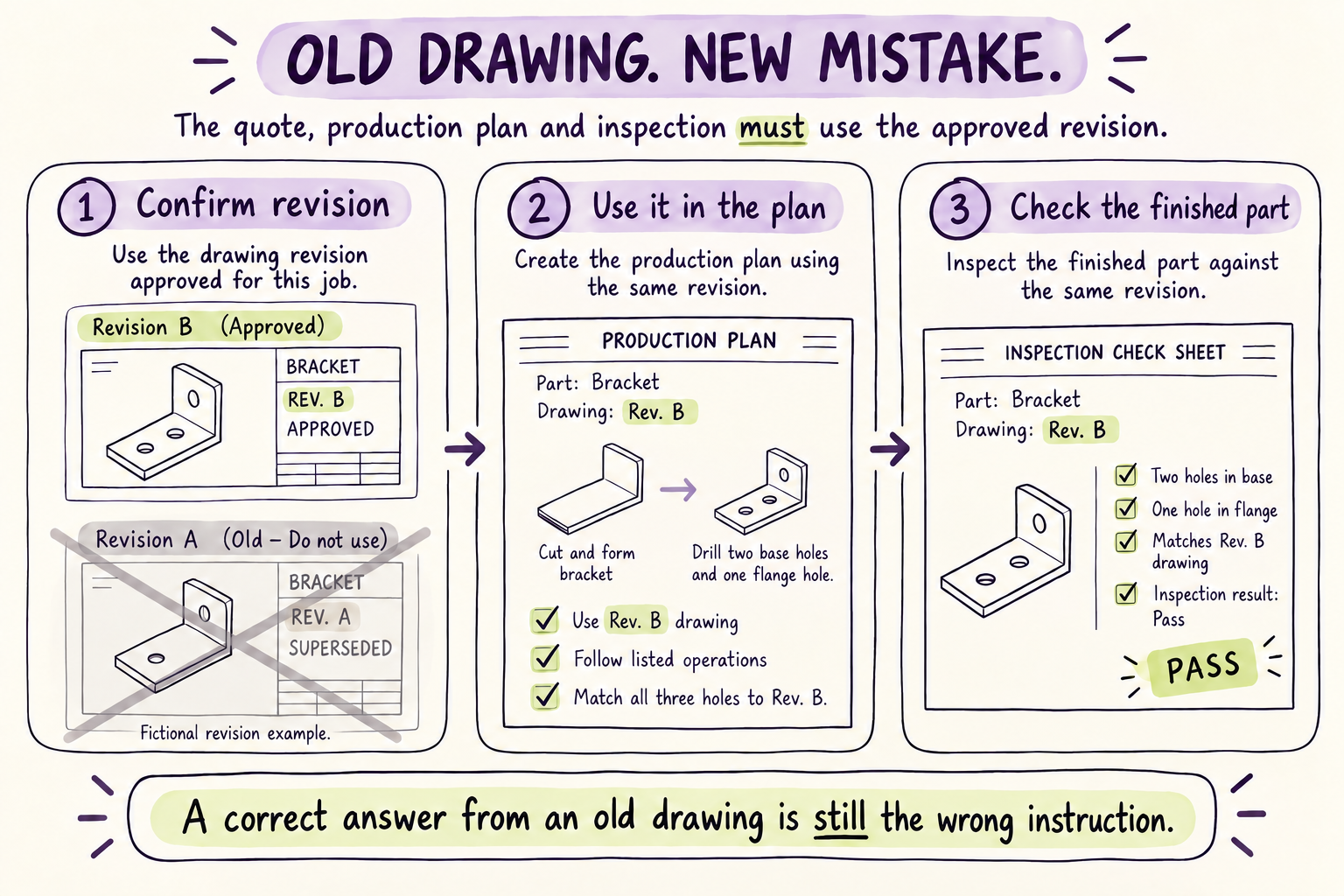
Read the visual explanation
Identify the current approved drawing and product revision.
Use the same revision in costing, instructions and production planning.
Inspect the finished part against that approved requirement.
Illustrative teaching example. The steps above are repeated in readable text below; depicted records are not customer results.
An incomplete RFQ needs a decision gate
Resolve omissions before pricing.
Release only within agreed authority.
The clarification branch is part of the workflow. A generated quote is not approval.
What the current tools can contribute
| Product or system | Documented role | Appropriate place in the sales path | Decision that still needs ownership |
|---|---|---|---|
| Paperless Parts | RFQ setup, geometry-informed estimating, costing and pricing | Organize the package and support the estimator's cost model | Confirm technical assumptions, shop-specific rates and whether to bid |
| Autodesk Fusion Manage | Item-linked changes, affected designs and drawings, approval workflow | Keep the approved definition and revision traceable | Decide which revision governs the quote, sample and production release |
| Microsoft Business Central | Production-order stages, materials and capacity-related planning | Carry an accepted commercial requirement toward manufacturing execution | Validate feasibility and authorize the correct operational stage |
| CRM and existing ERP | Customer history, opportunity, accepted order and actuals | Preserve ownership and return the actual result to sales | Reconcile lost reasons, cost variance and follow-up outcomes |
| Skild AI | Robotics intelligence for physical actions | A separate evaluation where physical work is the constraint | Prove task suitability, operational integration and production performance |
Paperless Parts documents geometry-driven costing, configurable pricing logic and assistance extracting information from quote packages. Its setup brief describes email forwarding, line-item organization and suggested extraction of details such as part numbers and revisions. Those capabilities can reduce preparation work; they do not eliminate the need for a correct commercial and engineering decision. Paperless Parts: Costing, Quote setup brief.
The company's broader product page covers several manufacturing processes and ERP integrations. That is a reason to test process fit, not assume one estimation method applies equally to sheet metal, machining and additive work. Paperless Parts product overview.
Autodesk's documentation describes change orders linked to affected designs and drawings, with approvers and workflow states; Fusion Manage requires separate licensing. Microsoft distinguishes simulated, planned, firm-planned, released and finished production orders. These controls can form part of a connected sales process without requiring a replacement of the underlying systems. Autodesk: Change orders, Microsoft: Production orders.
Physical AI and sales AI solve different constraints
Skild AI describes a robotics foundation model intended to work across different robot forms and tasks. Its published approach combines simulation and internet-video pretraining with targeted real-world data. Its site presents applications including inspection, mobile manipulation and packing. These are physical interaction problems. Skild AI: General-purpose robotic brain, Skild AI applications.
That makes Skild relevant to a factory's wider transformation discussion, but it is not an RFQ parsing or quoting product. A robot that can move or manipulate an object does not establish which drawing the customer approved, whether outside processing is included or whether the commercial price covers the job.
Choose the first project from the bottleneck. If the problem is slow clarification and lost quotations, improve digital sales operations. If orders are healthy but physical handling limits output, evaluate the relevant automation cell with operations specialists. Both may matter eventually, but their evidence, costs and acceptance tests are different. No performance or deployment claim about Skild is implied beyond its own published descriptions.
A worked RFQ: the revision that changes the margin
Consider fictional Northline Precision, a job shop asked to quote 500 machined aluminum brackets. The buyer supplies a PDF drawing marked revision B and a STEP file whose filename references revision C. The email requests anodizing and a two-week delivery, but the drawing note does not specify the finish class.
The first useful response acknowledges receipt and asks a consolidated set of questions: which revision governs, which finish specification applies, whether inspection documentation is required and whether two weeks means shipment or arrival. The opportunity remains active while an estimator reviews feasibility. It should not enter the system as “ready to quote” simply because all files uploaded successfully.
Assume the buyer confirms revision C and the required finish. For the fictional example, Northline creates this batch estimate, excluding taxes and with machine rates assumed to include the stated operating labor and allocated machine overhead. There is no second labor line for the same machining time.
| Cost component | Calculation | Batch cost |
|---|---|---|
| Material | 500 × $8.00 | $4,000 |
| Machine run time | 500 × 6 minutes ÷ 60 × $75/hour | $3,750 |
| Setup | 4 hours × $75/hour | $300 |
| Outside finishing | 500 × $2.50 | $1,250 |
| Inspection | 5 hours × $40/hour | $200 |
| Packing and delivery | Quoted allowance | $250 |
| Specific rework contingency | Explicit estimating allowance | $250 |
| Estimated job cost | Sum | $10,000 |
At a proposed price of $26 per part, revenue is 500 × $26 = $13,000. The estimated margin under this cost convention is $3,000, or 23.08% of sales. Because the rate includes allocated overhead, do not relabel this automatically as incremental contribution or cash profit.
Before the quote is released, revision D arrives. A tighter feature adds 1.5 minutes of machine time per part, and the inspection plan adds $300. The extra run cost is 500 × 1.5 ÷ 60 × $75 = $937.50. The revised total is $11,237.50.
If Northline keeps the $13,000 selling price, estimated margin falls to $1,762.50, or 13.56%. To retain the original $3,000 margin dollars, price becomes $14,237.50, or $28.475 per part. To target a 25% margin on the revised cost, the unrounded order price is $11,237.50 ÷ 0.75 = $14,983.3333, or $29.9667 per part. Quoting $29.97 per part for 500 parts produces a $14,985 order total and approximately 25.008% margin. Keep the rounded unit price and order total consistent.
These are different commercial choices. “Preserve margin” is ambiguous unless the team specifies margin dollars or margin percentage. AI can calculate the options and prepare the revised quote, but the pricing owner chooses the objective and approves the amount.
Capacity changes the promise and the attractiveness of the job
The revised run requires 500 × 7.5 ÷ 60 = 62.5 machine hours, plus four setup hours: 66.5 hours. Suppose only 60 suitable hours remain in the promised window. The quote needs a reviewed alternative: a later shipment, approved overtime, a validated alternate machine or approved subcontracting.
An available machine is not necessarily a capable machine. Workholding, tool availability, programming, operator skills, inspection access and supplier turnaround may still govern the delivery. The scheduling owner should provide the basis for the proposed date, with expiry where capacity is being held temporarily.
Business Central's order-promising documentation distinguishes availability-based and capability-based calculations. Those results depend on configured planning information. A software-generated date cannot compensate for an outside processor whose actual lead time is missing from the system. Microsoft: Order promising dates.
When the bottleneck machine is full, evaluate work against that constraint. A job with attractive margin percentage may use many scarce hours. Compare its incremental revenue and avoidable costs per constrained hour using a consistent finance-approved method, while considering customer strategy and downstream constraints. Do not substitute the earlier fully burdened quote margin into a contribution calculation without adjusting the cost basis.
Preserve the exact technical and commercial version
Assign the RFQ package an identifier and keep the original attachments. Record the customer part number, drawing revision, model revision, material, finish, quantity, delivery basis and unresolved notes. A filename is evidence to investigate, not authority that one revision supersedes another.
The approved quote should point to the accepted technical package and cost version. When a new drawing arrives, identify the affected lines and invalidate the previous approval where needed. The process should not overwrite history or let the unchanged headline price conceal a changed specification.
Autodesk's change-request learning material describes a path from a requested change toward a change order implementing approved changes. Use that distinction in the commercial process too: a buyer's proposed change is not yet the released instruction for production. Autodesk: Change requests.
For the Northline example, the quote record could say: “Q-318 version 3; part NP-42 revision D; quantity 500; finish per clarification C-19; price valid through the stated date; shipment date subject to the approved capacity option.” That gives sales, engineering and operations the same reference point.
Keep the sale moving after the quote
The next action should reflect what prevents a buying decision. If the buyer needs a technical clarification, answer it. If the quote assumes a volume they cannot commit to, present reviewed quantity breaks. If the decision depends on an outside-process lead time, obtain that lead time. A sequence of generic reminders does not address any of those blockers.
Record a loss reason grounded in the buyer's response where possible: price, lead time, capability, project postponed or incumbent retained. Mark inferred reasons as inferred. AI can summarize correspondence and suggest the next action; a commercial owner should ensure it is relevant and completed.
Where a sample or first article is required, give it its own commercial and technical state. Define the sample quantity, charges, revision, inspection deliverables, acceptance criteria and who may approve it. Sample delivery, inspection completion, customer acceptance and production release are separate events.
Suppose the buyer approves the appearance but has not accepted the dimensional report. The correct state is partial acceptance with the remaining requirement assigned. An assistant should not translate a positive email into full production authorization.
When the purchase order arrives, compare it against the latest accepted quote: quantity, unit price, revision, delivery, tooling, payment terms and exceptions. Resolve differences before handing off the order. The goal is an executable order, not simply a CRM opportunity marked won.
The architecture from inquiry to actual cost
Use a shared commercial record to connect the tools while preserving the authority of engineering, costing and production systems.
| Stage | Required output | Authority and completion evidence |
|---|---|---|
| RFQ intake | Versioned package with missing information identified | Source files, buyer identity and received time |
| Qualification | Bid, clarify, partner or decline decision | Named commercial and technical owner |
| Estimate | Cost build, assumptions, outside quotes and uncertainty | Approved rate tables and estimator review |
| Quote | Price, scope, revision and delivery basis | Approved quote version and verified dispatch |
| Sample | Defined acceptance package | Inspection evidence and authorized customer decision |
| Order handoff | PO-to-quote reconciliation and production requirement | ERP order ID, governing revision and release authority |
| Learning | Actual time, material, rework and commercial result | Reconciled job records, not an AI impression of success |
The system should separate a proposed change from a committed write. Repeated delivery of the same email must not create duplicate opportunities or orders. An ERP timeout needs reconciliation before retry. Access to customer drawings should follow the actual confidentiality and access requirements of the job; do not distribute entire packages to tools that do not need them.
The learning step closes a particularly valuable loop. If actual run time is nine minutes instead of 7.5, capture the reason: estimate error, machine condition, workholding issue or customer change. Apply validated corrections to future estimates. Blindly learning from every overrun can encode a one-time incident into all future prices.
An RFQ decision sheet your estimator can use
This proposed artifact can accompany a pilot or a vendor demonstration. It makes the business decisions visible without forcing the estimator to read a long generated narrative.
| Field | Required answer |
|---|---|
| Technical baseline | Which drawing and model govern, and who confirmed that? |
| Scope gaps | Which finish, tolerance, inspection or certification details remain unresolved? |
| Commercial basis | Which quantity, cost version, target and validity apply? |
| Delivery basis | Which capacity and outside-process assumptions support the date? |
| Main uncertainty | What could change cost or feasibility enough to alter the bid? |
| Next action | Who must do what, by when, to advance the buyer's decision? |
| Release evidence | Which approvals connect quote, sample and production order? |
Test the sheet on both won and lost historical RFQs. Include a mismatched drawing, a missing specification, a late revision, an expired supplier quote and a purchase order that differs from the accepted offer. A system that handles the happy path but hides these exceptions is not ready to carry a commercial promise.
Measure throughput and the quality of the work won
Track first useful response, time waiting for customer clarification, estimator touch time, time to approved quote and quote aging. Split these by complexity and customer type. A simple repeat part should not mask a queue of difficult new jobs.
For commercial results, measure qualified quote-to-order conversion, realized job margin under an agreed cost convention, estimate-to-actual variance, on-time promise performance and sample-to-production progression. Include declines and unfinished RFQs in the analysis. Otherwise, automation can appear successful by processing only the easy work.
A fictional pilot might handle 80 RFQs monthly and save 30 minutes of estimator preparation each: 40 hours of capacity. Whether that capacity becomes valuable depends on the next use. If it allows four additional suitable jobs to be won, verify their economics and whether production can absorb them. Do not claim booked revenue as realized margin before the jobs run.
Start with one process family and a bounded set of customer requirements. Shadow historical work, progress to assisted live quotes and expand only when revision handling, assumptions and handoffs are reliable. Set the review standard according to the consequence of error, not the apparent fluency of the AI output.
What Looqus would own
AI does the work. We own the outcome. A proposed Looqus engagement would focus on a defined commercial result: suitable RFQs moving through clarification, approved quotation, meaningful follow-up and an accurate order handoff.
The specialist takes the 90% job to 100% by obtaining the missing finish specification, coordinating the cost revision, getting the capacity answer, following sample acceptance and verifying that the production requirement matches what the customer approved. The manufacturer retains engineering release, final pricing and production authority within the agreed scope.
This is an operating proposal, not a claim that Looqus has implemented every named tool or delivered the fictional economics. A useful first engagement would establish feasibility, responsibilities and the exact finish before implementation.
If the main constraint is machine capacity, an isolated estimating task or engineering approval, address that constraint first; a managed commercial workflow may not be the right starting point.
If RFQs are arriving but profitable orders stall between sales, estimating and production, book a call with Looqus about the gap. Describe where suitable work stalls and the result you want to improve. No drawings, RFQ package or cost report is needed for the first conversation. We'll discuss the responsibilities and feasibility of a focused engagement.
Continue with the next decision
Compare the operating choices in the build-versus-buy guide, then explore the manufacturing examples.
Sources
Primary documentation directly reviewed on 14 September 2026. No vendor performance percentages have been adopted as independent findings.
- Paperless Parts. Pricing and costing automation. Geometry, pricing templates and extraction assistance.
- Paperless Parts. Quote setup solution brief. RFQ intake, file organization and suggested extraction; pages 2–3.
- Paperless Parts. Product overview. Manufacturing processes and integration positioning.
- Autodesk Help. Change orders. Linked items, approvers, workflow and licensing.
- Autodesk Learning. Fusion Manage: Change requests. Requested versus approved changes.
- Microsoft Learn. About production orders. Distinct production stages and operational meaning.
- Microsoft Learn. Calculate order promising dates. Availability and capability considerations.
- Skild AI Team. Building the general-purpose robotic brain. 29 July 2025; published robotics approach.
- Skild AI. Applications and product direction. Physical robotics scope; no RFQ or quoting capability inferred.
For listening or reading aloud
Read the spoken companion
Written companion transcript. Audio has not been recorded.
This is a written companion for listening or narration; no recorded episode is implied.
When a manufacturer asks how to use AI in sales, it is tempting to start with faster quotes. That can be useful, but speed alone is an incomplete objective. A fast quote using the wrong revision or an unrealistic delivery date can create a costly order.
The better objective is to turn more suitable RFQs into orders the factory can execute profitably. That means connecting the incoming drawings, clarification, estimate, capacity, quote, sample and final production requirement.
Consider a fictional job for five hundred machined brackets. The first cost estimate is ten thousand dollars. At twenty-six dollars a part, the quote brings in thirteen thousand dollars and leaves three thousand dollars of estimated margin under the shop's chosen cost convention.
Then a new revision arrives. It adds one and a half minutes of machining per part and three hundred dollars of inspection. At seventy-five dollars per machine hour, the extra run cost is nine hundred and thirty-seven dollars and fifty cents. The revised total cost is eleven thousand, two hundred and thirty-seven dollars and fifty cents.
If sales leaves the price unchanged, the margin has fallen substantially. There are now different pricing choices. Preserve the original margin dollars, preserve a percentage or accept a lower return for a documented commercial reason. An AI assistant can calculate and explain those choices. It should not decide what the company meant by “keep the margin.”
Capacity adds another constraint. The revised job requires sixty-six and a half machine hours including setup. Suppose only sixty suitable hours remain before the promised date. Someone must approve a different date, overtime, an alternate process or subcontracting. The date cannot be made true by putting it into a polished PDF.
This is where connected records matter. The quote needs to identify the approved drawing, the cost version, the finish specification and the basis for delivery. When another revision arrives, the affected decisions need review. History should remain visible so production knows precisely what the customer accepted.
There are useful commercial tools for different parts of this process. Paperless Parts supports quotation preparation and geometry-informed estimating. Autodesk has design-change workflows. Business Central has production and planning records. The point is to connect the right capabilities around your process, rather than assume a general assistant should replace every system.
You may also hear about physical AI companies such as Skild. That is a separate, important category concerned with robots interacting with the physical world. If handling or packing limits output, physical automation may deserve evaluation. If quotes are stuck waiting for specifications, the immediate problem is digital sales coordination. Start with the actual constraint.
And follow the opportunity past the quote. A sample being delivered is different from being accepted. A buyer liking the appearance is different from approving the inspection report. A purchase order may contain a different revision or delivery term. Those distinctions determine whether a won opportunity becomes good production work.
For a first project, select one process family. Test clean requests and difficult revisions. Measure useful response time, estimator effort, qualified conversion and the difference between estimated and actual job results. Keep unfinished cases in view.
The proposed Looqus role is to carry that commercial work through the blockers. AI does the work. We own the outcome. The specialist obtains the missing answer, coordinates the decision and verifies the handoff, while your engineering and production teams retain their authority. That is how a faster process can become a better order book.
AI does the work.We own the outcome.
Connect technical questions, costing and available capacity before a quote becomes a promise, with unresolved assumptions assigned to the people who can settle them.
- Agree the result
- Connect the work
- Own the follow-through