Begin with the business system, not a language demo
An Indian distributor or manufacturer may receive a request in Hindi and English, identify products using supplier codes, and keep prices in an accounting or ERP system. Voice notes and spreadsheets can carry important details outside the main record. The implementation challenge is connecting those inputs to a reliable commercial action.
Choose a bounded process with a clear finish. For example, convert a qualified enquiry into a checked quotation, or move a repeat buyer’s request through stock and pricing checks. A translation model can help understand the message, but it cannot establish the correct tax treatment, approved discount or available stock without business evidence.
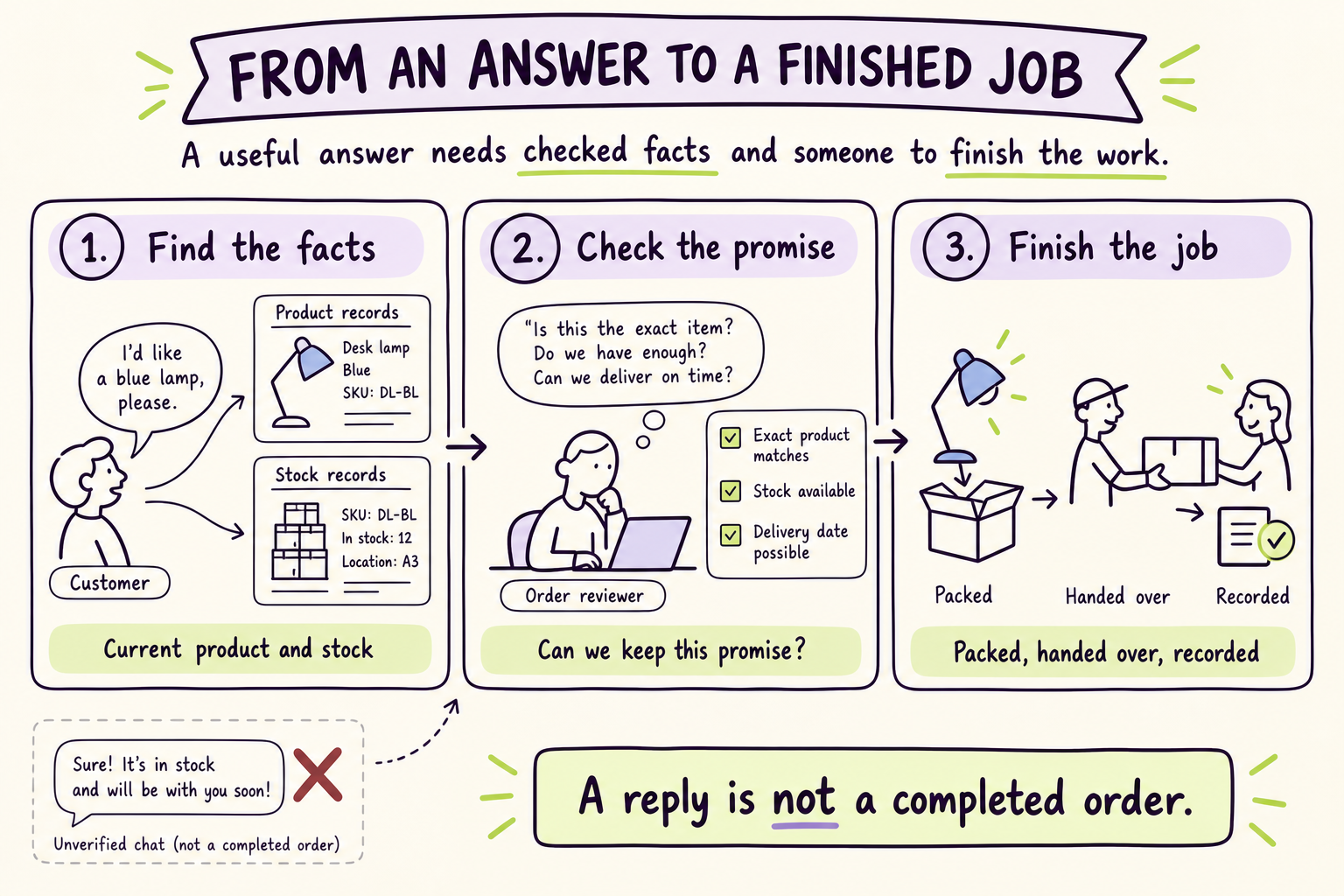
Read the visual explanation
Use the current product and stock records to understand the request.
Check the item, quantity and promise before committing to the customer.
Finish the physical or system task and record what actually happened.
Illustrative teaching example. The steps above are repeated in readable text below; depicted records are not customer results.
A worked example: a mixed-language reorder
Imagine a fictional buyer requesting the same item as last time, in a mix of spoken Hindi and English product terms. The workflow first transcribes or reads the request, retrieves the account’s actual order history and proposes a product match. It preserves the original message so that an uncertain interpretation can be checked.
Next, the system validates quantity and unit of measure. A carton, box and piece should never be treated as interchangeable because the text looks similar. It retrieves the current price and available-to-promise stock from the approved source. Applicable taxes, invoicing fields and credit rules come from finance-approved configuration, not model memory.
If the previous SKU is unavailable, a specialist resolves whether a substitute is acceptable or a partial delivery should be offered. The accepted decision is written back to the system and the buyer receives a clear next step. The completion metric is a valid commercial state, such as an approved quote or confirmed order, rather than the number of messages generated.
An India-focused pilot: orders, delivery and contribution
Consider a fictional brand selling through its own storefront, marketplaces and an offline distributor. The same product has three channel identifiers, and bundles use a different unit count. Before an AI assistant compares profitability, create the SKU mapping and separate a customer order from a shipment, delivered order and settlement. For cash-on-delivery transactions, an order confirmation is not evidence of money collected.
Connect the permitted order, fulfilment, marketplace settlement and accounting records. Show returns to origin separately from ordinary customer returns where the source data supports the distinction. A reduction in advertising spend might look sensible if the report treats undelivered orders as completed revenue or omits reverse-logistics cost. The report should instead flag the incomplete cohort and ask the responsible team to reconcile it.
For distribution, a message in Hindi or another regional language may contain an English product name, a pack quantity and a request for the previous price. The source of the previous price matters: it may be an expired promotion rather than the account’s contract. A bilingual specialist can resolve the commercial ambiguity after extraction, then write the approved decision back to the system. Translation alone cannot supply that approval.
For manufacturing, start with revision-controlled technical enquiries and the commercial follow-through around them. For service businesses, start with estimates awaiting a decision. Avoid prescribing the same connector stack for a business using Tally and spreadsheets as for one with a structured ERP and CRM. Confirm the actual interfaces and access available before promising an integration. The useful scope is the smallest process that can produce a checked business result with the records the company can provide.
Evaluate languages by component
Transcription, translation, document extraction and reasoning are different tasks. A vendor can support a language in one component and offer weaker coverage in another. Sarvam’s current model documentation lists different language coverage by product; its documentation also records retired models. Check the exact deployed version and endpoint instead of copying a familiar model name into an architecture slide. [1]
Build test cases in the language mix the business actually uses, including romanized text, code-switching, noisy audio and product names that should not be translated. Score amounts, dates, addresses and identifiers separately from general fluency. Ask domain-aware reviewers to judge whether the extracted information supports the intended action.
Do not infer that an English-only pilot proves readiness for Hindi, Tamil or Marathi. Nor should an Indian-language model be assumed superior on every task. Compare candidates using the same evidence, permitted tools and acceptance criteria. Keep a human clarification route for requests whose uncertainty cannot safely be resolved.
Connect the systems you actually have
Many teams need an adapter to an existing accounting, inventory or CRM setup rather than a replacement platform. Inventory the available APIs, export formats, permissions and sync frequency. If a process depends on a daily spreadsheet, acknowledge that freshness limitation and determine which actions must wait for a current record.
Plan for inconsistent customer names and historical product codes. Start with a reviewed cross-reference table and a queue for uncertain matches. Do not let the agent silently create duplicates to avoid asking a question. Changes to the product master or credit settings should remain inside the business’s authorization rules.
IndiaAI offers a compute programme with eligibility and application conditions. It may be relevant to an eligible organization’s infrastructure planning, but access or subsidy should not be assumed in an implementation quote. Compare ordinary operating costs first, then treat confirmed programme benefits as a separately documented scenario. [2]
Set data and cost decisions before scaling
MeitY publishes the Digital Personal Data Protection Rules, 2025 and related materials. Confirm the applicable requirements and commencement provisions for the deployment with the responsible adviser. Keep the practical controls concrete: purpose, notice, access, retention, deletion and the services receiving personal information. A local model is not a substitute for those decisions. [3]
Measure cost in the business’s working currency, usually INR for the operating comparison, even if a consolidated report uses USD. Include model usage, infrastructure, implementation, monitoring, rework and specialist handling. A cheap inference call that requires repeated manual correction can have a high cost per completed order.
Begin with one branch, product category or request type. Compare turnaround, matching errors, unresolved cases and quote-to-order conversion against a relevant baseline. Expand when quality and ownership are stable. Looqus can scope the AI and human delivery around this process; examples in this guide are illustrative rather than reported client outcomes.
Put the decisions side by side
| Business context | Work or evidence | Outcome or decision |
|---|---|---|
| Input | Language, audio quality and original record | Do not lose identifiers in translation |
| Context | Account history, SKU and unit conversion | Resolve uncertain entity matches |
| Action | Price, availability and permission | Use finance and system rules |
| Outcome | Quote, order or documented next step | Compare completion and correction costs |
Sources and scope
Worked scenarios are illustrative designs, not customer results or performance guarantees. Confirm current product availability and applicable requirements before implementation.
AI does the work.We own the outcome.
Turn multilingual requests into checked work by connecting branch records, language review and the people responsible for resolving ambiguity before action.
- Agree the result
- Connect the work
- Own the follow-through

Follow the work, one decision at a time.
- Mixed-language request
- Verified product and account
- Exception resolution
- Order and learning