The local problem is more specific than adding Arabic
A UAE business may sell in English, receive a buyer’s clarification in Arabic, and store product names in a mixture of transliterations, abbreviations and supplier codes. Translating a chatbot interface does not resolve that chain. Useful AI transformation connects the original message to the right customer, the right product and the next commercial action.
For an illustrative distributor operating in Dubai and Abu Dhabi, an enquiry might contain an English SKU, Arabic delivery instructions and a spreadsheet with a different unit of measure. The workflow should preserve the original evidence, normalize only what is safe to normalize, and show a human why a match was proposed. A fluent Arabic response is not a substitute for correct stock, price and delivery terms.
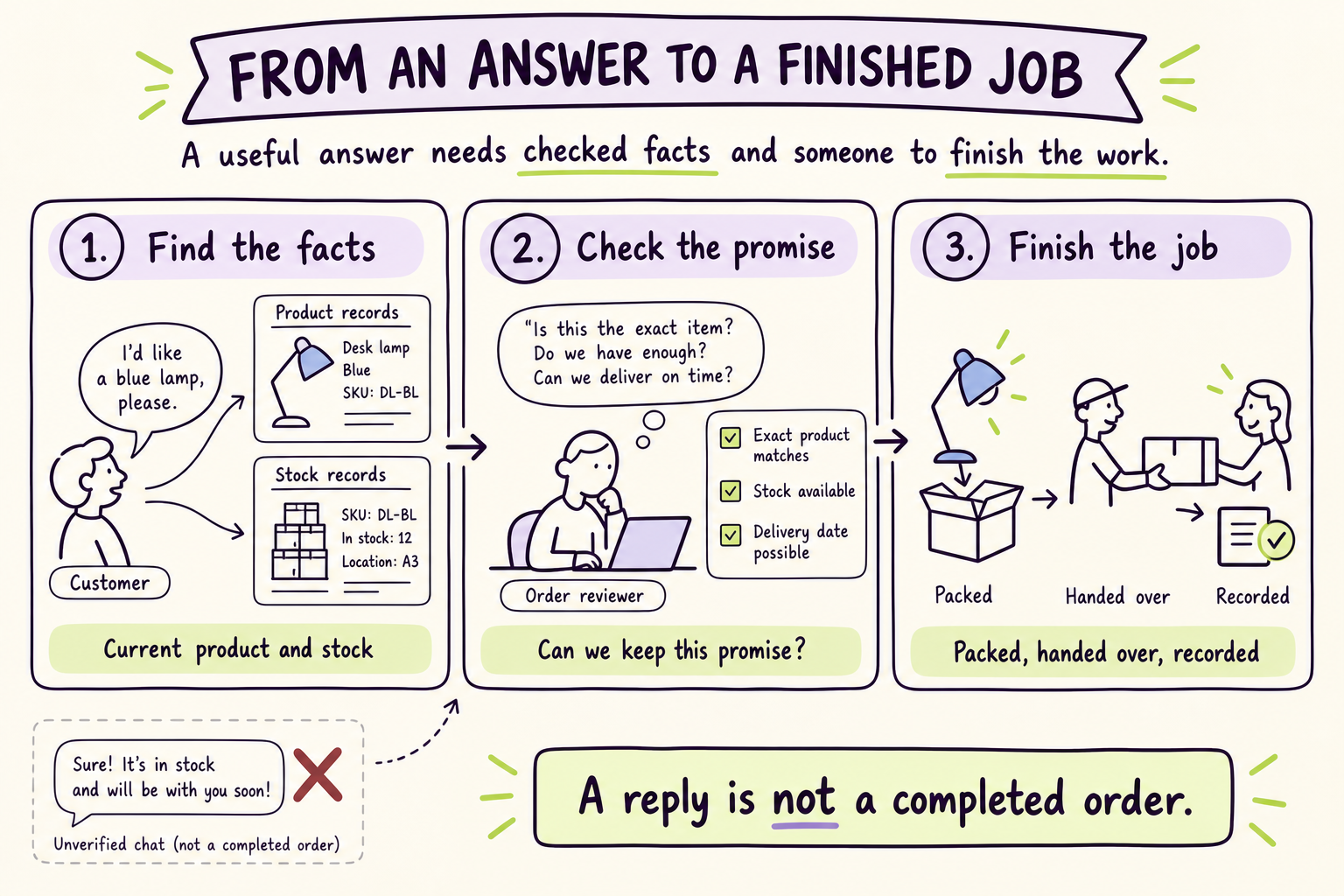
Read the visual explanation
Use the current product and stock records to understand the request.
Check the item, quantity and promise before committing to the customer.
Finish the physical or system task and record what actually happened.
Illustrative teaching example. The steps above are repeated in readable text below; depicted records are not customer results.
Map a bilingual enquiry from receipt to resolution
First identify the buyer and the channel through which the business is permitted to respond. Separate an existing commercial conversation from a new marketing campaign. Preserve the request’s language and ask which language the buyer prefers for the final quotation. Do not assume Arabic is preferred solely from a name or location.
Next retrieve current product, stock and account information from approved systems. Keep product identifiers unchanged through translation. A number such as 12 can mean pieces, cartons or cases; the conversion must come from the product master or a human clarification. Dates, currencies, decimal separators and delivery locations deserve their own validation rather than being left to a general language prompt.
A specialist then resolves the exception that prevents a safe next action. This could be an uncertain substitution, an unavailable delivery slot or a price outside the permitted margin. The corrected quote and the reasoning belong in the commercial record. Follow-up should know whether the buyer received it, asked for a change or placed an order. Merely generating a bilingual PDF stops too early.
Choose Arabic models through task tests
Jais and Falcon Arabic are relevant candidates for an Arabic-language evaluation, alongside multilingual models already approved by the business. TII’s Falcon Arabic release describes training spanning Modern Standard Arabic and regional dialects. That is a reason to test it, not proof that it will understand your customers’ terminology or outperform every alternative in your workflow. [2] [3]
Use a test set containing formal Arabic, Gulf dialect, English, mixed messages and transliterated product names. Include OCR from realistic scans if documents are part of the process. Score exact extraction, correct retrieval, faithful response and correct escalation separately. A model that writes elegantly but changes a SKU fails the business task.
Compare total cost per successfully completed request. An apparently inexpensive model can require extra retrieval calls, retries or specialist correction. A larger model may be unnecessary for a simple classification step. Route tasks by measured requirements, with a safe fallback, rather than using one model for every stage.
Draw the actual data boundary
List where documents, embeddings, model requests, logs and backups are processed. Ask whether support personnel can access those records from another jurisdiction. Self-hosting an Arabic model does not automatically localize a CRM, monitoring vendor or support desk.
The applicable privacy and contractual requirements depend on the business, data and legal environment. The UAE government’s data-protection overview is a starting point, not a complete deployment approval. Have the business’s responsible adviser confirm applicable federal, free-zone and sector requirements before sensitive data enters a new service. Do not use “UAE hosted” as shorthand for a reviewed end-to-end design. [1]
A useful deployment pack contains a data-flow diagram, approved subprocessors, access roles, retention decisions, an incident contact and an action approval matrix. Tie these documents to the process being delivered. A generic security slide does little to explain who can view an actual buyer enquiry.
Plan around the commercial calendar
Use the company’s actual hours and customer calendar when scheduling handoffs and reminders. Ramadan, Eid, trade events and cross-border delivery windows can change buying patterns and team availability. Treat these as configurable business context, with dates confirmed for the relevant year and market, rather than hard-coded assumptions about every UAE customer.
Measure response and completion by language and request type. Compare correction rates, unresolved exceptions and quotation turnaround. If Arabic requests wait longer for specialist resolution, the average can conceal a poor customer experience. Improve the handoff before increasing the number of automated replies.
Looqus can scope the connected work and the specialist responsibility around this process. Discuss the systems, language mix and permitted decisions. The example is illustrative and makes no claim of a local office, existing customer result or universal regulatory compliance.
Put the decisions side by side
| Business context | Work or evidence | Outcome or decision |
|---|---|---|
| Language | Keep original text and buyer preference | Arabic, English and mixed requests |
| Commercial data | Preserve SKU, unit, currency and validity | Compare with approved source records |
| Exception | Assign a person and a response deadline | Resolve substitution or missing quantity |
| Completion | Store delivered quote and next action | Track language-specific correction rate |
Sources and scope
Worked scenarios are illustrative designs, not customer results or performance guarantees. Confirm current product availability and applicable requirements before implementation.
AI does the work.We own the outcome.
Keep bilingual enquiries connected to checked product and commercial facts, with specialist responsibility for clarifying the details before your team sends a quote.
- Agree the result
- Connect the work
- Own the follow-through

Follow the work, one decision at a time.
- Arabic or English enquiry
- Verified business context
- Commercial decision
- Human follow-through