
Creative testing starts with a question
A useful creative test asks why a particular message or presentation might change buyer behavior. Producing five attractive images is not, by itself, a test plan. Define the customer, product, offer and decision you want to inform before generating variants.
Start with delivery and business evidence. Review spend, impressions, frequency, click behavior and purchase outcomes alongside stock, landing-page changes and tracking quality. A falling return on ad spend does not establish creative fatigue on its own. Changes in audience, auction costs or product availability can produce a similar pattern.
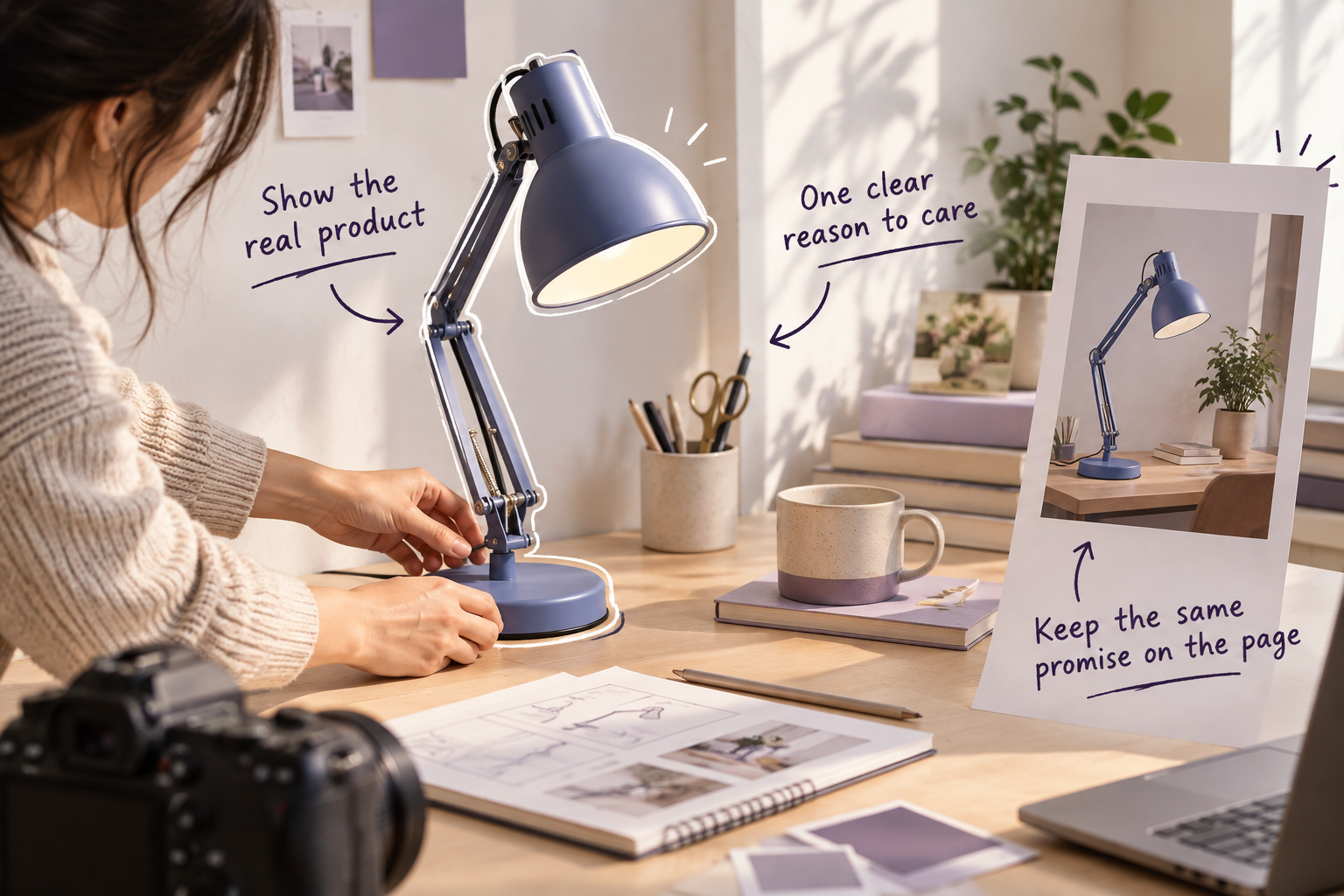
Read the visual explanation
Start with product facts and recurring customer questions.
Keep the ad and landing page aligned around the same supported promise.
Compare a clear change under the same rules and record what you learned.
The product, the reason to choose it and the landing-page promise should agree. This fictional lamp illustrates the comparison; it is not a product claim or customer campaign. AI-generated illustrative scene; not a photograph of a Looqus client.
Keep the original evidence attached
Create a brief that links each observation to its period and source. Label whether the observation is account data, an interpretation or a proposed hypothesis. A visual tag such as “product close-up” is a description; it becomes useful only when compared across sufficiently relevant examples.
Record campaign, ad set and ad identifiers as well as readable names. Names can change. Preserve the exact creative version, destination URL and offer so future analysis does not join yesterday’s results to today’s revised asset. Retain source image rights and approved product information.
Separate an iteration from a new concept
An iteration changes a narrow element of an existing idea. A new concept changes the organizing reason to buy. For the fictional Dayclose brand, changing “Close the laptop” to another evening-transition hook is a hook iteration. Moving from an evening ritual to a taste-led presentation is a broader concept.
Do not describe both as a single-variable test. Keep a hypothesis register: what changes, what stays fixed, why it might matter and what evidence would change your mind. A test can compare broad concepts, but its conclusions should remain at the concept level rather than attribute the result to one word or color.
Design the variants before making assets
A practical batch might include a control, a hook iteration, a visual iteration and two concept explorations. Give each an identifier and a precise purpose. Keep the product and offer consistent when they are not the variables under investigation.
For a sleep-related product, never invent health benefits, clinical evidence or ingredient effects because a competitor uses them. Use the brand’s approved claims and route claims to the appropriate reviewer. Creative inspiration does not establish permission to copy a competitor’s imagery or assertions.
Build approval into the work
Review factual accuracy, product appearance, mobile legibility, destination continuity and compliance with the brand’s approved rules. Confirm that the exported files match the approved versions. A draft approved in a presentation can still differ from the file uploaded to an ad platform.
Define who can publish, adjust spend and stop a test. Looqus specialists can resolve missing assets, repair a broken destination and coordinate approvals within the engagement. The customer retains agreed spending and release authority. A test should not launch merely because the generation step completed.
Read results without manufacturing a winner
Predefine the evaluation window, comparison method and business metric. Record inconclusive results. Avoid repeatedly changing the end date after seeing favorable numbers. If traffic or conversions are limited, a directional observation may justify another test but not a confident winner claim.
After the test, update the hypothesis register with what was learned and what remains uncertain. Store the losing variants too: they can explain why an appealing idea failed under a particular offer or audience. The output of the workflow is both approved creative and a better next decision, not a promise of higher ROAS.
Creative hypothesis register
Use this starting worksheet to agree the process with the people who will operate it. Replace the examples with your own rules and owners.
| Variant | What changes | What the result can tell you |
|---|---|---|
| Control | Nothing; preserve the exact approved asset. | Reference performance under current conditions |
| Hook iteration | Opening line; preserve visual, offer and angle. | Whether that hook merits another test |
| Visual iteration | Image treatment; preserve message and offer. | Whether the presentation changes response |
| Concept exploration | The organizing idea and corresponding execution. | Whether the complete concept merits investment |
| Release check | No test variable; verify assets and destination. | Whether launch matches the approved plan |
| Readout | No creative change during the evaluation window. | Observed result, uncertainty and next decision |
Sources and scope
This is Looqus’s practical design guidance. Worked scenarios are illustrative; they are not client results or guaranteed outcomes. The sources below provide the referenced platform or engineering context.
AI does the work.We own the outcome.
Give each creative test a clear buying question, consistent evidence and an owner who turns the learning into the next approved decision.
- Agree the result
- Connect the work
- Own the follow-through