
A discount's break-even ROAS is the net revenue divided by the contribution available to pay for advertising. Calculate it after the discount, product cost, variable fulfilment, payment fees and an appropriate returns allowance. If the remaining contribution is zero or negative, no positive advertising spend can make that order profitable on its own.
This is a promotion decision guide for ecommerce owners, not a substitute for a complete profit and loss statement. It helps answer a narrower question: how much can this specific offer afford to spend acquiring an order, and what extra volume would justify the discount? Fixed overhead, cash timing and future customer value require separate consideration.
A campaign can beat last month's reported ROAS and still leave less cash behind if its product mix, discounts or fulfilment costs change. The useful comparison starts with consistent revenue definitions and a cost model that reflects the basket customers will actually buy.
Define the revenue in your ROAS
ROAS is a ratio of attributed conversion value to advertising cost. The meaning of the numerator depends on what the measurement system receives. It might be merchandise revenue, a checkout total including tax and shipping, or another configured value. Google Ads documents that conversion values can represent revenue or other business values; the platform cannot infer your intended margin definition from a column label. Google Ads conversion values.
For the calculations here, revenue means merchandise revenue after discounts and excluding tax. Shipping revenue, if charged, should be added separately alongside the corresponding shipping cost. Returns can be modelled through a conservative allowance initially and reconciled with actual outcomes after the cohort matures.
Do not compare a revenue-based 4× ROAS with a contribution-based 4× conversion-value ratio. They are different metrics. Name the numerator in the report, and document which purchase events count. Duplicate conversions, cancelled orders and inconsistent currencies can overwhelm the precision of an otherwise careful calculation.
A storewide blended revenue-to-ad-spend ratio also differs from a platform's attributed ROAS. Use both where helpful, but do not add the same order's attributed revenue from several platforms and call the result total business revenue.
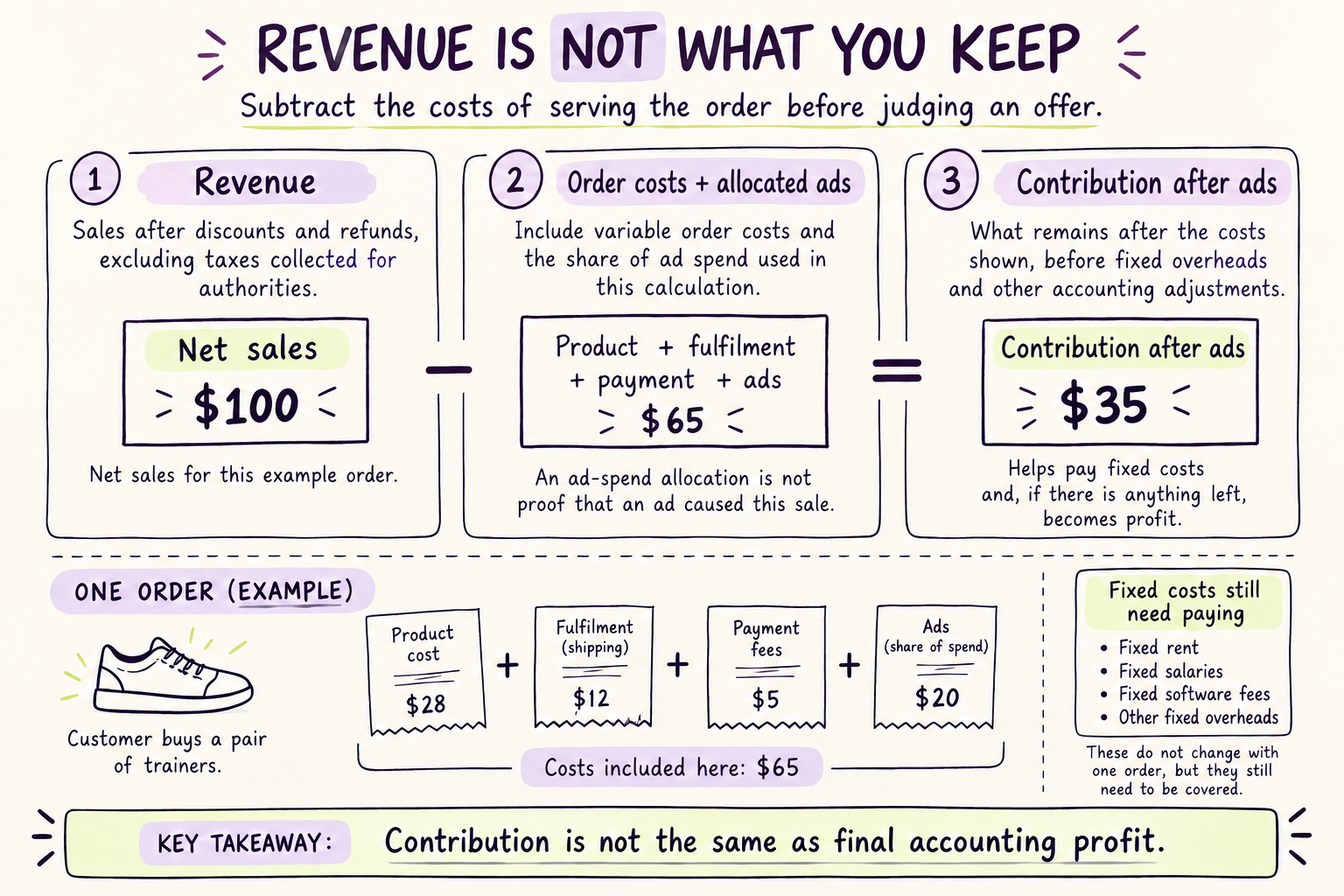
Read the visual explanation
Start with net sales after discounts, returns and collected sales tax.
Include the relevant order costs and clearly state how advertising cost is assigned.
What remains after those costs can contribute to fixed costs and profit.
Illustrative teaching example. The steps above are repeated in readable text below; depicted records are not customer results.
Assemble the cost stack for the promoted basket
Build the calculation from actual promoted products and likely quantities. A store average may hide a costly bundle component or a low-margin bestseller. Where costs are missing, mark the result provisional and use a conservative estimate approved by finance rather than silently assigning zero.
| Input | Include | Common mistake |
|---|---|---|
| Merchandise revenue | Actual discounted amount excluding tax | Using list price after the discount starts |
| Product cost | Cost of every included item and gift | Treating a free gift as costless |
| Payment charges | Applicable percentage and fixed fees | Applying the percentage to the wrong base |
| Fulfilment | Pick, pack, packaging and shipping subsidy | Using the cheapest destination for every order |
| Returns allowance | Expected net incremental loss and processing cost | Subtracting a full refund and the same loss twice |
| Advertising | Cost of acquiring the counted orders | Mixing campaign spend with unmatched revenue |
Shopify's product profit reporting uses recorded cost information and notes limitations of static cost fields. For a promotion, verify the relevant cost period and purchase batch where they materially change the decision. Shopify profit report limitations.
Separate an expected returns allowance from the later actual reconciliation. Define exactly what it covers: lost merchandise contribution, reverse logistics, unrecoverable product value or a combination. Consistency matters more than pretending one generic return percentage captures every category.
Retained revenue
Use the actual discounted revenue definition.
Variable costs
Deduct product, fulfilment, fees and a consistent returns allowance.
Acquisition room
The remaining contribution sets the advertising ceiling.
Conceptual guide by Looqus Editorial. Read the surrounding analysis for assumptions, exceptions and primary sources.
Work through a synthetic discount ladder
Fictional USD example. Monetary assumptions in this guide are illustrative US-dollar amounts, not quoted prices, measured results or exchange-rate conversions. The currency does not imply a US tax or legal setting.
Consider a product with an USD 200 list price excluding tax. Product cost is USD 70, variable fulfilment is USD 20, payment cost is 3% of merchandise revenue, and the simplified expected return-and-service allowance is USD 8 per order. These are illustrative assumptions, not market benchmarks.
At full price, contribution before advertising is 200 − 70 − 20 − 6 − 8 = USD 96. This is the maximum acquisition cost for first-order break-even on the stated variable costs. Break-even revenue ROAS is 200 ÷ 96 = approximately 2.08×.
| Discount | Net revenue | Contribution before ads | Break-even revenue ROAS |
|---|---|---|---|
| None | USD 200 | USD 96.00 | 2.08× |
| 10% | USD 180 | USD 76.60 | 2.35× |
| 20% | USD 160 | USD 57.20 | 2.80× |
| 30% | USD 140 | USD 37.80 | 3.70× |
At a 20% discount, payment cost falls to USD 4.80, but product and fulfilment costs remain unchanged in this model. Contribution therefore falls by USD 38.80, or about 40.4%, even though price falls by 20%. This asymmetry explains why a seemingly modest promotion can require a substantial improvement in acquisition performance.
Round the displayed ratios for readability while keeping full precision in the working model. A campaign at 2.80× against a calculated 2.7972× threshold has almost no practical buffer for cost uncertainty, refund changes or tracking differences.
Set a profit target above break-even
Break-even is a floor, not a sensible commercial ambition. If the owner requires USD 25 per order after advertising to support overhead and operating profit, subtract that requirement from contribution before advertising. At the 20% discount, allowable acquisition cost becomes 57.20 − 25 = USD 32.20.
The corresponding target revenue ROAS is 160 ÷ 32.20 = approximately 4.97×. A campaign delivering 4× would generate USD 40 advertising cost per order and leave USD 17.20 after the modelled variable costs. That is positive first-order contribution, but it misses the owner's USD 25 requirement.
If desired contribution exceeds contribution before ads, the offer cannot meet the target even with free acquisition. Change the price, basket, cost structure or target. Do not solve an impossible equation by selecting a more optimistic attribution window.
Google's target ROAS bidding aims at the configured conversion-value return on spend; it is not a promise that every order or period will hit the target. A finance-derived threshold still needs a media plan, reliable measurement and an allowance for variability. Google Ads target ROAS.
Calculate the extra volume the promotion must create
Suppose 100 orders would sell at full price with an acquisition cost of USD 40 each. Their post-ad contribution is 100 × (96 − 40) = USD 5,600. At the 20% discounted price and the same USD 40 acquisition cost, each order leaves USD 17.20.
To match USD 5,600, the discounted campaign would require 5,600 ÷ 17.20 = 325.58, rounded up to 326 orders. That is 226 additional orders above the 100-order baseline. A higher conversion rate is useful only if the resulting total contribution can justify this gap.
If acquisition cost improves to USD 30, each discounted order leaves USD 27.20. Matching the baseline then requires 5,600 ÷ 27.20 = 205.88, rounded up to 206 orders. Better acquisition economics materially change the decision, which is why both price and customer acquisition assumptions belong in the same model.
These comparisons assume every counted order is incremental to the relevant scenario and ignore fixed capacity limits. In a real promotion, some orders are brought forward from next month or diverted from another full-price product. Measure the period after the sale as well as the sale itself.
Synthetic contribution before advertising at four discounts on an USD 200 item.
Includes USD 70 product cost, USD 20 variable fulfilment, 3% payment cost and USD 8 return/service allowance. Corporate overhead and advertising are not included.
Test the checkout customers will actually use
Promotion rules can change the effective price through product discounts, order discounts, shipping offers, bundles and customer-specific codes. Shopify supports defined combinations with eligibility and interaction rules. Test the real cart rather than inferring the outcome from the campaign headline. Shopify discount combinations.
Build a small checkout matrix: one promoted item, multiple promoted items, a mixed basket, a gift threshold, a returning customer with an existing code, and an expensive shipping destination. Record the final amount, shipping treatment and included products for each case.
Also inspect the displayed offer. A banner saying “20% off” while the landing page shows an unclear reference price creates a different problem from poor campaign performance. Customers need to understand what qualifies, when the promotion ends and what they will actually pay.
| Situation | Decision before launch | Evidence of completion |
|---|---|---|
| Coupon stacks with automatic offer | Allow deliberately or prevent combination | Recorded cart result |
| Gift pushes basket into costlier packaging | Add the incremental packaging cost | Fulfilment estimate |
| Remote destination increases subsidy | Restrict or price the offer appropriately | Shipping-zone test |
| Low-margin variant dominates demand | Separate or exclude the variant | Variant-level contribution model |
| Return rate may rise with promotion | Add downside scenario and later reconciliation | Mature cohort comparison |
Positive contribution
Calculate break-even and the contribution target above it.
No contribution
Advertising cannot rescue the standalone order economics.
Future value
Treat future purchases as a separate, evidenced investment case.
Conceptual guide by Looqus Editorial. Read the surrounding analysis for assumptions, exceptions and primary sources.
Treat future customer value as a separate investment case
An owner may intentionally accept weak first-order contribution to acquire a customer likely to return. That can be reasonable when repeat contribution is demonstrated, the observation window is mature and cash can support the payback period. It is not enough to label every new customer “high lifetime value.”
Calculate future contribution after repeat-order fulfilment, returns, retention marketing and service costs. Compare like acquisition cohorts. A customer acquired through a deep discount may behave differently from a full-price organic buyer, so avoid applying the store's best cohort to the riskiest promotion.
State the payback period and the confidence level. For example, a proposed USD 15 first-order deficit with USD 25 expected contribution over the following six months is a different cash commitment from positive contribution at checkout. Show a downside case in which only half the expected repeat contribution arrives.
Cap the test budget when the future-value evidence is uncertain. A bounded experiment can buy useful information. An uncapped campaign justified by unverified future purchases can spend the business's working capital before the hypothesis becomes testable.
Give the operating team explicit authority
The marketing team needs an approved range for discount, spend and target contribution. The merchandising team owns product eligibility and truthful offer details. Finance owns cost definitions and reconciliation. Fulfilment owns capacity and destination costs. Someone must own the final decision across all four.
AI can calculate scenario tables, identify baskets that violate the contribution floor and reconcile reported revenue with order records. It can also flag unexpected coupon combinations and changes in product mix. The calculations should remain reproducible from stored inputs rather than depend on a persuasive narrative generated after the event.
Specialists resolve the gaps: missing COGS, conflicting discounts, unavailable stock and mismatched purchase events. An alert becomes completed work only when the underlying problem is corrected or an authorised exception is recorded. A system should not silently increase spend because yesterday's headline ROAS looked strong.
Define stop conditions before launch. Pause an affected offer when effective pricing differs from the approved model, a material cost input is missing or observed contribution breaches the agreed loss limit. Investigate ordinary day-to-day volatility in context rather than repeatedly changing the campaign without enough evidence.
Review the promotion through a full operating cycle
Before launch, approve the basket economics and checkout tests. During launch, monitor whether actual product mix, acquisition cost and fulfilment experience remain within the planned range. After the campaign, reconcile cancellations, refunds and actual costs over a sufficiently mature period.
Compare total contribution with a credible baseline or controlled test where possible. A prior week can be distorted by seasonality, payday timing, stock availability and a changed media budget. Be transparent when the design supports only a directional comparison rather than a causal claim.
Document what changed the decision. Perhaps the offer worked only on bundles, or a delivery surcharge erased the margin in one region. These findings are more useful for the next promotion than a universal claim that a certain discount percentage “works.”
Sources
- Google Ads conversion values
- Google Ads target ROAS bidding
- Shopify profit reports
- Shopify discount combinations
AI does the work.We own the outcome.
Check what a discounted order leaves after the relevant costs, then set an advertising limit consistent with the contribution your business needs.
- Agree the result
- Connect the work
- Own the follow-through