
A product catalogue is ready for search and AI-assisted discovery when people and machines can reliably identify the exact item, understand its important attributes, verify its price and availability, and reach a page where that same offer can be purchased. Start with accurate product records and consistency across the feed, visible page and checkout. Adding more descriptive copy to contradictory product data makes the contradiction larger.
For ecommerce owners, the practical outcome is fewer preventable listing errors and fewer customers arriving at the wrong variant or an unavailable offer. Better data can support eligibility and understanding, but it cannot guarantee rankings, AI citations or sales. Demand, competition, product value and the shopping experience still matter.
Google states that its AI search features do not require special AI markup or additional technical requirements beyond the relevant search foundations. Treat “AI readiness” as disciplined product information and a useful shopping experience, not a separate file that promises automatic recommendations. Google guidance for AI features.
Begin with the question a buyer needs answered
A useful product record helps answer a decision, not merely repeat a keyword. A buyer might need a refill that fits a particular dispenser, a garment in a specific material and size, or a device compatible with an existing accessory. If those facts live only in an image or an employee's memory, both customers and automated systems have difficulty using them reliably.
List the five to ten facts that change a purchase decision in each category. For clothing, fit, size, material, care and variant imagery may matter. For furniture, dimensions, assembly, finish and delivery constraints may dominate. For consumables, quantity, format, ingredients and appropriate usage may be important, with claims limited to approved evidence.
Distinguish a factual attribute from an advertising claim. “Contains 500 ml” is a quantity that can be checked. “The healthiest choice” is a comparative claim requiring a different evidential standard. AI-generated catalogue enrichment should preserve this distinction instead of making every description sound more impressive.
Create a source and owner for each material fact. Packaging, supplier specifications, an approved product sheet and a measured dimension may have different authority. Resolve disagreements before publishing a polished description.
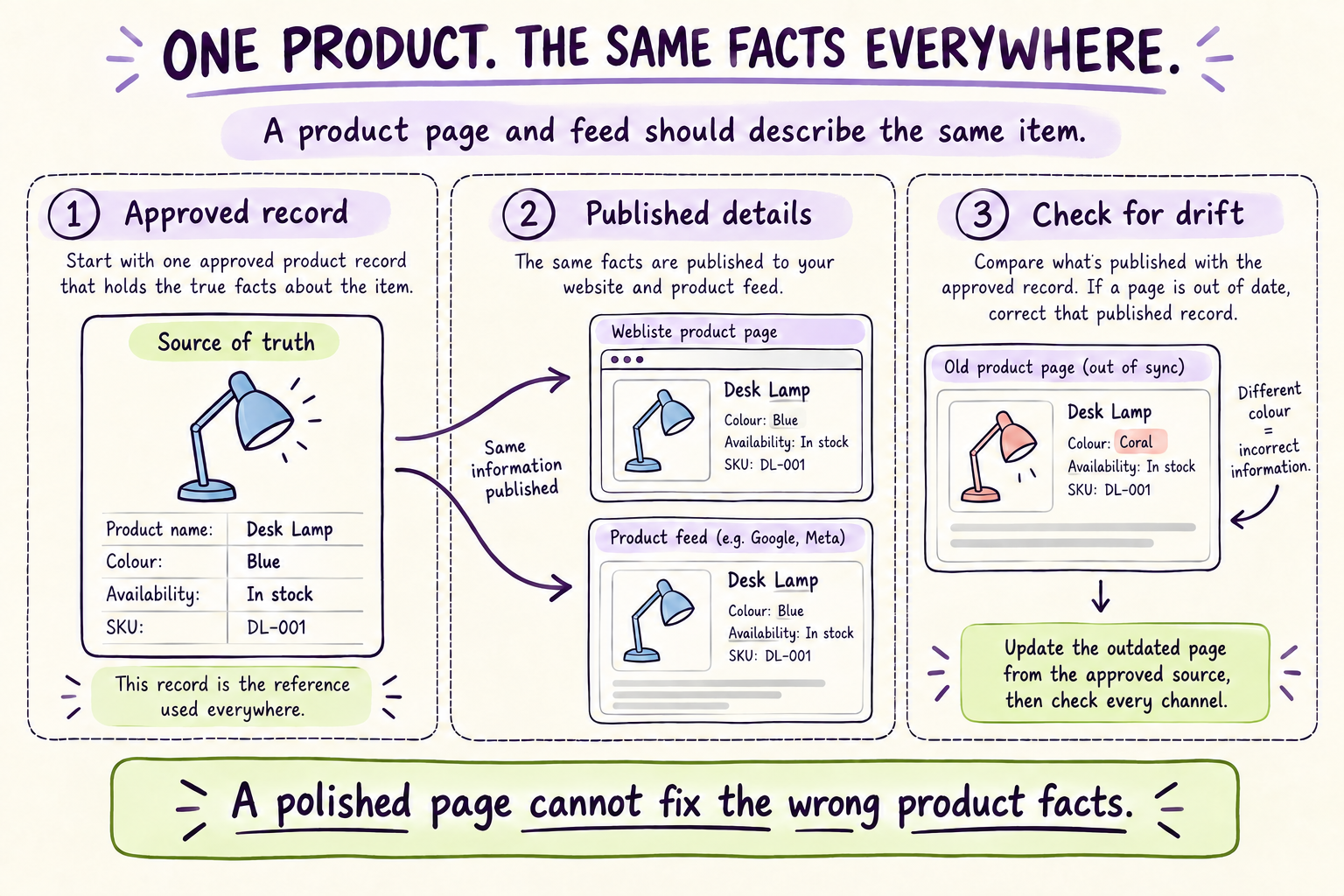
Read the visual explanation
Keep one approved record for the exact product and variant.
Publish the same checked facts to the website and product feed.
Compare published details with the reference and correct the outdated version.
Illustrative teaching example. The steps above are repeated in readable text below; depicted records are not customer results.
Establish one identity for every sellable variant
The parent product is not always the unit a customer buys. A shirt in navy, medium and cotton is a specific variant with its own stock, image and possibly price. The feed identifier, landing-page selection and checkout item should agree on that variant.
Google documents product variant structured data using ProductGroup and associated variant relationships. This helps describe how variations belong together; it does not remove the need for accurate individual offers. Google product variant structured data.
Build a mapping between the commerce platform's variant ID, the internal SKU and each channel's product identifier. Preserve stable identifiers where possible. Avoid recycling a discontinued SKU for a materially different product, because historical performance, support records and channel mappings may become misleading.
| Record | What it should identify | Example failure |
|---|---|---|
| Parent product | Shared product family | Different models grouped as colour variants |
| Sellable variant | Exact size, colour, material or pack | Feed links to default size instead |
| SKU | Internal operational item | Same SKU reused for two pack sizes |
| Channel identifier | The submitted channel item | New IDs created on every export |
| Manufacturer identifier | Genuine supplied identifier where applicable | Invented GTIN used to fill an empty field |
| Landing URL | Purchasable matching offer | Page opens a different price or colour |
A mapping table is valuable because it turns “the listing is wrong” into a specific mismatch that someone can fix.
Source record
Approved identity, attributes, price and stock.
Product page
The customer sees the same sellable variant and terms.
Feed & markup
Machine-readable facts agree with the visible page.
Conceptual guide by Looqus Editorial. Read the surrounding analysis for assumptions, exceptions and primary sources.
Make price and availability agree across surfaces
The visible page, structured data, feed and checkout should tell the same commercial story. Google Merchant Center's specification requires relevant price and availability consistency across these surfaces. A stale feed or an incorrectly selected variant can therefore be more serious than a weak product title. Google Merchant Center product data specification.
Fictional USD example. Monetary assumptions in this guide are illustrative US-dollar amounts, not quoted prices, measured results or exchange-rate conversions. The currency does not imply a US tax or legal setting.
Identify the authoritative price source and how quickly changes reach each destination. Include market and currency rules. A US page priced in USD should not accidentally submit a converted amount under another currency code. A promotion needs a defined start and end, including the propagation delay of each channel.
Availability is equally operational. A product may exist in a warehouse but be committed, unavailable for sale or unsuitable for the destination. The feed should represent the offer customers can actually complete, with the appropriate preorder or backorder information when applicable.
Use change-driven checks for high-risk events: promotion launch, price rollback, stockout, variant migration and theme release. A weekly catalogue audit may miss the most commercially important two hours of the week. Keep a record of when each surface was last checked so the team can distinguish a genuine contradiction from an expected update delay.
Build a catalogue quality contract
A quality contract defines which fields must be present, which must agree and which claims need evidence before an item is published. It should differ by product category. Requiring shoe size on a candle creates noise; omitting dimensions from a large piece of furniture creates customer risk.
| Check | Proposed rule | Failure action |
|---|---|---|
| Identity | Exactly one mapping to the sellable variant | Hold the affected listing and resolve the mapping |
| Price | Currency and payable merchandise price agree | Escalate the price source or propagation failure |
| Stock | Submitted status matches the current offer | Correct the availability source |
| Attributes | Decision-critical facts are explicit | Ask the product owner for evidence |
| Images | Correct product and variant are shown | Replace with approved matching imagery |
| Claims | Material claims have an approved source | Remove unsupported enrichment |
| Purchase path | Link reaches the matching purchasable item | Fix the URL or variant selection |
Do not interpret this as a requirement to suspend the entire catalogue for a minor punctuation issue. Separate critical offer contradictions from useful enrichment opportunities. Prioritisation keeps the team focused on defects that prevent discovery, mislead shoppers or break purchase decisions.
Google also documents how supported structured data attributes map to product data. Use that mapping when checking your implementation; a valid-looking field name is not enough if its value or meaning differs from the feed. Supported product structured data attributes.
Use AI for enrichment only where evidence exists
AI can normalise units, propose titles from approved attributes, detect likely duplicate products and compare a description with a specification sheet. It can identify missing compatibility information or flag a product whose image appears inconsistent with its selected colour. These are useful suggestions and quality signals.
It should not invent certifications, materials, compatibility, origin, health outcomes or product identifiers. An empty field means evidence is missing, not that the model should fill the gap with the most likely answer. Store the source used for each proposed material fact and route uncertainty to the product owner.
Protect approved product imagery. Generating a new lifestyle background may be a separate creative task, but changing the packaging, shape, label or colour can misrepresent the item. Catalogue quality should verify the exact product that the customer receives. If a generated asset is used, it needs its own governed approval process.
Keep batch changes reviewable. A specialist should be able to compare old and proposed values, approve a limited category and reverse a problematic release. Publishing thousands of plausible descriptions without a change record makes later correction expensive and damages confidence in every field.
Synthetic monthly contribution after USD 3,000 programme cost under three additional-traffic scenarios.
Assumes USD 60 contribution per additional order. Correcting a feed does not guarantee incremental sessions, rankings or sales.
Work through a synthetic prioritisation example
Assume a retailer has 2,000 sellable variants. An audit finds 120 critical offer mismatches. Eighty affected variants belong to a commercially important category that previously attracted 4,000 qualified product-page sessions per month. The team estimates that resolving the issues could restore some of that traffic, but does not count it as guaranteed demand.
For a deliberately simple scenario, assume 4,000 genuinely additional qualified sessions after correction, a 2.5% completed-order rate and USD 60 contribution per completed order before the improvement programme's cost. The resulting contribution is 4,000 × 0.025 × 60 = USD 6,000 per month.
If the remediation and ongoing quality process costs USD 3,000 for the evaluated month, net incremental contribution is USD 3,000. The break-even session count at those assumptions is 3,000 ÷ (0.025 × 60) = 2,000 additional qualified sessions. Alternatively, it requires 50 additional completed orders at USD 60 contribution each.
| Scenario | Additional sessions | Order rate | Contribution before programme | After USD 3,000 programme cost |
|---|---|---|---|---|
| Conservative | 1,500 | 2.0% | USD 1,800 | −USD 1,200 |
| Working hypothesis | 4,000 | 2.5% | USD 6,000 | USD 3,000 |
| Stronger demand | 5,000 | 3.0% | USD 9,000 | USD 6,000 |
These are scenario calculations, not predicted search results. Some corrected products may gain eligibility without gaining traffic. Some traffic may shift from another product or channel. Measure actual incremental contribution cautiously and avoid attributing every change after a catalogue release to the release itself.
Verify
Trace the disputed field to an authoritative source.
Correct
Update every affected surface within the agreed permissions.
Check
Re-fetch the page and feed; confirm the correction propagated.
Conceptual guide by Looqus Editorial. Read the surrounding analysis for assumptions, exceptions and primary sources.
Validate the page as well as the feed
A successful feed upload proves that a file was received, not that every item is eligible or the purchase path works. Inspect channel diagnostics, then open representative landing pages on mobile and desktop. Include a discounted item, an out-of-stock item, a product with many variants and a product with destination-specific restrictions.
Validate structured data against the appropriate requirements and compare it with the visible page. Google describes both on-page structured data and Merchant Center feeds as routes for supplying product information, with some experiences using both. Consistency is therefore worth testing across both paths. Google product structured data overview.
Test a real variant change. Does the price update? Does the image match? Does the cart contain the item shown? Can the user discover delivery and return terms without abandoning the page? These checks often reveal a gap that a schema validator cannot detect.
Also inspect image loading and readable product facts on small screens. A technically complete page can still hide the decision-critical dimensions below an oversized visual or an intrusive banner. Product information should help a person choose with confidence.
Assign ownership from source to correction
Merchandising owns product facts. Commerce operations owns price and stock sources. Engineering owns mappings and page behaviour. Channel operations owns diagnostics and publication status. Without an accountable lead, each team can correctly claim that its local system is working while the customer sees a contradiction.
AI can continuously compare these surfaces and create a ranked exception list. Specialists then resolve the underlying cause, verify the corrected listing and record whether similar products are affected. They should have authority to hold a misleading offer when necessary, within the merchant's approved rules.
Set response expectations by severity. A wrong payable price deserves urgent investigation; a missing optional attribute can enter a planned enrichment batch. Repeated failures should produce a source-system correction rather than a permanent manual patch in the exported feed.
AI does the work. We own the outcome. For Looqus, that means the product is accurately represented and its corrected state is verified. A list of suggested feed improvements is an intermediate output, not the finished service.
Implement in a sequence that protects the catalogue
Begin with a bounded category and preserve a baseline export, page samples and channel status. Establish variant mappings and critical-field rules before rewriting descriptions. Correct price, stock and identity problems first because they affect the truth of the offer.
Next, add useful missing facts from approved sources. Release a small batch, confirm both channel processing and the customer journey, and inspect any new warnings. Expand by category once the source and rollback process are reliable. Keep changes traceable to their owner and evidence.
Finally, monitor operational outcomes: critical mismatches, time to correction, eligible items, qualified visits, completed orders and customer complaints tied to product information. Separate leading indicators such as eligibility from the commercial result. A larger indexed catalogue is valuable only when it contains useful products presented accurately.
Sources
- Google AI features and your website
- Google Merchant Center product data specification
- Google product variant structured data
- Supported product structured data attributes
- Google product structured data overview
AI does the work.We own the outcome.
Keep product variants, prices and availability consistent across buying surfaces, with someone responsible for tracing mismatches and verifying that corrections reached customers.
- Agree the result
- Connect the work
- Own the follow-through