Start with the bottleneck, not a winner
A team struggling to upload approved ads has a different problem from a team that cannot decide what to create. Both might search for an AI advertising tool. Buying the same product for both problems can leave one of them untouched. Map the last ten creative tests from the first question to the final decision. Where did they wait? Which handoff caused rework? Who carried the unfinished work?
This comparison uses the vendors’ public product descriptions checked on 14 September 2026. It is not an account-level benchmark, and it does not establish which product will improve your advertising results. Capabilities overlap and change. The practical evaluation below is our proposed buying method; it is not a claim that a particular vendor passes or fails it.
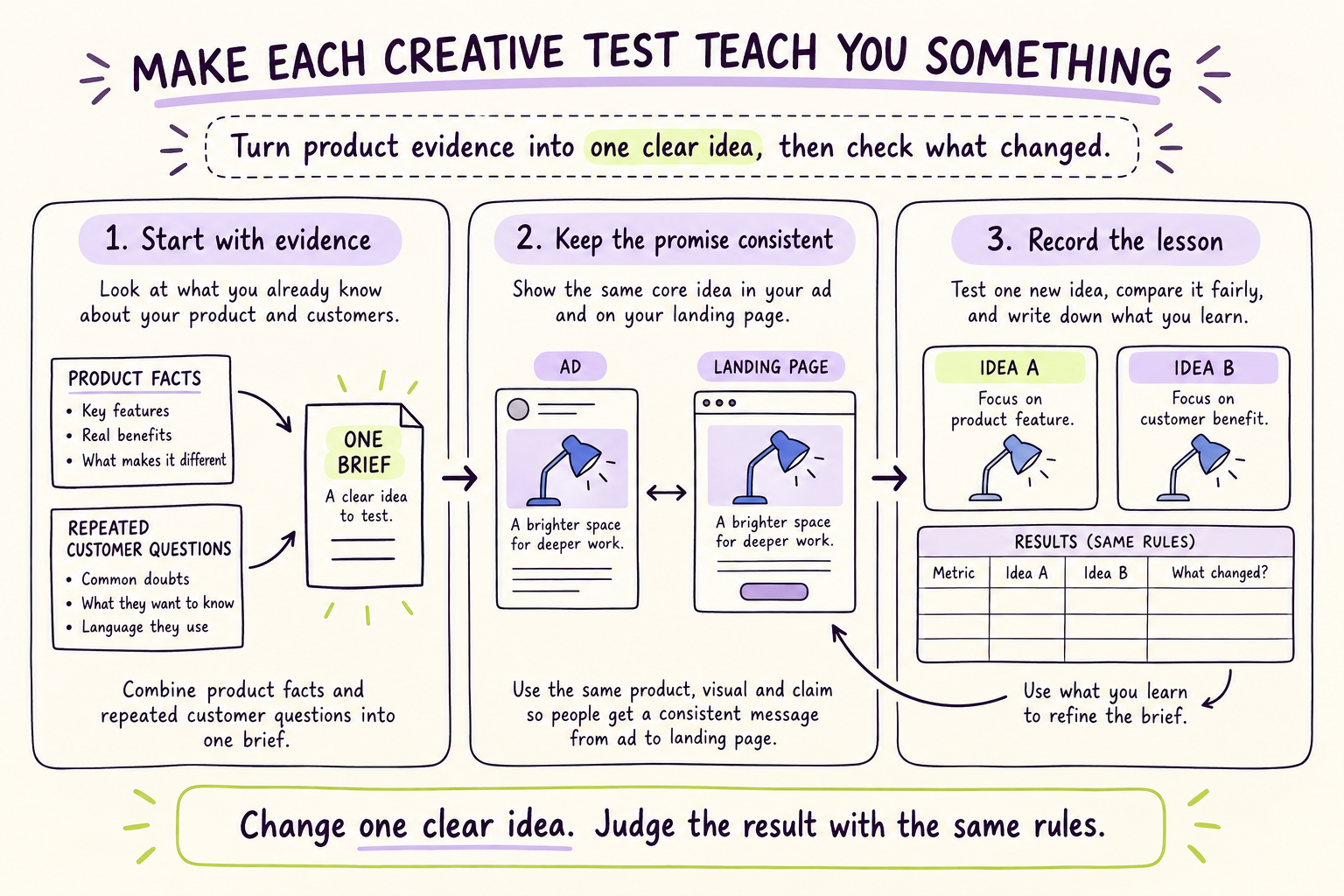
Read the visual explanation
Start with product facts and recurring customer questions.
Keep the ad and landing page aligned around the same supported promise.
Compare a clear change under the same rules and record what you learned.
Illustrative teaching example. The steps above are repeated in readable text below; depicted records are not customer results.
Foreplay: evaluate the research-to-brief process
Foreplay describes a suite spanning saved advertising references, competitor monitoring, discovery, creative performance analysis through Lens, and briefs with storyboards, scripts and brand profiles. It also advertises an API for competitor advertising data. Describing it only as a swipe file would miss much of its current positioning. [1]
For your trial, start with a specific research question: which ways of presenting an evening ritual could our brand credibly test? Save references with the relevant scene, hook and destination. Then ask a strategist to turn the references into a brief that names what changes, what stays fixed and what evidence would alter the decision. Measure the time spent turning research into a brief another person can execute.
A competitor ad being publicly visible does not reveal its profitability. Keep observed creative patterns separate from your own measured performance. Also distinguish studying an idea from having the rights to reuse the original footage, likeness or packaging.
Atria: evaluate the connection from analysis to launch
Atria currently presents Raya as supporting research, briefs, creative generation, Meta uploads and performance learning. Its public site explicitly describes batch uploads to Meta and a user-controlled launch step. A comparison that assumes Atria stops at inspiration or cannot launch ads would be inaccurate. [2]
Test the continuity of the record. Can your team trace a generated asset back to its hypothesis, source evidence and approved brief? When someone changes the product, price or claim, does the final launch reflect that change? Ask to see the actual account destination, creative variant and destination URL before anything is made live.
A useful trial includes an awkward revision, not just a clean first draft. For example, remove an unapproved claim after the brief has been accepted. Follow the correction through the copy, rendered image, landing page and launch payload. The number of manual repairs tells you more about your operating fit than the number of assets generated.
Segwise: evaluate the quality of the creative explanation
Segwise describes multimodal creative tagging, performance analysis, competitor tracking, strategy and creative generation. Its examples connect attributes such as hooks, visual formats, emotions and calls to action with creative-level performance. It also describes draft generation for teams to edit and approve. These are vendor-described capabilities, not independently verified accuracy scores. [3]
Bring a set of your own ads with deliberately similar and different concepts. A product close-up and a lifestyle scene can use the same headline but represent different visual hypotheses. Check whether tags preserve that distinction. Manually review a sample, record disagreements and decide which attributes are valuable enough to maintain.
Then inspect the analysis denominator. A tag appearing in a high-return ad may also coincide with a different audience, promotion or season. Ask to see spend, dates, attribution context and the number of examples behind an explanation. Use the pattern to propose an experiment. Do not turn an association into a causal statement simply because a dashboard offers a confident summary.
AdManage: evaluate launch accuracy at the volume you actually need
AdManage focuses on bulk ad launching and advertises support across channels including Meta, TikTok and Google Ads. Its public page describes naming controls, creative enhancement settings and media imports from cloud tools such as Dropbox, Air, Box and Frame.io. Check the current supported formats and account requirements for the channel you plan to use. [4]
Give a media buyer an approved launch sheet containing two concepts, three placements and two copy versions. Each row should specify the account, campaign, ad set, asset version, copy, URL, tracking parameters and desired status. The acceptance test is whether the intended ads are created accurately, with duplicates prevented and failures made visible. Speed matters after correctness.
Include one unavailable asset and one invalid destination in the test. Does the system stop the affected item, explain the error and preserve the successful items? Can the operator safely retry without creating duplicates? Verify enhancement settings on the created ad, not only on the upload screen. A launch tool is especially useful when these repetitive controls consume time that a capable media buyer could spend on better decisions.
One test plan, five concrete outputs
Use an illustrative sleep-gummy brand with the angle “close the working day.” The control is a product photograph and a closing-ritual headline. Test a new hook against the same visual, then a new visual against the original hook. Keep additional concept tests identifiable as new concepts rather than presenting all five ads as interchangeable variants.
The research output is a reference board with annotated reasons. The strategy output is a brief with a hypothesis and constraints. The production output is an approved asset manifest, including versions and rights. The launch output is a verified record of the ads actually created. The learning output joins the manifest to measured results using stable IDs.
Naming helps people navigate, but it should not be the only join key. A readable example is DC_US_Ritual_HookB_Static_4x5_v2. Keep account, campaign, ad-set, ad and asset IDs alongside it. If a person renames an ad, the experiment record should remain intact. Decide how to handle a reused asset or a duplicated campaign before those events make the report ambiguous.
Where custom work and human ownership belong
These products can be complementary. A team with a strong strategist, designer and media buyer may obtain substantial value from a specialist tool without needing a managed delivery partner. Choose that route when the process already has clear owners and the missing capability is well bounded.
Custom delivery becomes more relevant when work crosses the advertising account into product availability, contribution margin, claims, landing-page testing, CRM follow-up or an exception queue nobody owns. The integration is only part of that purchase. Someone must resolve a rejected creative, correct a stale offer and decide whether the next test should proceed.
Looqus scopes AI work and specialist follow-through around those responsibilities. It is not automatically a replacement for every product in the stack. Ask for the permitted actions, named delivery responsibilities, acceptance evidence and full operating cost. A token-fee arrangement should be evaluated as part of the commercial agreement, not mistaken for zero total cost.
Compare the complete cost of a completed test
Track licence charges, implementation, operator time, creative production, review, retries and error correction. Divide the relevant cost by the number of approved tests actually launched with a usable result record. Keep advertising spend separate from software and delivery cost so the comparison remains interpretable.
Do not award a tool credit for revenue merely because an ad was uploaded through it. Compare performance with an appropriate test design and enough evidence for the decision at stake. If a trial saves launch time but leaves creative quality unchanged, that can still be a valuable and honest result. The correct purchase solves the bottleneck your business has, with a team capable of carrying the rest.
Put the decisions side by side
| Product | Advertised focus | What to verify in your trial |
|---|---|---|
| Foreplay | Research, references, analysis and briefs | Produce an executable brief with traceable references |
| Atria | Creative analysis, generation and Meta launch | Carry a revised brief into the correct launched asset |
| Segwise | Creative attributes, analysis and generation | Validate tags and the evidence behind a proposed test |
| AdManage | Bulk campaign launching | Verify destination, settings, version and safe retry |
| Looqus | Custom connected work and specialist follow-through | Define ownership and verify completion across the agreed process |
Sources and scope
Worked scenarios are illustrative designs, not customer results or performance guarantees. Confirm current product availability and applicable requirements before implementation.
- Foreplay product capabilities
- Atria product capabilities
- Segwise product capabilities
- AdManage product capabilities
AI does the work.We own the outcome.
Find the gap between creative research, decisions and launch before buying another tool, then assign responsibility for completing the work around it.
- Agree the result
- Connect the work
- Own the follow-through

Follow the work, one decision at a time.
- Research the opportunity
- Build the test
- Launch accurately
- Learn and follow through