
A reply is not a qualified opportunity
An automated acknowledgement can improve responsiveness, but it does not establish buyer fit or a confirmed appointment. Define the stages your business actually uses: enquiry received, information complete, fit assessed, next step proposed, booking confirmed and opportunity progressed.
Keep the distinction visible in reporting. A calendar link sent to a prospect is not a booked call. A submitted form is not a attended meeting. A positive response is not a signed agreement. Connecting these stages helps identify where follow-through is breaking.
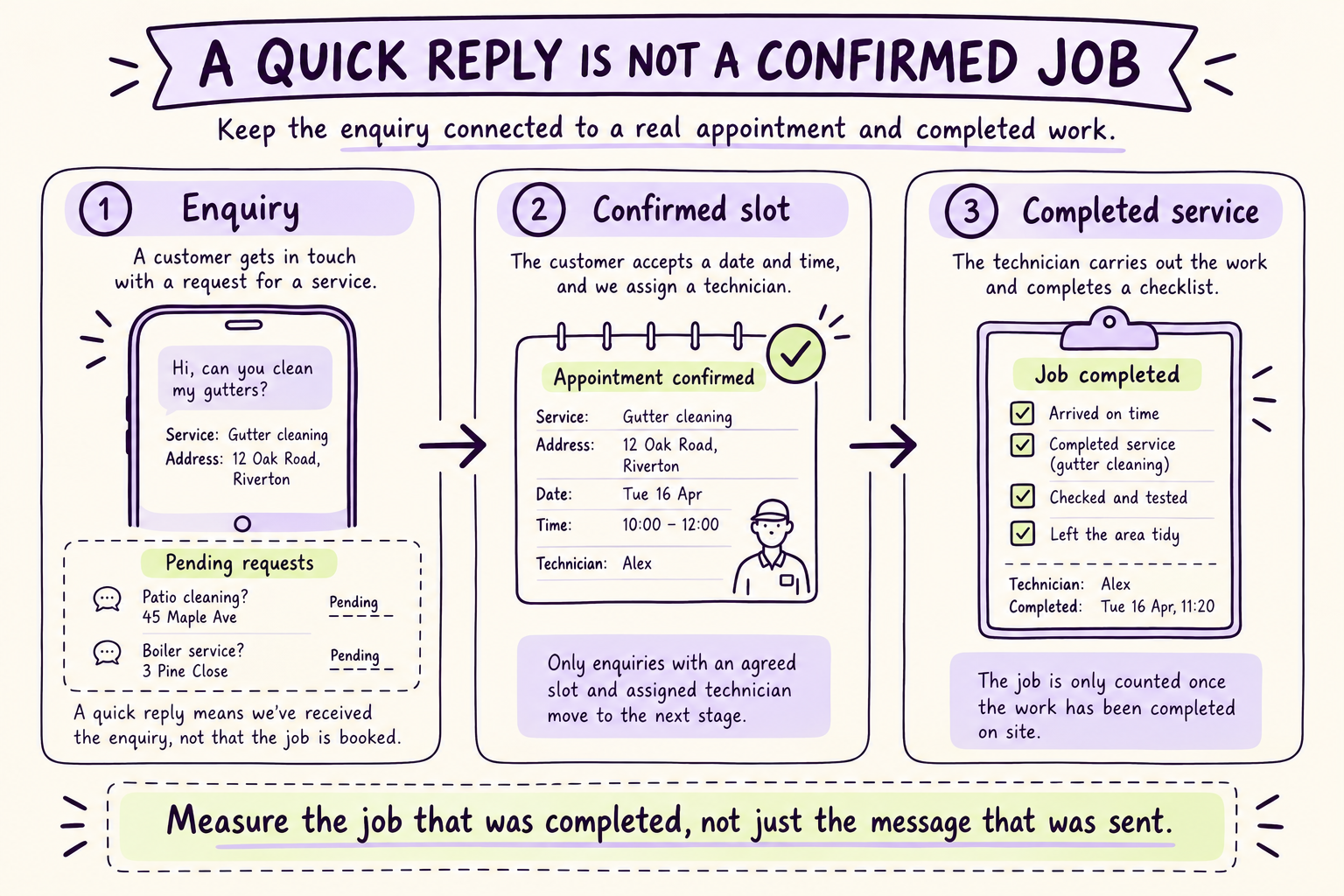
Read the visual explanation
Clarify what service the customer needs and where.
Confirm a real slot and the person responsible for attending.
Record completed work or an honest resolution of the customer's request.
Illustrative teaching example. The steps above are repeated in readable text below; depicted records are not customer results.
Start with the customer’s request
Capture the requested product or service, location if relevant, timing, contact preference and source. Use only information appropriate to the business purpose. Avoid collecting extra fields simply because an AI system can summarize them.
For a service business, service area and availability may determine whether the enquiry is actionable. For a property sale, the next step may depend on the specific listing and viewing availability. For a distributor, account and product information may matter more than a generic lead score.
Keep follow-up relevant and permitted
Define which channels can be used, the purpose of each message and when follow-up stops. Honor opt-outs and changes in contact preference. Do not let a sequence continue simply because a reply was not recognized by the automation.
Use message history to avoid asking the same question repeatedly. If the request is ambiguous, obtain the missing information rather than inventing a likely answer. Route complaints, unusual commitments and policy-sensitive requests to the appropriate person.
Design the human exception path
An actionable handoff includes the customer’s request, known facts, missing information, attempts already made and the next decision needed. The human should not have to reconstruct the entire conversation to understand the blocker.
In a fictional service enquiry, the requested time may fall outside the available calendar while the customer describes an urgent need. The system can identify the mismatch. A specialist can coordinate a suitable next step within the business’s rules. It should not promise an appointment that the destination calendar has not confirmed.
Confirm the destination record
When an appointment is agreed, check the correct calendar event, attendee details, timezone and confirmation state. When a lead is qualified, confirm the relevant CRM record and associated account. Preserve the relationship between the original enquiry and the new record.
Microsoft’s Dynamics documentation distinguishes lead qualification from the resulting account, contact and opportunity records. Whatever CRM you use, map the actual record lifecycle rather than treating a label in a chat transcript as proof that the sales system changed.
Measure progression and quality
Report enquiry volume, response time, information completion, confirmed next steps, attendance and qualified opportunities separately. Include cancellations, duplicate bookings and records reopened for correction. Segment by source and request type where the sample is useful.
Looqus can build and run this follow-through around the organization’s systems, with specialists resolving agreed exceptions. Customer owners retain the decisions defined in scope. Start with a bounded channel and clear stage definitions so the business can see whether more enquiries are reaching a useful next step.
Lead-stage evidence worksheet
Use this starting worksheet to agree the process with the people who will operate it. Replace the examples with your own rules and owners.
| Stage | Required evidence | Do not confuse with |
|---|---|---|
| Enquiry received | Original enquiry and source captured. | A qualified buyer |
| Information complete | Required business-fit fields available. | A positive purchase decision |
| Next step proposed | Relevant action offered through a permitted channel. | A confirmed appointment |
| Booking confirmed | Correct event exists with the agreed details. | A calendar link click |
| Meeting attended | Attendance recorded by an appropriate source. | A confirmed booking |
| Opportunity progressed | CRM stage and supporting evidence updated. | A positive-sounding chat reply |
| Business outcome | Order, job or agreement confirmed in its system. | A generated proposal |
Sources and scope
This is Looqus’s practical design guidance. Worked scenarios are illustrative; they are not client results or guaranteed outcomes. The sources below provide the referenced platform or engineering context.
AI does the work.We own the outcome.
Move stalled enquiries toward an agreed next step, with follow-up that respects customer preferences and an owner who checks what actually happened.
- Agree the result
- Connect the work
- Own the follow-through