
AI transformation in distribution means connecting the work between a customer's requirement and a correctly fulfilled, commercially sound order. Start with one repeatable customer journey, connect the relevant product and account context, query current operational facts, and give a named owner responsibility for the exceptions. Automating order entry is useful, but the result still depends on pricing, supply, delivery and the customer's acceptance.
A distributor can answer enquiries faster while disappointing more buyers. A quick quote for the wrong pack size creates rework. A promised date based on unallocated stock creates a service failure. A large order won at an unexamined discount can leave little money after delivery. These problems cross departments, so the implementation needs a shared commercial outcome rather than a separate AI tool for every inbox.
Choose a customer journey that can be completed
Pick a defined segment: repeat replenishment for existing accounts, a standard product family for trade buyers, or service recovery on a small supplier group. The first scope should be large enough to reveal the real handoffs and small enough for the responsible people to inspect the result.
Write the finish line in customer terms. For repeat replenishment, it might be the correct approved items and quantities, a supportable promise, a reconciled delivery and any remaining balance explicitly resolved. A generated quote or recorded order is an intermediate state. Keeping those states separate prevents a high automation rate from concealing unfinished work.
Map the current journey using a few real cases, including one that went badly. Identify where staff reconstruct information, where decisions wait and which systems record completion. Do not assume the slowest activity is the largest loss. Ten minutes of item research can prevent a costly wrong delivery; a one-minute unverified price override can destroy the order's contribution.
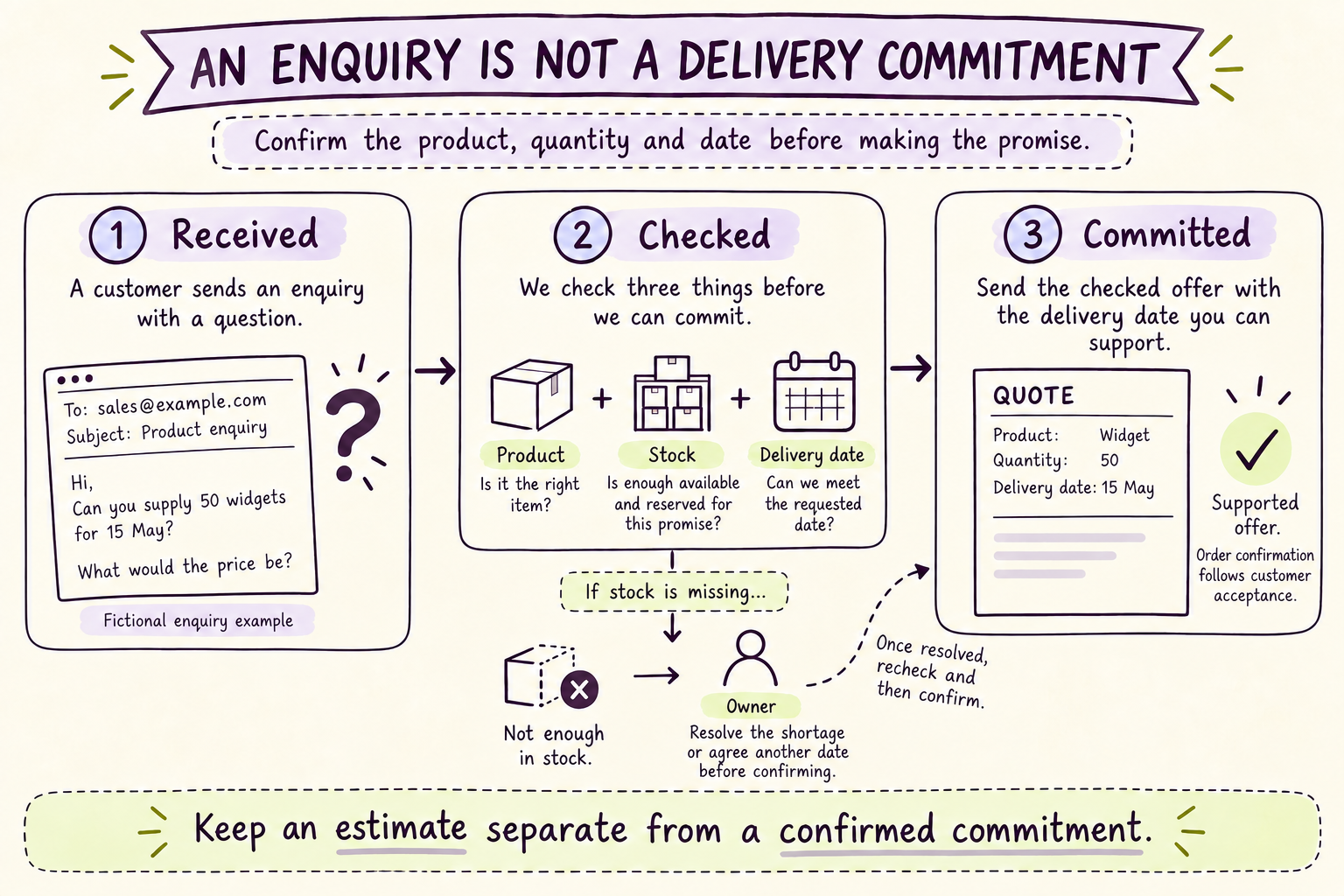
Read the visual explanation
Record the enquiry without turning it into a delivery commitment.
Check the product, available stock, capacity and delivery terms.
Keep the supported quote and the customer's accepted order as distinct states.
Illustrative teaching example. The steps above are repeated in readable text below; depicted records are not customer results.
Put the commercial constraint ahead of the technology list
| Business constraint | Useful first AI-supported work | Evidence of a finished result |
|---|---|---|
| Sales staff repeatedly research routine requirements | Prepare a product/account evidence pack | Correct proposal accepted into the order process |
| Buyers chase uncertain availability | Gather current supply evidence and prepare choices | Agreed line action and next promise recorded |
| Frequent quote revisions delay purchase | Compare requested changes and current terms | Approved revision reaches the correct buyer |
| Orders lose margin after fulfillment | Reconcile pricing, delivery and adjustments | Contribution reviewed on a consistent cost basis |
| Accounts receive inconsistent service across branches | Retrieve scoped account decisions and open issues | New owner completes the promised action |
This is a prioritization tool, not a claim that every row should be automated. Compare frequency, consequences, data accessibility and the authority required. A task with high volume but unreliable source records may need master-data repair first. A rare exception may be worth supporting manually if its commercial consequence is large.
Agree what contribution includes with finance. Product cost, freight, rebates, returns and payment terms can affect the comparison. Do not mix quoted margin with realized contribution or count all invoice revenue as value created by AI.
Requirement and evidence
Keep the original instruction with its source, account scope and freshness.
Authorized decision
Record what was approved, by whom and for which case.
Verified action
Attach the destination record and confirm the requested work is complete.
Conceptual guide by Looqus Editorial. Read the surrounding analysis for assumptions, exceptions and primary sources.
Build shared context without creating another stock ledger
The shared business brain should hold approved product explanations, customer-specific terminology, sales policies, decision history and evidence references. Its purpose is to avoid reconstructing context every time a new employee or AI session begins. The companion distribution second-brain guide explains that knowledge layer in detail.
Product identity needs care before any generation. GS1 defines GTINs for identifying trade items; those identifiers do not by themselves establish a negotiated price or permission to substitute. Where your catalogue uses them, retain the relevant packaging level and relationship to internal items. GS1 GTIN guidance.
Current stock, allocation, customer-specific price, credit status and order state should come from their authoritative systems when the decision needs them. A supplier sheet indexed last month may explain a product, but it is weak evidence of today's availability. Record when each operational fact was checked and what should happen if the lookup fails.
Connect four records around one case
A practical implementation can begin with four linked records: the customer requirement, the supporting evidence, the authorized decision and the resulting action. They can live in existing systems where those systems support the necessary links. The important design choice is a stable case identity across the handoffs.
The requirement retains the original message and its customer, branch and item references. The evidence identifies the current catalogue, account terms and supply response. The decision records the approved proposal or exception. The action stores the destination record and verification result. Staff should be able to move from a disputed delivery back to the instruction and decision that produced it.
GS1's GDSN describes synchronized product information exchanged through interoperable data pools. It is a useful example of structured product-data sharing, not a requirement to buy a particular network or proof that your price and inventory are synchronized. GS1 GDSN explanation.
Avoid copying every source into a new database before proving the journey. Start with the minimum facts and links needed to complete the case. Expand only when a real decision requires additional context.
Give language work and business calculations different jobs
AI can extract a requirement, compare versions, find candidate items, organize supplier responses and draft a clear explanation. Deterministic rules should handle arithmetic, unit conversions and explicit commercial limits. The ERP or other designated system should remain authoritative for the transaction it owns.
A model should not improvise a customer price from a familiar order or infer that two technically similar products are interchangeable. If required evidence is missing, it should create a visible exception with the relevant source and question. The specialist then obtains the answer, coordinates the authorized decision and verifies the resulting record.
Availability has similar boundaries. Microsoft's order-promising documentation distinguishes methods based on inventory and capacity assumptions. The implementation must use the method and configuration that actually support your promise; a generic lead-time field cannot establish every delivery date. Microsoft order promising.
Fictional USD example. Monetary assumptions in this guide are illustrative US-dollar amounts, not quoted prices, measured results or exchange-rate conversions. The currency does not imply a US tax or legal setting.
Synthetic example · monthly capacity-value comparison
1,200 eligible cases. Proposed totals include exception work, maintenance and USD 3,500 monthly charges. Differences are USD 4,620 and USD 420; released capacity is not automatic cash saving.
A worked business case that includes the remaining work
Consider a synthetic distributor handling 1,200 eligible customer cases monthly. Today, each case takes an average of twelve minutes of coordination and checking: 240 hours. At an assumed loaded rate of USD 70 per hour, the monthly capacity value is USD 16,800. This is not automatically a cash expense that can be removed.
The proposed design leaves four minutes of review on every case: 80 hours. An additional 180 exceptions require eight extra minutes each: 24 hours. Source maintenance, monitoring and ownership consume another twenty hours. Total residual work is 124 hours, worth USD 8,680 at the same rate. Add USD 3,500 monthly system and operating charges for a recurring comparison of USD 12,180.
The modeled difference is USD 4,620 monthly. With USD 18,000 implementation cost, simple payback against that capacity-value difference is about 3.9 months. Cash payback could be different if staffing expenditure does not fall. Do not add expected sales growth to this figure without a separate comparison that supports it.
Now assume review takes seven minutes, rather than four. Review becomes 140 hours; with the same 24 exception hours and twenty maintenance hours, total work is 184 hours. At USD 70 plus USD 3,500 charges, recurring cost is USD 16,380. The difference falls to USD 420 and simple payback becomes about 42.9 months. The business case depends on usable completed work, not merely successful extraction.
Approved context
Product explanations and account rules support interpretation.
Current checks
Read stock, allocation, price and order state from their authoritative systems.
Authorized action
Draft, release or change only within the approved scope.
Conceptual guide by Looqus Editorial. Read the surrounding analysis for assumptions, exceptions and primary sources.
Define permission before adding an action button
| Action | Proposed initial authority | Evidence required before expanding |
|---|---|---|
| Retrieve approved product guidance | Read within the user's scope | Correct source and access tests |
| Prepare a quote or order draft | Draft only | Item, unit, price and account checks |
| Change a price or grant freight concession | Authorized commercial decision | Recorded approval and updated terms |
| Promise a delivery date | Approved rule or named owner | Current supply evidence and date definition |
| Release an order | Agreed release authority | Destination checks and recovery tests |
| Cancel or substitute a line | Explicit applicable approval | Buyer instruction and fulfillment state |
The boundaries should be enforced by the integration, not only written in a prompt. Separate read credentials from write permissions where practical. A user who can inspect an account's service history may not be allowed to view another account's negotiated terms.
Document-level permission filters are an established retrieval pattern; Microsoft's documentation distinguishes security filtering from native permission features with different implementation requirements. The particular mechanism must be tested against your sources and identity model. Microsoft document-level access control.
Prove failure handling before the first live release
Test a buyer resending the same request through two channels, a quantity revision arriving after draft approval, a stale stock response, an inaccessible customer price, and an ERP create request whose response times out. Check the destination record, not only the automation's success message.
A technical retry must not become another order. AWS describes using stable caller-provided identifiers to support idempotent operations. If the destination lacks that contract, the design needs reliable reconciliation and an owned ambiguous-state path; a local “sent” flag is insufficient proof of a single remote write. AWS on safe retries.
Also test the people boundary. If the account owner is absent, another authorized person must accept the case. If a supplier never answers, the customer update still needs an owner and a truthful next step. An exception queue that grows unnoticed is a failed service, even when every AI component is technically available.
Roll out by evidence, then extend the journey
Begin with historical cases and known outcomes. Check ordinary work and deliberately difficult examples. Then run in shadow mode on live incoming cases while the existing process remains responsible for action. Compare proposed items, commercial terms and next steps with the actual decisions.
Allow a narrow set of drafts next. Measure how often reviewers correct them and which fields drive correction. If the team is rewriting most outputs, improve the source or scope rather than quietly accepting the review burden. Release authority can expand only after the relevant action and recovery tests pass.
Track accepted case completion, end-to-end elapsed time, specialist minutes, open-exception age and downstream corrections. Break results out by account group and product family. A simple repeat account can conceal poor performance on the harder cases where the business expected the most help.
Once the first journey works, extend adjacent work using the same records: clearer product recommendations, better account follow-up or margin reconciliation. The existing guides on SKU matching, backorder communication and duplicate prevention provide detailed controls at those individual stages.
Put ownership into the operating model
The most useful first implementation may look modest: one account group, dependable evidence and fewer unresolved cases. A broad autonomous system is a poor starting point when product identity is unclear, the warehouse state is unreliable or commercial authority lives only in someone's memory. Repairing those foundations can be part of the work, but their cost belongs in the plan.
Looqus can help connect the customer requirement, business context and operational action, with specialists actively resolving missing evidence and verifying the agreed result. Your authorized team retains commercial decisions outside the agreed scope. AI does the work. We own the outcome.
Sources
- GS1: Global Trade Item Number.
- GS1: Global Data Synchronisation Network.
- Microsoft: order promising.
- Microsoft: document-level access control.
- AWS: safe retries with idempotent APIs.
AI does the work.We own the outcome.
Connect customer requests to purchasing and delivery decisions, with one accountable process for resolving the gaps between a quote and a promise you can keep.
- Agree the result
- Connect the work
- Own the follow-through