
AI transformation in manufacturing should connect a defined production or commercial decision to reliable evidence, qualified approval and verified execution. Start where missing context and repeated coordination delay useful work. A document assistant, a quality-inspection model and a machine-control system solve different problems and require different validation. Buying one should not be mistaken for implementing all three.
For a manufacturer, the opportunity may be less visible than a robot or an animated factory dashboard. Engineering changes wait for the right drawing. Planners discover a material restriction after promising a date. Quality records arrive without the context needed to investigate a recurring defect. AI can help assemble and compare evidence, but the improvement is real only when the responsible team can make and complete a better decision.
Locate the constraint in the actual production story
Follow one product family from enquiry through design, planning, purchasing, production, quality release and delivery. Identify where work stops, what information is missing and who can remove the blockage. Use actual timestamps and examples rather than asking every department for an AI wish list.
An engineering response delay may be starving a well-equipped line. A lack of operator availability may make a scheduling tool irrelevant. A recurring defect may need a process correction rather than a faster inspection summary. The starting problem should describe the constraint and consequence precisely enough to judge whether the proposed work changes it.
NIST's digital-thread programme examines the flow of design and manufacturing information into production and inspection. That is relevant context for connecting evidence across the product lifecycle; a chat interface by itself does not create that continuity. NIST Digital Thread for Smart Manufacturing.
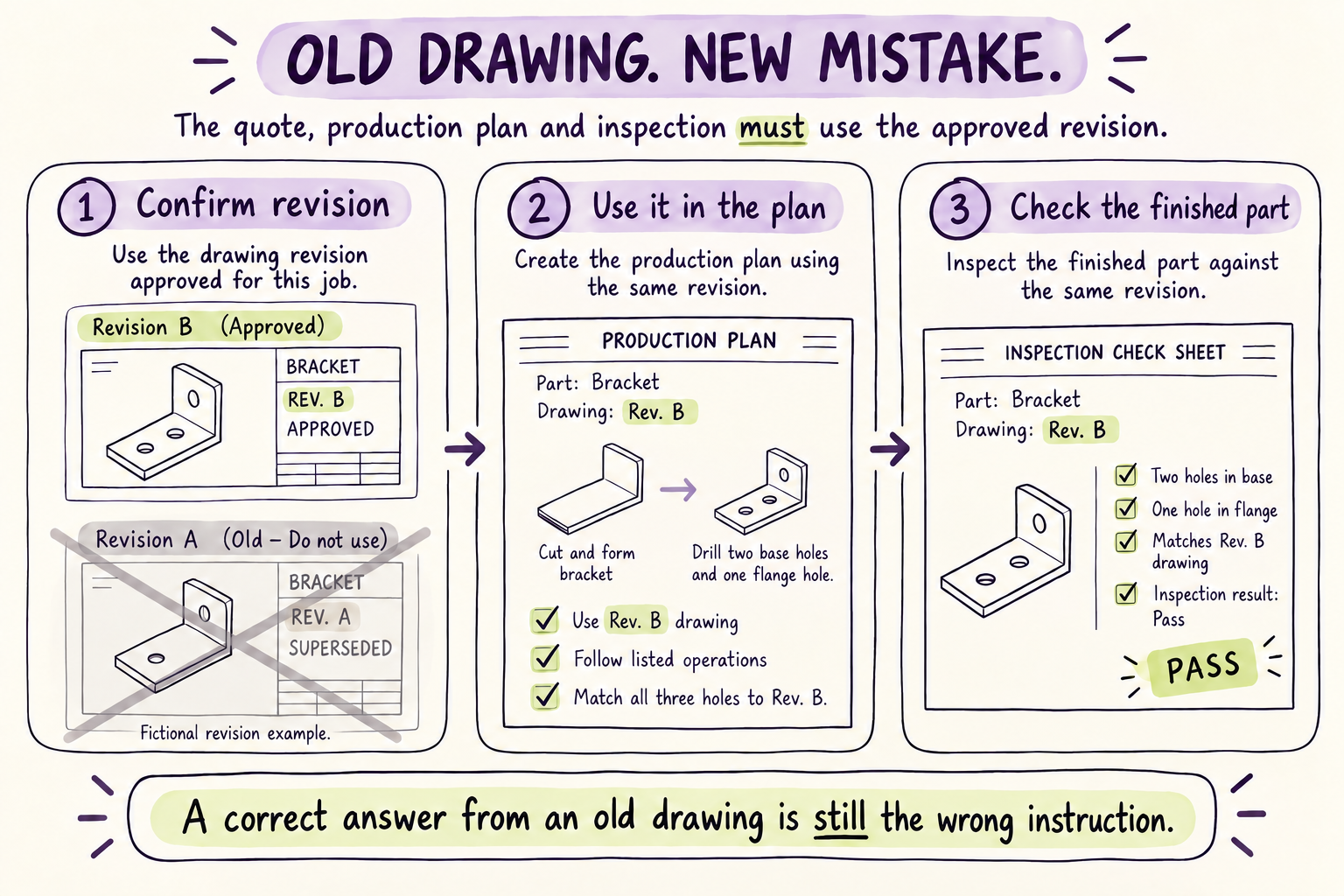
Read the visual explanation
Identify the current approved drawing and product revision.
Use the same revision in costing, instructions and production planning.
Inspect the finished part against that approved requirement.
Illustrative teaching example. The steps above are repeated in readable text below; depicted records are not customer results.
Choose the kind of AI work before choosing the model
| Work type | What AI may contribute | What the implementation must prove |
|---|---|---|
| Document and decision support | Retrieve requirements, compare revisions, prepare evidence | Correct scope, source and qualified review |
| Forecasting and prioritization | Estimate demand or identify likely exceptions | Representative data and measured error consequences |
| Visual inspection assistance | Identify patterns in images | Product-specific validation and handling of misses |
| Maintenance support | Organize history or analyze relevant signals | Asset context, useful intervention and operational integration |
| Physical process control | Influence equipment behavior | Appropriate engineering, safety and control-system validation |
These are different implementation classes. A manufacturer can start with valuable document and coordination work while leaving equipment control unchanged. That choice does not imply the other classes are unimportant; it puts the first investment where evidence and authority can be established.
For operational technology, performance, reliability and safety requirements shape the design. NIST's OT security guide addresses those distinctive constraints. A general-purpose AI workflow should not be given a route into machine control simply because both systems expose an API. NIST SP 800-82 Rev. 3.
Decision assistance
Document and planning support require source, revision and acceptance checks.
Prediction and inspection
Forecasts and defect detection need representative testing and error analysis.
Physical control
Equipment actions require a separate engineering and operational safety process.
Conceptual guide by Looqus Editorial. Read the surrounding analysis for assumptions, exceptions and primary sources.
Build one versioned work package around the decision
Consider an engineering change affecting a recurring assembly. The useful AI-supported output is a reviewable package: the proposed change, applicable drawing revision, affected BOM and route, open orders, supplier implications, current quality evidence and the decisions required. It is not a confident summary of whichever file was easiest to find.
Record product identity, revision, site and effective scope. Link the original change request and every source used. Preserve the difference between proposed, approved and released states. If a customer authorizes a change for future production only, the package must not silently apply it to work in progress.
Microsoft's engineering-change documentation describes managing changes through requests and orders with responsibilities and product-version consequences. Its specific product behavior must be checked in the installed system; the general implementation lesson is to preserve change identity and ownership. Microsoft engineering change management.
The manufacturing second-brain guide covers how to retain the rationale and lessons behind these decisions without confusing historical knowledge with current release authority.
Decide which facts must be current
A work instruction may remain valid until its controlled revision changes. Capacity, material availability, open-order quantities and inspection status can change during the day. The implementation should fetch those operational facts when the decision requires them and show the time and source of the check.
Planning evidence also needs the right scope. Available hours across the factory do not establish capacity at a constrained process in the required week. Microsoft's finite-capacity documentation explains that resource limitations can push scheduled work out. That supports checking the relevant bottleneck rather than presenting a generic availability score. Microsoft finite capacity planning.
Cost evidence belongs to a scenario too. The same component at another quantity or site may have a different cost basis. BOM calculations can explicitly depend on version, quantity, date and site; preserve those inputs when a proposed change affects the quote. Microsoft BOM calculations.
If a required lookup fails, separate the work that can continue from the decision that must wait. The system can prepare a revision comparison while holding a delivery commitment that lacks current capacity evidence.
Put technical acceptance and operational ownership in different seats
The qualified engineer or quality owner decides whether the proposed technical condition is acceptable. The operating specialist makes sure missing evidence is obtained, decisions reach the right person and the approved action is reflected in the relevant system. Those roles support each other; neither is a substitute for the other.
For an engineering change, the specialist might obtain a supplier response, reconcile the affected order list, arrange the review and verify that the released revision is visible where work is prepared. They should not approve a tolerance, material substitution or process deviation outside their authority.
Define the receiving team's acceptance. A planner needs a usable schedule input, not merely an attached report. Purchasing needs the approved specification and commercial instruction. Production needs the correct released documentation. Completion should be recorded at the receiving point, where a wrong or missing handoff would otherwise become a factory problem.
Fictional USD example. Monetary assumptions in this guide are illustrative US-dollar amounts, not quoted prices, measured results or exchange-rate conversions. The currency does not imply a US tax or legal setting.
Synthetic example · evidence-pack preparation only
80 packages, qualified review and exception work included. No downtime, defect or payroll saving is assumed. USD 14,000 setup gives about 12.1 months simple payback against this capacity-value comparison.
Work through an implementation case without inventing downtime savings
Take a synthetic manufacturer processing eighty change or production-readiness packages monthly. Staff currently spend fifty minutes per package collecting and reconciling evidence: 66.67 hours. At an assumed loaded rate of USD 120 per hour, the baseline capacity value is USD 8,000.
In the proposed design, each package requires twenty minutes of review, or 26.67 hours. Sixteen exceptions need twenty additional minutes each, adding 5.33 hours. Maintaining the sources and checking the process adds ten hours. Total residual work is forty-two hours, valued at USD 5,040. Add USD 1,800 in monthly system and operating charges: USD 6,840 total.
The modeled capacity-value difference is USD 1,160 monthly. If setup costs USD 14,000, simple payback is about 12.1 months on that comparison alone. There is no assumed reduction in headcount, downtime or defects. Those outcomes need their own observed evidence.
In a second fictional scenario, assume two rework events are prevented monthly, each with USD 900 of incremental material and external-processing cost. A real pilot would need event-level evidence to support that benefit. That would add USD 1,800 of avoided cost, making the combined modeled difference USD 2,960 and simple payback about 4.7 months. But the rework benefit must not include the same staff time already counted above, and the causal link needs investigation. Until that evidence exists, use the narrower USD 1,160 case.
This approach makes a modest business case inspectable. It is more useful than estimating the value of every minute the line might theoretically have lost and calling all of it recovered production.
Applicable definition
Identify the product, revision, site and supporting source evidence.
Qualified decision
Technical owners approve the change within its intended scope.
Receiving acceptance
Planning, purchasing and production confirm receipt and required action.
Conceptual guide by Looqus Editorial. Read the surrounding analysis for assumptions, exceptions and primary sources.
Write failure tests in the language of the plant
| Test condition | Expected behavior | Responsible closure |
|---|---|---|
| Old drawing ranks above the released revision | Current applicability is checked; conflict is exposed | Document-control owner resolves source state |
| Same part number has site-specific routes | The correct site is retained | Planning or engineering verifies scope |
| Supplier response changes material availability | Affected commitment is reviewed | Purchasing obtains a current decision |
| Inspection data is incomplete | Quality conclusion remains bounded | Qualified quality owner decides next step |
| Approval arrives after package generation | Package is refreshed before release | Specialist verifies the approved version |
| Destination update has an unknown result | No blind repeat that changes production twice | Integration owner reconciles state |
| Unqualified user requests a process change | Read and action permissions remain enforced | Authorized owner receives the request |
Include a document containing an instruction that conflicts with the workflow's rules. Source documents provide evidence, not authority to change permissions. Include unreadable pages, decimal and unit ambiguity, missing attachments and a supplier document whose title resembles the correct part but whose revision differs.
NIST's Generative AI Profile discusses confabulation and information-integrity risks. Its practical relevance here is that a plausible answer is not a verified manufacturing instruction. Evaluation needs representative failure cases and continuing oversight. NIST Generative AI Profile.
Introduce the system through the team's working rhythm
Start with completed historical packages whose final decisions are known. Have the responsible disciplines inspect what the proposed system retrieves, omits and confuses. Record the correction effort instead of treating reviewers as a free resource.
Move to live shadow work next, with existing approval and release processes intact. Attend the actual production or engineering review where the output will be used. If the package arrives after the decision, uses unfamiliar identifiers or requires another spreadsheet to become useful, fix that interface before expanding.
Allow bounded preparation and administrative updates only after their permissions and recovery behavior are tested. Changes to technical acceptance or physical control need their own authorization and validation. A successful read-only pilot does not justify escalating every action at once.
Give each unresolved package a due date, named owner and next step. At shift or staff changes, verify the handoff. The system should make the absence of an answer visible early enough for someone to act, rather than simply recording that an automated task ran.
Measure the decision and the downstream consequence
Useful measures include package acceptance without material correction, elapsed time to a qualified decision, specialist effort, open-exception age and downstream work using the wrong revision. Keep the definitions stable and segment by product family or change type.
For throughput claims, check whether the relevant bottleneck actually produced more useful output. For downtime claims, distinguish unplanned stops from scheduled maintenance and show whether the intervention changed the result. For quality claims, specify the inspected population and the consequences of false negatives. The appropriate measure follows the work type selected earlier.
Review the whole cost: preparation, review, exception handling, source maintenance, integration support and the price of the system. If a programme only moves effort from engineering to an unseen operations team, it may still help capacity allocation, but it has not removed that effort from the business.
Expand where the evidence connects
This is a poor first automation project when source revisions are uncontrolled, qualified decision owners are unavailable or recurring evidence work is too limited to justify maintenance. Resolve those constraints before expanding authority.
Once one decision package works, adjacent use cases can reuse the same product identity, source controls and ownership. A change-management implementation may improve quotation readiness and supplier clarification. A maintenance-history assistant may support troubleshooting preparation. Expansion should follow demonstrated relationships rather than a generic list of AI use cases.
The detailed guides on RFQ bid decisions, BOM quotation costing and supplier qualification explore those narrower decisions. This implementation pillar supplies the connection between them.
Sources
- NIST: Digital Thread for Smart Manufacturing.
- NIST: Guide to Operational Technology Security.
- Microsoft: engineering change management.
- Microsoft: finite capacity planning.
- Microsoft: BOM calculations.
- NIST: Generative AI Profile.
AI does the work.We own the outcome.
Choose a factory problem AI can meaningfully help solve, then define the information, operating limits and specialist responsibility needed to complete the work.
- Agree the result
- Connect the work
- Own the follow-through