
AI transformation in retail starts by choosing a store outcome, connecting the records needed to deliver it, and giving staff and specialists clear responsibility for completing the work. A useful first outcome might be fewer failed collection promises: the correct item is located, reserved through an authorised process, prepared and handed to the customer. The AI helps interpret requests and coordinate the evidence. The store still needs a verified physical result.
For a multi-store retailer, the challenge is the relationship between the sales floor, stockroom, website and central office. An item can appear available online while sitting in a damaged-goods cage. An associate can promise a collection before the transfer arrives. A customer can repeat their question because the next shift cannot see what was agreed.
This guide explains how to connect those activities without replacing every system at once. It concentrates on physical retail and omnichannel service, including assisted selling, collection and cross-store exceptions. Advertising production and ecommerce acquisition have different implementation priorities, covered in the ecommerce AI transformation guide.
Choose a customer promise you can observe
Start with an event that happens often enough to inspect: an unavailable size, a collection order, a product question or a return needing a manager decision. Define what should happen next and what proves completion. “Improve the store experience” is an ambition. “Correctly resolve a customer's request for an unavailable variant” is a job the team can evaluate.
For an unavailable size, the complete result might be a verified alternative location, an authorised reservation and a confirmed collection instruction. Sometimes the correct result is that the product cannot be supplied. The system should communicate that honestly rather than keep an impossible sale open.
Select the first use case using three questions. Is the failure costly or frustrating? Are the necessary sources reasonably reliable? Can a named person resolve the exceptions? A project with an impressive potential saving but no inventory owner is usually less ready than a smaller, observable service problem.
| Store problem | First AI-assisted job | Evidence of completion |
|---|---|---|
| Staff cannot answer a product question | Retrieve the correct specification and approved explanation | Associate receives a supported answer for the exact variant |
| Requested item is absent from the branch | Check alternatives and coordinate the chosen fulfilment route | Customer receives a verified, feasible option |
| Collection promise fails | Reconcile order, stock and preparation status | Correct item is ready before a ready notification |
| Return falls outside routine rules | Assemble the applicable policy and transaction evidence | Authorised manager decision is recorded and communicated |
| Shift handoff loses a customer request | Preserve the promise, owner and due time | Next shift accepts and completes the outstanding action |
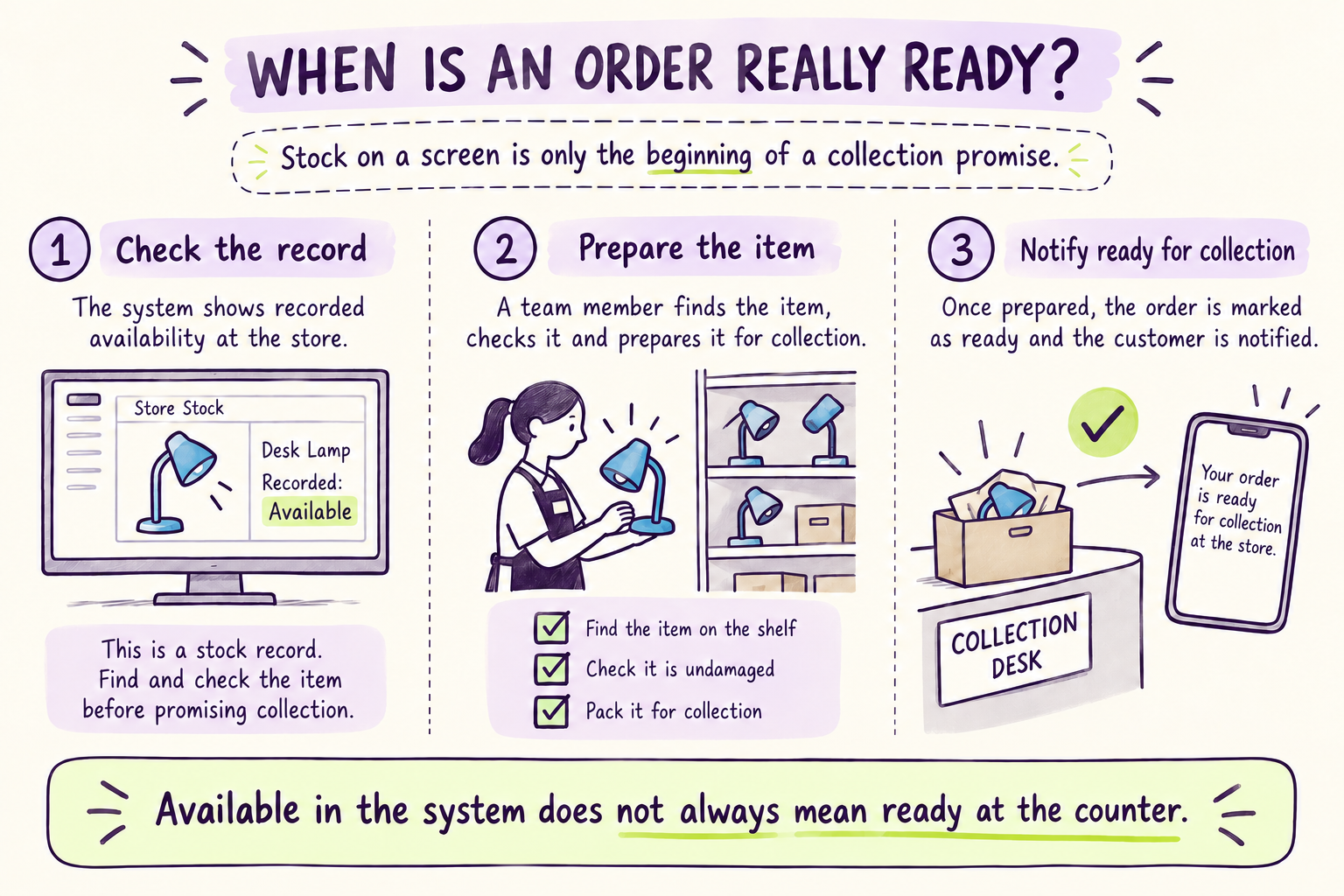
Read the visual explanation
Treat the stock screen as a record of availability that may need checking.
Find the correct item, inspect it and prepare it for collection.
Tell the customer it is ready after preparation is confirmed.
Illustrative teaching example. The steps above are repeated in readable text below; depicted records are not customer results.
Map the systems around the store's actual work
Follow one real case through the point-of-sale system, inventory records, product catalogue, order system and customer communication. Record which identifier connects each step. A product name that staff recognise is not always enough to distinguish size, finish, pack or model revision.
Do not assume the newest system owns every fact. The product information system may own specifications, the POS may hold recent local transactions, the order system may own reservations and central operations may own collection policy. Choose an authoritative source per field and identify how changes propagate.
For example, Microsoft documents a POS inventory calculation that accounts for local transactions not yet synchronised to headquarters. Its documentation also describes limits: other locations can remain dependent on the last available snapshot. A live-looking screen is therefore not proof that every location has equally fresh information. Microsoft: POS inventory lookup and channel-side calculation.
Keep your existing POS and inventory system as the transaction authorities unless there is a separate reason to replace them. The first implementation can connect a narrow read path and a controlled work queue. Rebuilding checkout to answer product questions creates unnecessary scope and makes it harder to identify what improved.
Identify
Select the exact variant and requested store.
Verify
Check stock state, freshness and the route needed.
Complete
Authorised staff prepare the item before confirming readiness.
Conceptual guide by Looqus Editorial. Read the surrounding analysis for assumptions, exceptions and primary sources.
Separate store knowledge from live commercial facts
Approved product explanations, care instructions and operating policies belong in a shared retail knowledge layer. Current stock, reservation status and payable price usually require a lookup at the moment they matter. An old training document can explain how collection works; it cannot prove that a particular item is ready today.
An AI second brain for retail makes these distinctions usable for associates. Each answer should identify the product, relevant store, applicable policy and any missing evidence. It should show when a commercial fact was checked without burying the associate in technical logs.
Treat physical inventory states carefully. Shopify distinguishes available stock from committed, unavailable and incoming quantities. Those categories answer different questions; adding them together and calling the result “in stock” can produce an incorrect customer promise. Shopify: Understanding inventory states.
For a last-unit promise, require the business's chosen verification step. That could be a physical check followed by a reservation. The appropriate rule depends on count accuracy, item value and how quickly the product sells. An AI answer should not replace a reservation merely by using confident language.
Design the handoff between online and store fulfilment
An online order for collection creates work inside the store. Someone must find the item, inspect it, put it in the collection area and ensure the customer's instructions match the actual state. AI can identify missing steps and organise the queue, but readiness needs evidence from the team doing the preparation.
The collection route also affects timing. Shopify's pickup documentation distinguishes inventory already at the collection location from orders requiring store transfers and allows different processing times for the latter. This is a useful example of why one blanket promise can be misleading across fulfilment routes. Shopify: Setting up pickup in store.
Define what happens when only part of an order is available, the customer changes branch or the transfer arrives damaged. Do not silently split an order or substitute a product unless the customer and the business's rules permit it. Put the decision in the order record so another shift can understand the arrangement.
Where stock movement is the main problem, use the more detailed retail stock-transfer guide. The transformation project should connect the movement to the customer promise, rather than duplicate every allocation rule inside a new assistant.
Give store roles appropriate authority
An associate who can answer a returns-policy question may not be authorised to refund an exception. A stockroom employee who receives goods may not be authorised to change their selling price. Preserve these distinctions when AI can prepare or initiate work.
Use roles tied to the actual staff identity and location. Shared devices need a reliable sign-in and handoff process, especially when a manager temporarily approves an action. A conversation started under one person's permissions should not remain available to the next user merely because the screen is still open.
Shopify's POS permission model illustrates distinct controls for discounts, returns, transfers and fulfilment, including manager approval for selected actions. The practical design principle is to retain the source system's authority boundaries rather than giving every action the permissions of one powerful integration account. Shopify: Point of Sale permissions.
AI can prepare the evidence for approval. Specialists should resolve an unclear policy, coordinate a stock check or obtain an authorised decision. They are responsible for getting the exception to a finish, not simply forwarding the same request among departments.
Fictional USD example. Monetary assumptions in this guide are illustrative US-dollar amounts, not quoted prices, measured results or exchange-rate conversions. The currency does not imply a US tax or legal setting.
Synthetic monthly capacity-value comparison for 600 stock and collection exceptions across three stores.
Assumes USD 60 per staff hour, eight baseline minutes per case, three proposed minutes plus five additional minutes on 20% of cases, and USD 1,400 fixed monthly system cost. Released capacity is not automatically cash saved.
Calculate a business case that respects store capacity
Consider a synthetic three-store pilot handling 600 stock and collection exceptions per month. Under the current process, each takes an average of eight staff minutes. That is 80 hours. At an assumed loaded cost of USD 60 per hour, the baseline consumes USD 4,800 of staff capacity.
Suppose a connected process reduces ordinary handling to three minutes per case. Twenty percent of cases need an additional five minutes of specialist coordination. The total is 30 ordinary hours plus ten exception hours: 40 hours and USD 2,400 of labour capacity. Assume another USD 1,400 monthly for the system and its continuing maintenance.
| Monthly component | Calculation | Synthetic amount |
|---|---|---|
| Current handling | 600 × 8 minutes ÷ 60 × USD 60 | USD 4,800 |
| Proposed ordinary handling | 600 × 3 minutes ÷ 60 × USD 60 | USD 1,800 |
| Additional exception handling | 120 × 5 minutes ÷ 60 × USD 60 | USD 600 |
| System and maintenance | Assumed recurring allocation | USD 1,400 |
| Proposed total | 1,800 + 600 + 1,400 | USD 3,800 |
| Monthly capacity-value difference | 4,800 − 3,800 | USD 1,000 |
At an illustrative USD 9,000 setup cost, simple recovery from that difference takes nine months. This is not a Looqus price or a forecast. Salaried staff may remain on payroll, so released time is not automatically cash saved. Explain whether it reduces overtime, avoids a genuine hiring requirement or frees staff for customers.
At half the volume, baseline capacity cost becomes USD 2,400. Proposed labour becomes USD 1,200 while system cost remains USD 1,400, producing a negative USD 200 difference. Volume matters. Do not add hypothetical recovered sales to rescue the case without evidence that those purchases are additional and can be fulfilled.
600 cases monthly
USD 4,800 baseline versus USD 3,800 proposed cost.
300 cases monthly
USD 2,400 baseline versus USD 2,600 proposed cost.
Read the difference
Synthetic capacity value: USD 1,000 versus negative USD 200. Fixed costs still need to be covered.
Conceptual guide by Looqus Editorial. Read the surrounding analysis for assumptions, exceptions and primary sources.
Build a pilot that includes the awkward store conditions
Run representative cases from busy and quiet periods, several staff roles and the product variants that cause confusion. Include a last unit, a stale stock result, a damaged item, a split collection and a customer returning after the original associate's shift ends.
Use a separate challenge set for rare but consequential failures. Its deliberately difficult mix should not be presented as the normal error rate. The purpose is to reveal whether the process knows when it cannot make a promise and can route the exception to someone able to resolve it.
| Pilot gate | Pass condition | When to stop or restrict |
|---|---|---|
| Product identity | Correct sellable variant selected | Ambiguous item treated as confirmed |
| Availability | Source state and freshness are visible | Stale quantity becomes an unconditional promise |
| Authority | Action respects staff and store permissions | Unauthorised refund, discount or reservation |
| Handoff | Outstanding work has a current owner | Case disappears between shifts |
| Recovery | Failed actions can be reconciled before retry | Retry risks a duplicate reservation or message |
| Store usability | Staff can complete the task during normal work | Interaction adds more delay than it removes |
Agree hard gates before looking at results. Zero critical failures in a pilot is useful evidence, but it cannot prove the future failure rate is zero. Continue monitoring after release and repeat relevant tests when rules, systems or permissions change.
Introduce AI without disrupting a trading day
Begin with historical replay and read-only support. Compare suggested answers with the existing process, correct the source mappings and observe what associates actually need on screen. Add live lookup before adding transaction writes. That sequence makes defects easier to isolate.
Move to one store and one job with a visible fallback. Schedule training around shift patterns, including part-time staff who may miss a central session. Keep instructions short enough to use at the counter. A missed prompt should not leave a customer request without an owner.
Test degraded connectivity deliberately. A cached product-care answer and a payment or reservation action have different consequences. Shopify documents specific offline-payment behaviour, including pending payment states; availability and financial completion should never be inferred from a generic “offline supported” claim. Shopify: Offline POS payments.
Expand to a second store only after confirming that its assortment, permissions, devices and stock practices match the tested assumptions. A flagship store staffed by experienced managers is not automatically representative of every branch.
Make daily ownership visible
Assign one retail operations owner to the overall result and specific owners to product facts, stock accuracy, policy changes and integrations. A central specialist can clear cross-store questions and evidence gaps while associates stay with customers. Each recurring failure should lead to a source or process correction, not an ever-growing manual workaround.
Review unresolved cases, time to completion and incorrect promises alongside handling time. Measure the customer outcome across channels. An online sale lost from one attribution report and recovered in a branch may be a successful customer journey; it should not become a dispute between channel teams.
AI transformation is a poor first move when basic stock counts are unreliable, policies contradict one another and nobody can authorise a correction. Fix the highest-impact source problems first. A single store with few complex requests may need a better product reference and clearer handoff rather than a large AI programme.
Sources
- Microsoft: POS inventory lookup with channel-side calculation
- Shopify: Understanding inventory states
- Shopify: Setting up pickup in store
- Shopify: Point of Sale permissions
- Shopify: Offline POS payments
Primary documentation checked 15 September 2026. Platform examples support specific operating distinctions, not product recommendations. The implementation framework and economics are original illustrative analysis.
AI does the work.We own the outcome.
Bring store stock and collection commitments into one accountable process, with staff checks and clear ownership when the records and physical shelf disagree.
- Agree the result
- Connect the work
- Own the follow-through