
Good backorder communication tells the buyer which lines are affected, what is known about availability, which choices they can make and when the next update will arrive. It separates a supplier estimate from a distributor commitment. AI can assemble evidence and draft updates; an accountable owner must resolve uncertainty, obtain approvals and verify the promised action happened.
The commercial problem is rarely a shortage notification alone. It is the succession of unowned promises after that notification: a date copied from an old email, a proposed substitute mistaken for an accepted one, or a split shipment that quietly doubles freight. This guide proposes controls for that narrower problem. A synthetic worked example makes the cost of a split delivery explicit.
Separate receipt, acceptance and a delivery commitment
A received purchase order is not necessarily an accepted order, and an accepted order is not necessarily a confirmed dispatch date. These distinctions have a practical standards foundation: GS1's purchase order response message can acknowledge receipt, accept an order, propose amendments or notify non-acceptance. GS1 ORDRSP specification.
A backorder process should preserve these states at line level. If eight lines are available and two are uncertain, “your order is confirmed” is too broad unless the response clearly explains the exceptions. The customer's production planner needs to know what can actually be relied upon.
Before automating customer updates, define the words the team will use. “Expected inbound” means something different from “allocated to your order.” “Ready to dispatch” requires a different event from “supplier has shipped.” A polished message can increase misunderstanding when the underlying vocabulary is loose.
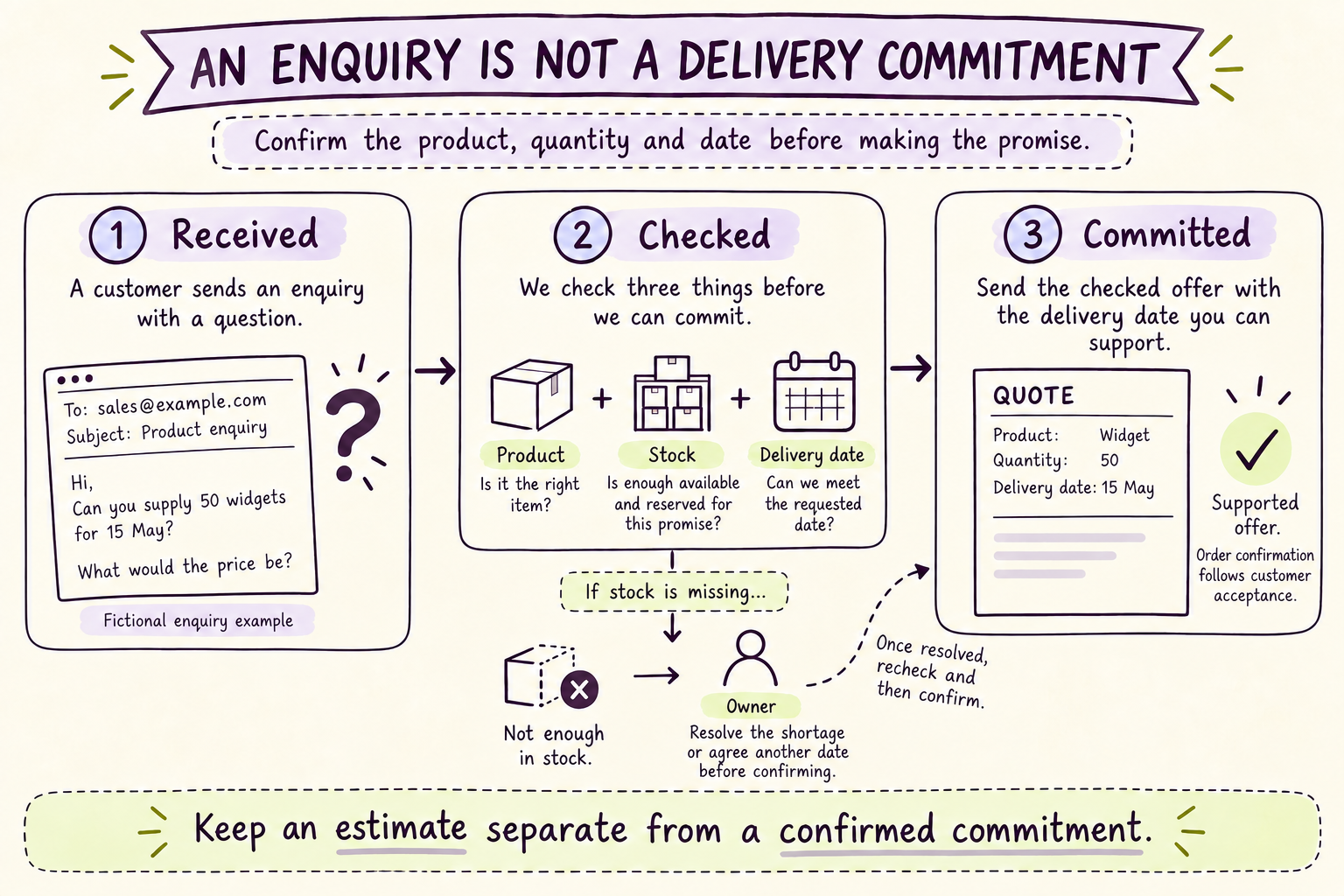
Read the visual explanation
Record the enquiry without turning it into a delivery commitment.
Check the product, available stock, capacity and delivery terms.
Keep the supported quote and the customer's accepted order as distinct states.
Illustrative teaching example. The steps above are repeated in readable text below; depicted records are not customer results.
Create an evidence record for each affected line
The proposed record below keeps the facts needed to make a commercial decision. It should remain linked to the original order and the latest buyer instruction, rather than becoming an isolated spreadsheet with another version of the truth.
| Record field | Why it matters | Example of unacceptable evidence |
|---|---|---|
| Original promised date | Makes changes visible | Replacing it with the latest date |
| Unfulfilled quantity and unit | Prevents a partial balance becoming a full reorder | Header-level total only |
| Current stock and allocation | Distinguishes inventory from usable supply | A stock figure without other commitments |
| Supplier estimate and timestamp | Shows freshness and source | “Usually next week” |
| Next internal decision | Gives the owner a concrete action | “Monitor” with no deadline |
| Buyer choice and approval | Supports split, wait, cancel or substitute | An internal sales preference |
| Next customer update time | Makes uncertainty manageable | “We will keep you posted” |
Capture evidence timestamps separately from message timestamps. A message sent at 10:00 may repeat a supplier estimate from three days earlier. Readers should not infer that a freshly written sentence contains newly verified information.
Received
The purchase order arrived and was recorded.
Accepted
The agreed order or line has been accepted.
Committed
The delivery promise is supported by supply evidence.
Conceptual guide by Looqus Editorial. Read the surrounding analysis for assumptions, exceptions and primary sources.
Build dates from the actual supply position
Available-to-promise and capable-to-promise methods are not interchangeable with a generic lead-time field. Microsoft documents distinct order-promising methods, including inventory-based and capacity-aware calculations. Their behavior depends on the product configuration and planning setup. Microsoft order promising.
For a distributor, a usable date may depend on supplier dispatch, inbound transport, receiving, inspection, allocation and outbound delivery. A supplier's arrival estimate does not account for all these steps. If inspection is required, communicate availability after the relevant release step rather than pretending arrival means shippable stock.
Record date confidence as evidence categories, not invented percentages: confirmed carrier event, supplier-confirmed dispatch, supplier estimate, or historical planning assumption. The category tells the specialist what still needs verification. If the evidence deteriorates, the next action is to resolve it and update the customer appropriately, not merely rephrase the old promise more confidently.
For orders dependent on manufactured replenishment, capacity constraints may push dates out; finite scheduling explicitly considers resource limitations in Microsoft's documented model. That illustrates why a lead-time average is not a substitute for a current plan. Microsoft finite capacity planning.
Offer choices with their commercial consequences
| Buyer option | When it may help | Decision that must be explicit |
|---|---|---|
| Wait for complete order | Items are needed together | Revised date and whether original terms remain |
| Ship available lines | Some goods create immediate value | Additional freight and remaining balance |
| Approve a substitute | An acceptable alternative exists | Specification, price and authorization |
| Reduce quantity | Buyer can cover the shortfall elsewhere | Revised commitment and cancellation of balance |
| Cancel affected lines | Delay destroys the requirement | Correct closure without cancelling good lines |
Do not imply all choices are always available. A made-to-order item may carry different commercial commitments from a stocked consumable. The applicable agreement governs the decision; the table is an operating aid, not legal advice about cancellation rights.
Fictional USD example. Monetary assumptions in this guide are illustrative US-dollar amounts, not quoted prices, measured results or exchange-rate conversions. The currency does not imply a US tax or legal setting.
Present the meaningful tradeoff first. For example: “Twenty cases can leave on Thursday. The remaining ten have a supplier estimate for next Tuesday, still awaiting confirmation. Splitting the shipment adds USD 80 freight under the proposed arrangement.” That gives the buyer something concrete to decide. It also reveals exactly which part remains uncertain.
A usable customer update, with no invented certainty
Here is a synthetic example of a line-specific update:
“Order PO-418: 20 of 30 cases of item FL-12 are available for Thursday dispatch. The remaining ten cases are on backorder. Our supplier's current estimate is Tuesday 22 September; that is not yet a confirmed dispatch date. We can ship the available cases now or hold for one delivery. A split shipment would add USD 80 freight. Sara owns the remaining balance and will update you by 15:00 tomorrow, even if confirmation is still pending.”
The example earns its length because each sentence supports a decision: quantity, affected item, estimate status, choices, cost and next contact. It should be adapted to the approved commercial position, not used to manufacture dates or freight terms.
When nothing has changed, avoid sending identical daily noise to every buyer. Follow the agreed update cadence and send material changes promptly. If an update deadline is missed internally, the specialist must still close that commitment; silence is also an outcome the customer experiences.
Synthetic example · incremental delivery decision
The original USD 150 delivery occurs under both scenarios and is not counted again as incremental cost. Retained contribution depends on the buyer decision.
Worked example: the economics of a partial shipment
Consider a synthetic order for 100 cases at USD 120 per case, with acquisition cost of USD 84 per case. The gross contribution before delivery is USD 36 per case, or USD 3,600 for the order. Seventy cases are available now and thirty are delayed. A normal single delivery costs USD 150; splitting creates a second USD 150 delivery plus USD 40 handling.
The incremental cost of splitting is therefore USD 190, not USD 340: the first USD 150 would exist under either arrangement. If the customer pays USD 80 toward the split, the distributor absorbs USD 110 incremental cost. This is a decision model, not a statement about accounting treatment or typical distributor margins.
Suppose the alternative is a customer-confirmed cancellation of the thirty delayed cases. Keeping those cases preserves USD 1,080 of gross contribution before incremental delivery cost. Paying USD 110 to retain them would leave USD 970 on these assumptions. But if cancellation is merely a sales representative's fear, that preserved value is hypothetical and should not be booked as a benefit.
For uncertain cancellation, let the probability of losing the delayed balance without splitting be an explicitly estimated 15%. Expected contribution exposure is 0.15 × USD 1,080 = USD 162. The USD 110 cost would have a modeled USD 52 advantage if splitting actually removes that risk. At 5%, exposure is USD 54 and the same intervention costs more than the modeled benefit. Buyer relationships and service commitments may still justify it, but the reason should be stated honestly.
Wait
Explain the supported date or uncertainty and next update.
Split
Confirm quantities, extra freight and the remaining balance.
Change
Approve a substitution or cancellation before altering the order.
Conceptual guide by Looqus Editorial. Read the surrounding analysis for assumptions, exceptions and primary sources.
Control substitutions and balance changes
A substitute is a proposed product change, not a matching correction. GS1's order-status codes distinguish substitution, cancellation and backorder-related situations, reinforcing the need to represent different events rather than collapsing them into “resolved.” GS1 order-status code definitions.
Keep the original line visible and link the accepted alternative to the approval. Recalculate quantity conversions, prices, freight and any technical acceptance requirements. A similar appearance or shared category is not evidence of interchangeability. Technical products may require a qualified decision outside the account team's authority.
After a buyer cancels the remaining balance, verify that replenishment allocation and warehouse instructions no longer release it. After a partial dispatch, confirm the balance is correct. A communication process that leaves the ERP unchanged can create exactly the duplicate delivery or disputed invoice it was intended to prevent.
Give exceptions an active owner
Define ownership around completion: obtain supplier confirmation, agree a buyer option, update the order, verify release or cancellation, and close the record with evidence. An owner who merely forwards messages is still passing work between queues.
Use age and consequence together when prioritizing. A small backorder blocking a customer's whole installation may deserve attention ahead of a larger low-urgency replenishment order. Capture the stated business impact instead of inferring it from order value alone. Record whether the buyer has supplied a required-by date and whether that differs from the original requested date.
Set escalation triggers for missing evidence, repeated date movement and an approaching customer commitment. Avoid universal timing promises: a sensible operating window depends on opening hours, supplier responsiveness and the service agreed with the buyer. Outside those hours, the customer should still receive an accurate expectation of the next owned action.
Measure promises kept, then automate carefully
Start by measuring the existing process for a defined period. Count affected lines, manual touches, supplier response time, customer follow-up contacts and date changes. Preserve the initial promised date when calculating reliability; overwriting it with the newest date makes poor service appear punctual.
Useful measures include updates delivered by the promised update time, percentage of affected lines with an identified owner, unresolved balance age, and actual delivery against the original and revised commitments. Report both original and revised performance, since each answers a different question. Separate customer-approved deferrals from distributor-caused delay where the evidence supports that classification.
Pilot evidence gathering and draft updates on one supplier group. The specialist checks quantities, current dates, commercial choices and recipients. Only automate release of a narrow class of messages once their inputs and approval boundaries have been tested. A failed delivery or bounced email must return to an owned queue; “message generated” is not customer communication completed.
Review exceptions after each replenishment cycle. Repeated supplier uncertainty may require sourcing or stock-policy changes. Better communication cannot compensate indefinitely for a fundamentally unreliable supply position. Escalating that pattern is part of owning the commercial outcome.
Where the approach fits and the next practical step
This design fits distributors with recurring partial orders, fragmented supplier updates and avoidable customer chasing. It is less suitable for automatic customer messaging where availability data is inaccessible, contract commitments are unclear, or product substitutions require specialist qualification that is not available. In that situation, start by organizing evidence and ownership rather than promising an autonomous service desk.
Looqus can coordinate the work behind a reliable backorder update: gather current supply evidence, resolve missing dates, prepare the buyer's choices and verify the agreed order action. Your authorized team retains decisions on substitutions, freight concessions and customer commitments. AI does the work. We own the outcome.
Sources
- GS1: purchase order response message.
- Microsoft: order promising.
- Microsoft: finite capacity planning.
- GS1: item and order-status definitions.
AI does the work.We own the outcome.
Give buyers clear options when stock is delayed, with checked dates and an owner for confirming the choice before making a delivery commitment.
- Agree the result
- Connect the work
- Own the follow-through