
Retail clienteling follow-up works when the store remembers a genuine customer need, fulfils the next promised action and makes the purchase easier without creating unwanted contact. Capture a small amount of useful context, confirm the appropriate communication permission, assign an owner and close the loop with an accurate product or appointment response.
This is different from sending every customer a new-arrivals message. A shopper waiting for a specific size needs a stock answer. Someone comparing two products needs a clear comparison. Someone who asked for delivery details needs those details. The value comes from completing the conversation the customer began.
For a retailer, the commercial outcome is additional profitable purchases and stronger service continuity across visits, staff shifts and channels. Message count, contact capture and attributed revenue are intermediate measures. They should not become targets that encourage staff to collect unnecessary information or repeatedly contact customers who have lost interest.
Define the service promise before the software
Choose one or two follow-up situations where the next action is clear. Good starting points include an unavailable variant, a considered purchase requiring product clarification, an agreed appointment or a customer's request to receive a saved selection. These have a reason, a product and a natural completion state.
Avoid beginning with a broad instruction to “personalise the customer journey.” Store associates need a concrete question: what did the customer ask us to do, by when, and through which channel? The system should preserve that answer when another associate takes over.
| Customer situation | Promise worth recording | Completion state | Unhelpful substitute |
|---|---|---|---|
| Required size unavailable | Check the exact variant and respond | Accurate stock answer delivered | Generic new-arrivals campaign |
| Comparing products | Send agreed factual differences | Comparison received or question resolved | Long promotional catalogue |
| Considering a selection | Send the selected items and terms | Customer can review the correct selection | Link to the homepage |
| Appointment requested | Confirm time, location and purpose | Appointment confirmed or declined | Unconfirmed calendar suggestion |
| Aftercare question | Provide approved care guidance | Customer's question resolved | Immediate cross-sell |
Start with service situations that occur often enough to measure and are valuable enough to justify staff time. A low-volume luxury retailer may need a different cadence and economics from a high-volume everyday retail chain.
Read the visual explanation
Identify a plausible need, such as replenishment or relevant service.
Check communication permission and unresolved customer issues.
Offer useful help at a sensible time and measure the result.
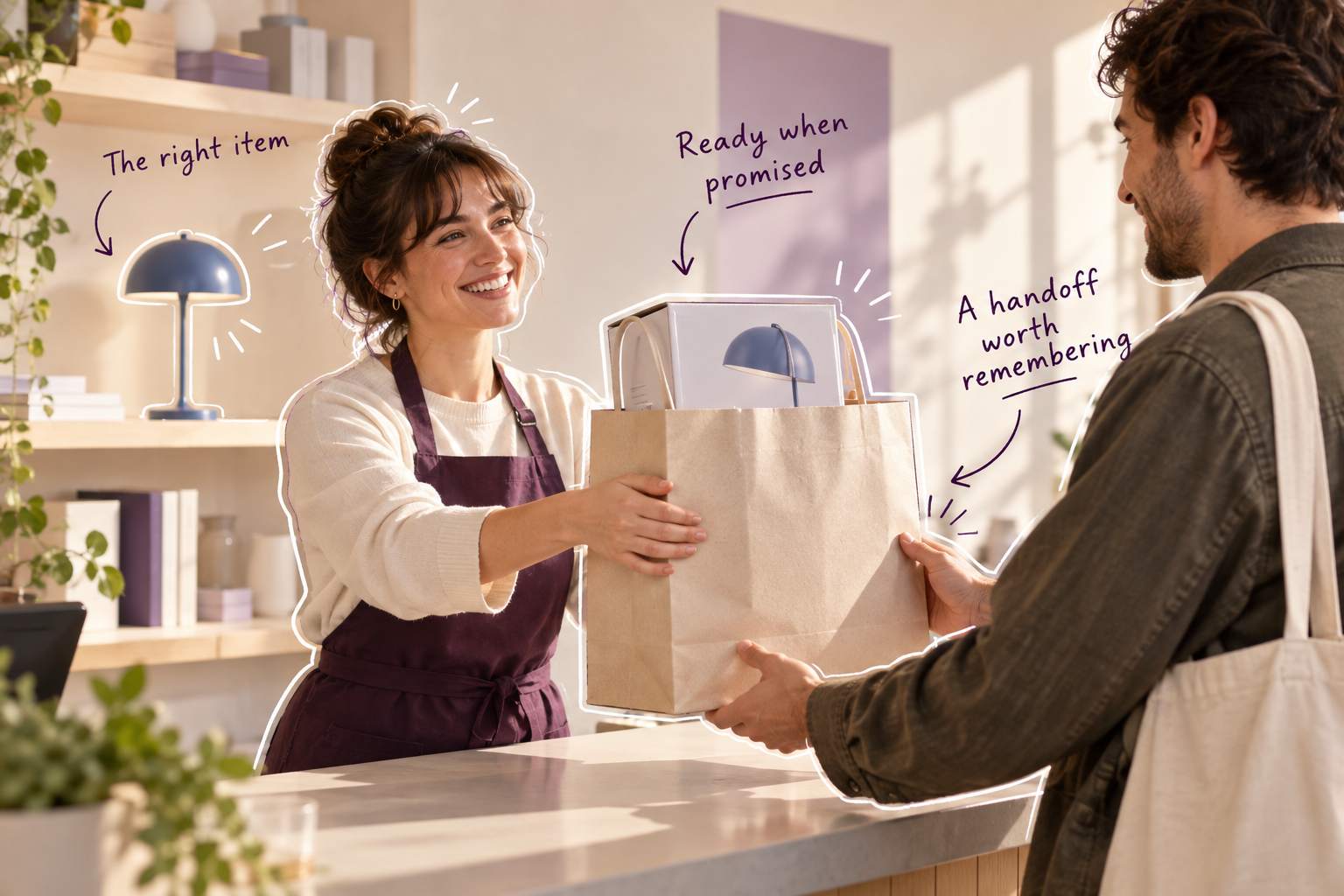
A customer experiences the handoff, not the automation behind it. The right item must be prepared before readiness is promised. AI-generated illustrative scene; not a photograph of a Looqus client.
Capture enough context to be useful
The record should include the requested product or variant, the question, the promised action, the channel preference, the owner and the due date. Use the customer's stated preferences rather than inferred personal characteristics. A note such as “asked for the oak finish in 140 cm” is operationally useful. Speculation about wealth or family circumstances is not.
Shopify POS customer profiles can hold contact details, notes and marketing preferences. The availability of those fields does not mean every field is necessary for every sale. Design the record around the service you are providing. Creating Shopify POS customer profiles.
Use structured choices for common situations and a short free-text field for the actual question. Excessively long forms slow down the store interaction and produce low-quality data. Test capture during a busy shift, not only in a quiet office demonstration.
Confirm product identity with a variant or SKU selection. “Blue dress” may be enough for the associate who helped the customer, but it is unreliable for another shift. The next person should be able to identify the item without asking the customer to repeat the entire conversation.
Remember
Record expressed preferences with appropriate permission.
Check
Confirm suitability, current availability and service context.
Follow through
Assign the response, reservation or service issue to an owner.
Conceptual guide by Looqus Editorial. Read the surrounding analysis for assumptions, exceptions and primary sources.
Separate a requested response from continuing marketing
A customer asking for one stock update has not necessarily asked for an indefinite promotional sequence. Record the scope of the request and apply the appropriate channel and market rules. Broader marketing should respect the relevant preferences and permissions.
Shopify documents separate mechanisms for collecting marketing consent. Its checkout options also distinguish marketing preferences from some transactional notifications. Use that distinction operationally rather than assuming that a receipt email or phone number permits every future message. Collecting customer contact information and Shopify checkout marketing options.
Keep preference changes connected across channels and staff. If a customer opts out, another associate should not restart the same sequence from a personal spreadsheet. A shared suppression state is more reliable than expecting everyone to remember the last conversation.
Do not make unnecessary data capture a condition of completing an ordinary purchase. Shopify notes that required checkout information can impede sales when customers do not want to provide it. Choose the minimum information needed for the requested service. Shopify POS required checkout information.
Make the follow-up immediately actionable
A useful stock response identifies the exact item, the location or delivery option, the current availability and any reservation terms the store can honour. If stock is not reserved, say so plainly. Do not imply the item is held because a message was sent.
A saved selection should contain the chosen variants, current prices and a path to purchase or ask a question. Shopify POS provides an email-cart flow for eligible POS Pro locations that can let the customer complete checkout online. Check plan and device details against the current documentation before designing the operating process around it. Shopify POS email cart.
The message should resemble a competent associate completing a promise. For example: “The 140 cm oak table you asked about is available at our Jumeirah store today. Delivery to your area is AED 80. I can help confirm a collection or delivery option.” Only use these details if the records support them.
Avoid artificial urgency and unverified scarcity. If the system cannot confirm stock freshness, have the specialist check before responding. A precise answer delivered slightly later can be more useful than an instant answer that causes an unnecessary journey.
Give every conversation an owner and an end
A follow-up task needs one current owner even when several people contribute. Define reassignment for days off, shift changes and store transfers. The customer should not receive two contradictory messages because both the original associate and a central team thought they owned the case.
Use a small set of meaningful states: captured, awaiting evidence, ready to respond, response sent, customer replied, fulfilled, declined or closed without response. A sent message is not necessarily a fulfilled request. A confirmed appointment and a proposed appointment should remain distinct.
| Situation | Next action | Escalation owner | Closing evidence |
|---|---|---|---|
| Stock data uncertain | Check physical or authoritative stock | Store inventory lead | Verified variant and quantity |
| Product answer missing | Obtain approved specification | Merchandising specialist | Answer and source recorded |
| Customer asks for exception | Apply approved authority limits | Store manager | Decision communicated |
| Owner absent | Reassign before due time | Shift lead | New owner acknowledges task |
| Customer already purchased | Stop redundant selling follow-up | Clienteling owner | Matched completed order |
| Customer declines contact | Update preference and close sequence | Channel owner | Suppression applied |
The state model should make overdue service visible. It should not become a bureaucratic checklist that requires more effort than the customer interaction itself.
Synthetic pilot: 36 completed purchases versus 24 in a comparable 200-customer group.
Assumes AED 220 contribution per purchase. Small-sample uncertainty remains; both groups retain normal owed service. Attributed sales alone do not establish causality.
Work through a synthetic contribution example
Suppose a pilot includes 400 eligible customers who have agreed to a relevant follow-up situation. Randomly assign 200 to the new structured programme and 200 to the existing service process. Both groups continue to receive appropriate responses to direct customer requests; the test must not withhold an owed service to create a control.
Assume the structured programme produces 36 completed purchases in the agreed observation window and the comparison group produces 24. The observed difference is 12 purchases. At AED 500 net merchandise revenue per purchase, that is AED 6,000 of observed additional revenue before considering costs and uncertainty.
| Per-purchase contribution input | AED |
|---|---|
| Net merchandise revenue excluding tax | 500 |
| Product cost | 220 |
| Payment, packaging and incremental fulfilment | 35 |
| Expected returns and aftercare allowance | 25 |
| Contribution before programme cost | 220 |
The 12 additional purchases contribute 12 × 220 = AED 2,640. Assume the programme requires 12 staff hours at an allocated AED 60 per hour plus AED 200 in tools and messaging. Cost is AED 920, leaving AED 1,720 observed incremental contribution.
Break-even requires 920 ÷ 220 = 4.18, rounded up to five additional purchases under these assumptions. The test's observed 12-purchase difference is not a guaranteed causal result. Small samples, purchase timing and customer selection create uncertainty. Report a range and repeat over enough customers and sales cycles before forecasting a permanent uplift.
Contact
A permitted message was delivered.
Progress
The customer replied or an agreed next step occurred.
Outcome
A completed purchase or resolved service need is evidenced.
Conceptual guide by Looqus Editorial. Read the surrounding analysis for assumptions, exceptions and primary sources.
Measure influence without claiming every sale
A customer may receive a follow-up and buy for unrelated reasons. Staff attribution can reward contribution to a sale, but it does not establish that the programme caused the sale. Keep compensation rules, journey attribution and experimental measurement separate.
Where an experiment is practical, use comparable groups and a pre-agreed window. Where it is not, compare similar stores or situations and state the limitations. A before-and-after result can be affected by seasonality, product launches, local events and staffing changes.
Track service outcomes alongside commercial ones: promises completed on time, incorrect product responses, repeat contacts, unresolved questions and complaints. A programme that increases attributed revenue while causing avoidable visits to out-of-stock stores is not delivering excellent service.
Also inspect the next period. A customer may simply buy earlier, or a follow-up may shift a sale from one store to another. The chain should evaluate total contribution and customer value rather than letting local attribution create internal competition over the same purchase.
Use AI to prepare the work, and specialists to finish it
AI can turn brief associate notes into a structured task, retrieve approved product facts, suggest a concise response and identify overdue promises. It can reconcile recent purchases to avoid redundant messages and rank cases by urgency, evidence completeness and likely usefulness.
The system should not invent a conversation, pretend an associate remembers something that was never recorded, or send unsupported product claims. It should not promise stock reservations, discounts or delivery dates outside its authorised rules. Uncertain facts should remain uncertain until verified.
Specialists complete the difficult parts: obtaining a missing specification, coordinating a stock check, finding a suitable approved alternative and resolving the customer's reply. They need access to the right teams and authority to act within clear limits. A polished draft left waiting for days is still an unfulfilled promise.
For Looqus, AI does the work. We own the outcome. In clienteling, the outcome is a useful customer response and a completed next action, with the commercial result measured honestly. Automation volume is not the offer.
Introduce the programme in the store's real working rhythm
Start with one store, one service situation and a small group of associates. Observe how requests are captured during busy periods. Remove fields that are not used and clarify situations that create inconsistent records. Train with realistic examples of unavailable stock, missing product facts and customers who decline further contact.
Next, connect the task to the approved product and inventory records. Test shift reassignment and response handling. The customer reply must reach an owner who can act; a message sent from an unattended channel defeats the purpose of personal service.
Run the pilot with a clear time budget. Estimate how many tasks an associate can complete without reducing attention to customers already in the store. A central specialist can clear evidence gaps and coordinate cross-store questions while associates remain available for the floor.
Review the complete cycle each week: capture, evidence, response, reply, purchase or closure. Expand only when the team can maintain service quality and the economics remain credible. If too many tasks lack a clear customer request, narrow eligibility before increasing message volume.
Decide what excellent clienteling looks like
Excellent clienteling feels remembered because the business kept a promise. It gives the customer a correct answer, a useful option and an easy way to respond. It respects a decline and does not force every conversation toward an immediate sale.
Proposed pilot thresholds should reflect that standard. Require a verified product match before a product-specific message. Escalate an approaching promised deadline. Suppress promotional follow-up after a relevant opt-out. Stop a sequence when the customer has purchased, declined or exhausted the agreed contact scope.
There are genuine limits. A store with unreliable inventory should fix stock accuracy before promising availability at scale. A product requiring detailed professional advice may need an appropriately qualified person. A small customer base may benefit more from carefully supported manual follow-up than a complex automated programme.
Sources
- Creating Shopify POS customer profiles
- Collecting customer contact information
- Shopify checkout marketing options
- Shopify POS required checkout information
- Shopify POS email cart
AI does the work.We own the outcome.
Turn remembered customer interests into useful follow-through, with permission, accurate answers and a clear owner when the promise passes between staff shifts.
- Agree the result
- Connect the work
- Own the follow-through