
A service business should implement AI around a complete job journey: understand the request, prepare an appropriate next step, confirm that the business can deliver, and close the work with evidence. Begin with one service category and one team. Connect the customer context, service rules and capacity information needed to make accurate promises, with a person responsible for exceptions.
For a cleaning company, maintenance operator or installation business, the constraint is often physical. A faster reply cannot create a qualified technician, a missing part or access to a locked property. The value of AI is to reduce avoidable coordination while making those constraints visible early enough to resolve them.
This guide concerns ordinary service operations. Emergency dispatch, clinical decisions and other high-stakes work require specialist design beyond this scope. The implementation method and numerical example are original editorial tools using synthetic information, not accounts of a customer deployment.
Start with the service promise rather than a chatbot
Select a recurring service whose boundaries are understood. An annual maintenance visit, a cleaning assessment and a custom installation differ in the evidence required before quoting or booking. Define the request, required information, decision maker and finish for the chosen category.
For an assessment, the finish may be a confirmed visit with accurate location, access and fee information. For a scheduled service, it may be completed work with required evidence and a resolved customer question. The system should not collapse those into one conversion because a form was submitted.
Map where requests currently fail. Some are unanswered. Some receive an estimate that does not explain the work. Others are accepted but scheduled without the right skills or materials. A service owner should select the constraint supported by actual records rather than assume every business needs an automated receptionist first.
Choose the simplest useful intervention. Better call routing or a clear request form may solve an early problem. AI becomes more useful when varied customer language must be connected to approved service knowledge and several operational handoffs.
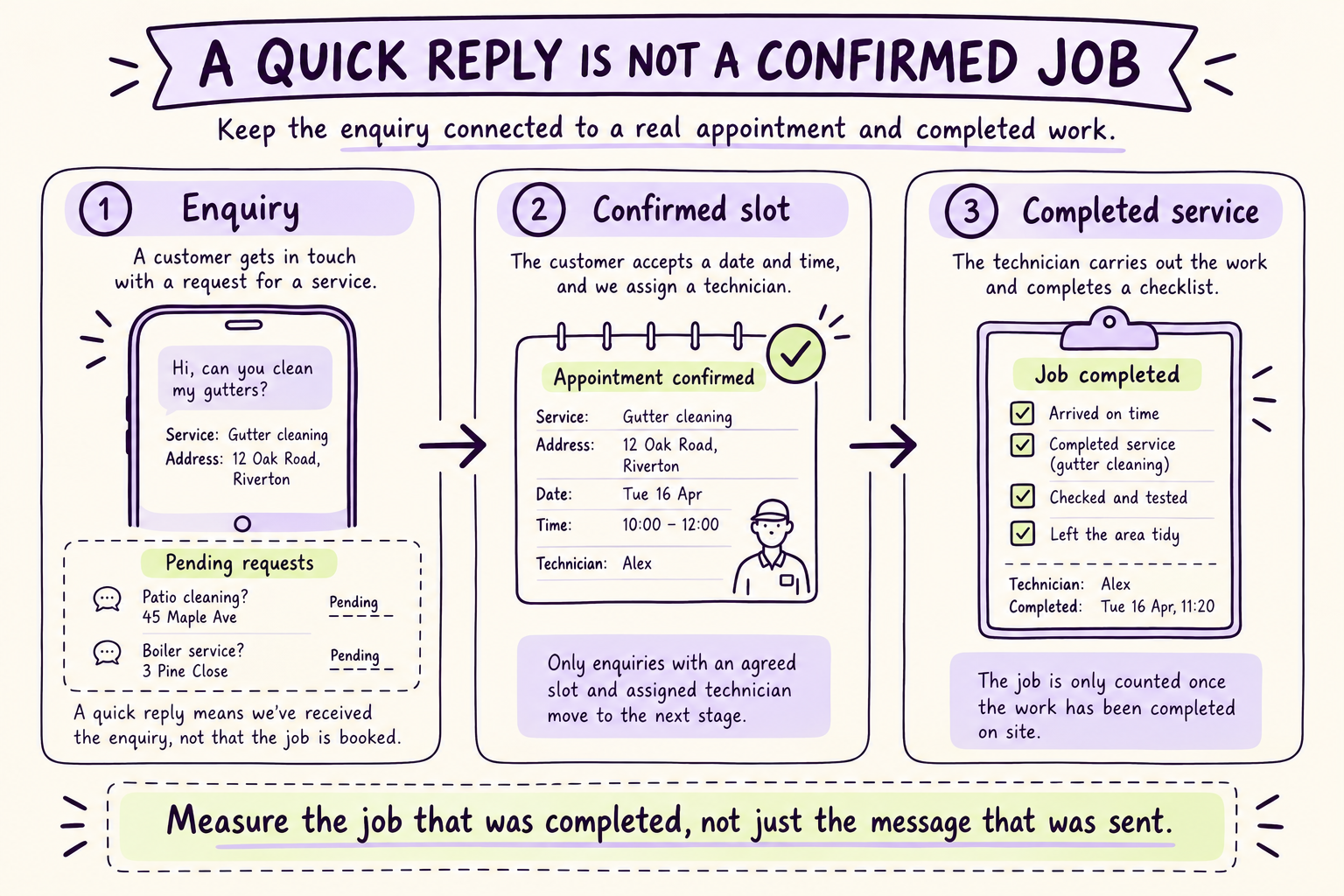
Read the visual explanation
Clarify what service the customer needs and where.
Confirm a real slot and the person responsible for attending.
Record completed work or an honest resolution of the customer's request.
Illustrative teaching example. The steps above are repeated in readable text below; depicted records are not customer results.
Build service knowledge that reflects the work you actually do
Create a shared record of service categories, coverage areas, approved descriptions, exclusions, required skills, typical information needs and escalation routes. Add the applicable commercial rules: assessment fees, quote validity, cancellation process and who may approve exceptions.
Keep diagnosis separate from request understanding. “Customer reports intermittent cooling” is a factual intake note. “Compressor needs replacing” is a technical conclusion that may require inspection. The assistant should preserve the customer's words and avoid turning them into an unsupported work instruction.
Use approved guidance for ordinary questions and route uncertainty to a qualified person. If a customer's description suggests a potentially dangerous situation, follow the business's reviewed escalation procedure. Do not let the model improvise instructions or promise attendance outside actual coverage.
Update the knowledge when the service changes. A new team, revised territory or discontinued package can invalidate old answers. The record needs an owner and review trigger, not merely a folder of documents uploaded at the start of the project.
Enquiry and estimate
Actual request and accepted scope
Appointment and work
Verified resources, access and instructions
Resolution and payment
Completed work and financial state remain distinct
Conceptual guide by Looqus Editorial. Read the surrounding analysis for assumptions, exceptions and primary sources.
Connect enquiry evidence to a single job record
Create an identity linking the contact request, estimate, appointment, work order and resolution. Preserve source messages and related attempts without creating a separate job for every call. A repeat customer may have several properties or requests, so matching by phone number alone can join the wrong work.
Technical events are useful inputs, but they are not business outcomes. A phone system can report that a call completed without proving that the caller received help. Twilio's voice-webhook documentation describes event delivery; the implementation must still connect those events to the actual enquiry state. Twilio voice webhooks
Use the missed-call recovery guide for the narrower callback process. At implementation level, the important connection is that a later booking, cancellation or completed conversation stops an obsolete recovery sequence.
| Connected record | Minimum evidence | Operational consequence |
|---|---|---|
| Enquiry | Actual request, source and permitted contact route | Appropriate next response |
| Estimate | Current scope, version, assumptions and price basis | Clear customer decision |
| Appointment | Customer agreement and verified resources | A promise the business can support |
| Work order | Accepted scope, access and delivery instructions | Technician can perform the right work |
| Completion | Required job evidence and remaining issues | Accurate closure and next action |
| Financial outcome | Invoice, adjustments, payment and defined costs | Credible commercial evaluation |
Do not distribute every record to everyone. Technicians need the service instructions and relevant access details; a marketing workflow does not need unrestricted property or customer information. Keep access proportional to the job being performed.
Make estimates understandable before automating reminders
A service estimate should clarify what is included, what remains conditional, how price is determined and what the customer can do next. An indicative estimate based on a description differs from a fixed quote after inspection. The follow-up language must preserve that difference.
AI can prepare a scope summary, identify missing inputs and organize customer questions. It should not invent a price, remove necessary work to meet a budget or apply a discount outside the owner's authority. A qualified estimator resolves technical uncertainty; an authorized commercial owner decides exceptions.
The estimate follow-up guide explains response categories and version control. The wider implementation must connect an accepted estimate to the actual work order so the field team receives the accepted inclusions, exclusions and assumptions.
If the customer requests a revision, suspend the old approval path and prepare a new version. A reminder to accept an obsolete estimate creates confusion even if it is sent on schedule. The owner should verify that the current document and scheduling record agree before the job proceeds.
Treat scheduling as a capability decision
A usable appointment requires more than a gap on a calendar. Check service territory, technician skills, travel time, duration assumptions, required equipment and materials, and access constraints. Some jobs also need a second person or a particular vehicle.
Google Calendar documents that appointment schedules do not check co-host availability by default. That specific example illustrates why a scheduling tool must be tested against the real resource combination rather than assumed to cover it. Google Calendar appointment setup
Represent proposed, held and confirmed slots separately. If dispatch must approve the resource, the customer should receive an accurate request acknowledgement. Do not announce a confirmed technician before the business has committed one.
Allow the dispatcher to see why a slot was proposed. “Nearest available technician” may still be wrong if that person lacks the required skill or carries a job likely to overrun. The specialist should be able to correct the assumption and preserve the reason for future recommendations.
Fictional USD example. Monetary assumptions in this guide are illustrative US-dollar amounts, not quoted prices, measured results or exchange-rate conversions. The currency does not imply a US tax or legal setting.
Monthly modeled coordination cost for the same 300 completed jobs.
Synthetic scenario. Setup USD 7,800. Monthly difference USD 1,300 in working case versus USD 100 with heavier exceptions; no job-revenue uplift assumed.
Design the field handoff for a busy person on a phone
The field view should make the job, location, access, accepted scope and unresolved concern easy to find. A long AI summary can be less useful than a short structured brief with the original customer description available behind it. Put material changes since scheduling near the top.
Collect completion evidence that fits the service. That might include a checklist, approved photographs, customer acknowledgement or a recorded exception. Do not require irrelevant documentation simply to make the system look rigorous. Every field should support delivery, quality, billing or a needed next action.
A technician marking a visit complete may still leave a follow-up job, missing part or unanswered customer question. Preserve those as owned work rather than hiding them behind the closed appointment. Distinguish “attended,” “work completed” and “customer issue resolved.”
W3C's accessibility guidance emphasizes usable information and interaction for people with disabilities. Apply that principle to customer forms and staff interfaces: readable labels, usable controls and a keyboard path where relevant. A polished screen that makes the task difficult is not a completed implementation. W3C accessibility introduction
Skills and territory
The assigned team can perform this service here
Time and materials
Travel, duration and required parts are feasible
Owned exception
A missing requirement creates a dispatch decision
Conceptual guide by Looqus Editorial. Read the surrounding analysis for assumptions, exceptions and primary sources.
Calculate value without assuming every new booking is extra profit
Consider a synthetic business completing 300 jobs per month. Coordination currently takes 18 minutes per job, including normal rescheduling and record updates. At USD 80 an hour, that is 90 hours and USD 7,200 of modeled capacity cost.
Suppose the connected process reduces routine coordination to eight minutes per job. That requires 40 hours, costing USD 3,200. Add 15 hours of specialist exception work at USD 80 and USD 1,500 of monthly tools and system cost. Total recurring cost becomes USD 5,900, leaving a modeled USD 1,300 difference before setup.
| Scenario | Routine coordination | Exception effort | Tools and system | Total monthly cost |
|---|---|---|---|---|
| Baseline | USD 7,200 including normal exceptions | Included | No incremental AI cost | USD 7,200 |
| Working case | USD 3,200 | USD 1,200 | USD 1,500 | USD 5,900 |
| Exception-heavy case | USD 3,200 | USD 2,400 | USD 1,500 | USD 7,100 |
At an illustrative setup cost of USD 7,800, simple recovery is six months in the working case. Doubling exception work leaves only USD 100 monthly difference and extends recovery to 78 months. The sensitivity makes clear why a business needs reliable service records and an owner able to resolve blockers efficiently.
The released time is not automatically cash saved. If it allows more work, check whether demand and field capacity exist. Additional jobs should contribute after materials, technician labor, travel, payment costs and relevant rework. A new booking that displaces an equally valuable existing job does not create the full additional contribution its invoice suggests.
Put permission and exception handling inside the process
Define which actions may happen routinely and which need a decision. Reading service information, drafting an estimate and sending an approved confirmation are separate permissions. Changing price, promising an urgent visit or charging a payment method should follow explicit business authority.
Respect communication preferences and stop requests across the connected record. WhatsApp's policy requires businesses to manage permission and honor opt-outs. Check the applicable channel and local requirements before enabling proactive messages; a customer number alone is not a universal messaging authorization. WhatsApp Business Messaging Policy
When a connection fails, preserve the job and its last verified state. A scheduling timeout may leave uncertainty about whether a booking was created. The owner should reconcile the destination before retrying, rather than risk creating two appointments or sending conflicting confirmations.
Prioritize exceptions by customer promise and operational consequence. A missing part for tomorrow's installation may matter more than an older general enquiry. The record should show the blocker, next action, owner and expected update time so somebody can actually close it.
Introduce one service category through a full operating cycle
Begin by reviewing recent jobs and defining the current baseline. Then replay representative cases without taking live action. Include incomplete descriptions, repeat callers, estimate revisions, absent technicians, unavailable parts and customer cancellations. The correct response to some cases is a hold with a useful explanation.
Run a limited live pilot with one team and a manual fallback. Observe the complete path through delivery and resolution, not just response speed. If field staff repeatedly correct the brief, examine the source and classification rules before expanding volume.
NIST's voluntary AI Risk Management Framework supports ongoing management and evaluation. Applied to this service workflow, the essential practice is to keep testing when service categories, models or connected systems change and to assign responsibility for resulting failures. NIST AI Risk Management Framework
Measure accepted estimates, confirmed appointments, attendance, completed jobs, unresolved issues, correction effort and contribution using consistent definitions. Track customer complaints and duplicate contact alongside speed. The goal is dependable service, not a larger volume of automated activity.
Choose where an owned service can help
This approach fits a business whose recurring service work is slowed by fragmented information and coordination. It is a poor first automation project when technical diagnosis is undefined, pricing is unreliable, qualified decision makers are unavailable or the field team is already unable to fulfil demand. Fixing those constraints may create more value than acquiring more enquiries.
A small business with a manageable workload may need a disciplined shared queue rather than a large implementation. A larger operator may need integrations and dedicated exception ownership. The scope should follow the volume, variation and consequence of unfinished work.
Sources
- Twilio: Voice webhooks
- Google Calendar: Appointment setup
- W3C: Introduction to web accessibility
- WhatsApp: Business Messaging Policy
- NIST: AI Risk Management Framework
AI does the work.We own the outcome.
Give enquiries, estimates and field preparation one connected process, with clear responsibility for resolving the gaps that keep a service job waiting.
- Agree the result
- Connect the work
- Own the follow-through