
AI transformation in a brokerage means connecting current property information to marketing, buyer conversations and completed follow-through. Start with one property portfolio and one repeatable customer journey. Establish which facts are authoritative, which actions the business can authorize and who resolves the work that does not proceed cleanly. More generated descriptions or faster replies are useful only when the property promise remains accurate.
A brokerage can appear responsive while still disappointing buyers. The advertisement quotes yesterday's price. The enquiry reaches an agent who does not control access. The viewing happens, but the answer about an important property detail never arrives. Each team completes its local task; the customer experiences an unfinished service.
The implementation opportunity is to connect those tasks without taking judgment away from the people accountable for them. This guide focuses on brokerage operations rather than automated investment advice, valuation or legal decisions. Its worked example is synthetic, and its implementation method is an original operating proposal.
Choose the property journey you want to improve
Begin with the result a brokerage owner can observe: accurate marketing for an approved listing, a suitable buyer reaching an attended viewing, or a transaction file whose missing operational documents have been resolved. Select one journey before assembling a list of AI features.
Residential resale, off-plan sales, leasing and commercial brokerage require different evidence and handoffs. An off-plan project campaign can involve approved developer material and launch terms. A resale viewing depends on current owner instructions and access. A commercial requirement may need more detailed use, area and fit-out information. Do not force all of them into one generic lead score.
Choose a portfolio with enough recurring work to evaluate and an identifiable owner for its data. A project where every enquiry is unique and source information is disputed may first need a better operating record. Automating that ambiguity merely distributes it more quickly.
Write the intended finish in one sentence. For example: “Every eligible enquiry for this resale portfolio receives an accurate response and a verified next step, with unresolved property questions owned until closure.” Eligibility, accurate and verified then need practical definitions, not marketing interpretation.
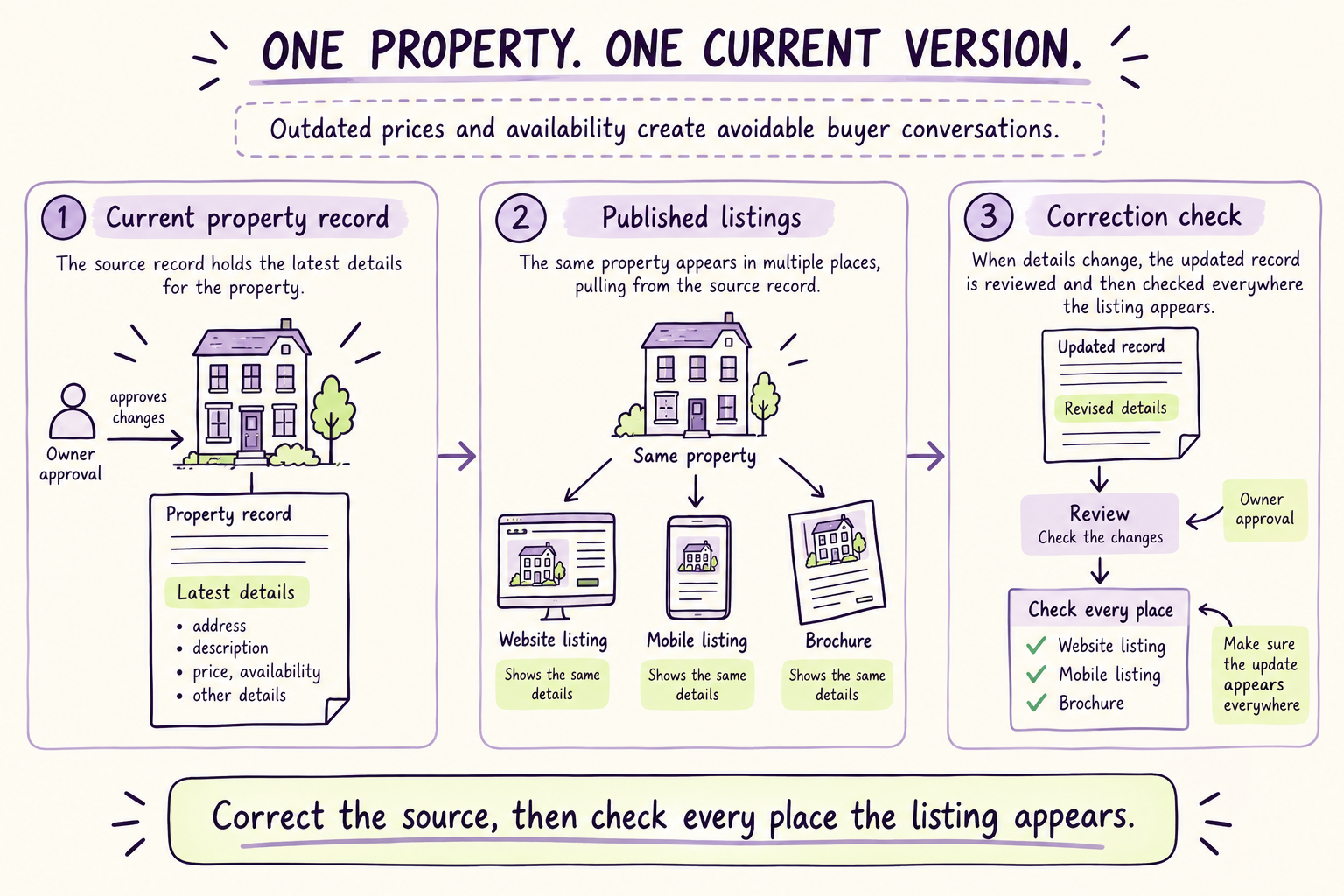
Read the visual explanation
Confirm the current property facts and the owner's instructions.
Publish the approved version wherever buyers see the listing.
Find and correct old prices, descriptions and availability.
Illustrative teaching example. The steps above are repeated in readable text below; depicted records are not customer results.
Create a company brain that knows which facts are current
A brokerage's shared AI context should connect property identity, approved descriptions, asset rights, channel placements, buyer needs, operating rules and prior decisions. It should preserve the difference between public listing facts, confidential owner instructions and an agent's unverified note.
Retrieval-augmented generation supplies a model with relevant information from an external source. It can help staff find and use approved context; it does not establish that an uploaded brochure is current. Microsoft's explanation of retrieval-augmented generation
Use the real estate second-brain guide for the detailed record design. At implementation level, the critical rule is that rapidly changing facts need a current check when a promise is made. A stored description may explain a home; today's availability may require a separate authorized lookup or agent confirmation.
Give contradictions somewhere to go. If the portal, CRM and owner message contain different prices, the assistant should show the conflict and identify its owner. It should not choose the most frequently repeated value or blend several prices into an estimate.
Property facts
Current identity, approved information and source ownership
Customer handoff
Marketing and agents share the actual promise
Verified finish
Attendance and unresolved questions remain distinct
Conceptual guide by Looqus Editorial. Read the surrounding analysis for assumptions, exceptions and primary sources.
Connect marketing to approved property evidence
Creative production can become faster when briefs use verified property facts, approved imagery and a clear buyer question. A layout illustration might explain room relationships. A factual comparison might distinguish two available options. Each visual should clarify what the buyer is actually considering.
Keep photographs, renders and illustrative scenes distinct. A generated living room must not quietly change the layout, view, fixtures or condition of the offered property. An attractive image that misrepresents inventory increases the gap between marketing and the viewing.
In Dubai, the advertising workflow also needs the applicable permit process. Dubai Land Department's service describes real estate advertising categories and supporting documentation. The authorized brokerage owner should determine the requirements for the actual activity; the AI can prepare and check the evidence package. DLD Real Estate Ad Permit service
DLD's Madmoun service provides advertisement verification through a QR code. Preserve the verification route in relevant final placements and check the rendered result. This supports advertising verification; it does not replace a current check of access or suitability for a particular viewing. DLD's Madmoun explanation
Make the handoffs visible across the customer journey
Use a common property and enquiry identity across the systems involved. The marketing team needs to know which live placement produced an enquiry. The agent needs the actual question and commitments already made. The coordinator needs to know which blocker remains open after the agent's conversation.
| Workstream | AI can prepare | Specialist must complete | Evidence of finish |
|---|---|---|---|
| Property onboarding | Extract facts and identify missing fields | Resolve conflicting owner or source instructions | Approved current property record |
| Marketing | Draft brief, copy and placement checks | Obtain assets, approval and publication verification | Correct approved placement live |
| Enquiry handling | Assemble context and propose next response | Resolve suitability, permission and ownership gaps | Useful response or clear closed reason |
| Viewing coordination | Compare preferences and approved availability | Confirm access, agent and buyer agreement | Attended viewing with next decision |
| Transaction administration | Organize requested documents and deadlines | Obtain missing operational evidence through authorized roles | Complete agreed file or explicit unresolved item |
Keep transaction coordination within its actual authority. Organizing documents does not establish legal sufficiency, financing approval or permission to sign. The implementation should expose missing decisions rather than write a confident completion summary over them.
For detailed process design, use the guides to enquiry-to-viewing conversion and listing accuracy across campaigns. Those are components of the wider implementation, not substitutes for connecting the full journey.
Define read, draft, send and commit as separate permissions
An employee's access to a record does not imply authority to change a price, publish an advertisement, contact a buyer or make a contractual promise. Give each workflow an action boundary and an approval route for work outside it.
A sensible first release may permit reading approved property facts, drafting responses and creating internal tasks. Later, a narrow class of factual acknowledgements can be authorized after testing. Price changes, property substitutions and consequential commitments require the brokerage's agreed decision process.
Keep channel preference and permission alongside the enquiry. A phone number is not a universal subscription. WhatsApp's business policy requires businesses to manage permission and respect stop requests. Verify the current channel requirements and applicable local rules for the proposed communication. WhatsApp Business Messaging Policy
Design the receiving person's experience as carefully as the automation. They should see the original question, supporting facts, uncertainty and proposed action without opening five applications. A specialist who has to reconstruct the entire case will spend the time the system supposedly saved.
Monthly modeled operating cost for the same 180 property tasks.
Synthetic scenario. Setup AED 11,280; working-case monthly difference AED 1,880. Capacity value is not automatically cash saved.
Calculate the value of a connected operating cycle
Consider a synthetic portfolio that needs 180 monthly marketing updates, enquiry preparations and coordination tasks. The current process spends 20 minutes per task collecting and reconciling context. At an illustrative loaded cost of AED 120 an hour, that is 60 hours and AED 7,200 in modeled capacity cost.
Suppose a connected process reduces routine preparation to eight minutes per task. That requires 24 hours, valued at AED 2,880. Add 12 hours of specialist exception handling at AED 120, plus AED 1,000 of monthly system cost. Recurring modeled cost is AED 5,320, leaving a difference of AED 1,880 before setup.
| Monthly case | Routine preparation | Exception effort | System cost | Total modeled cost |
|---|---|---|---|---|
| Existing process | AED 7,200 including normal exceptions | Included in baseline | No incremental AI cost | AED 7,200 |
| Connected working case | AED 2,880 | AED 1,440 | AED 1,000 | AED 5,320 |
| Exception-heavy case | AED 2,880 | AED 2,880 | AED 1,000 | AED 6,760 |
At AED 11,280 illustrative setup cost, the AED 1,880 monthly difference would recover setup in six months. If exception effort doubles to 24 hours, the monthly difference is only AED 440 and simple recovery takes approximately 25.6 months. Reliable source information materially affects the commercial case.
These are capacity economics, not automatically cash savings. Staff may remain employed and use the released time elsewhere. Additional transactions should be evaluated separately, using mature cohorts and contribution after relevant costs. Do not add the value of released hours to revenue supposedly generated by those same hours without explaining the relationship.
One portfolio
Enough repeat work to inspect
Bounded actions
Read, draft, send and commit have separate authority
Owned exceptions
Resolve missing access, facts and approvals
Conceptual guide by Looqus Editorial. Read the surrounding analysis for assumptions, exceptions and primary sources.
Pilot one complete loop instead of several unfinished assistants
First reconstruct a recent set of property journeys. Identify where the facts changed, who had to intervene and which commitments remained open. Establish baseline preparation time, repeat contact, incorrect information and closure quality. Keep difficult cases in view rather than selecting only clean enquiries.
Next run historical replay and shadow work. The proposed system prepares the property brief or enquiry response while the existing team still performs the real action. Review disagreements against source evidence. Include withdrawn listings, shared contact details, unavailable agents, changed prices and a buyer who has asked to stop contact.
Then allow a limited live workload with explicit actions and a named operator. Test one full cycle from source update to marketing or customer response and back to the outcome record. A functioning draft generator does not prove that the downstream handoff works.
NIST's AI Risk Management Framework provides voluntary guidance for managing and measuring AI across its lifecycle. Applied here, the practical requirement is ongoing evidence and an owner after launch, not a one-time approval of a polished demonstration. NIST AI Risk Management Framework
Design failure handling around the buyer's promise
When a source connection fails, mark affected information stale and restrict claims that depend on it. When a message cannot be delivered, return the case to its owner. When two agents act on the same enquiry, stop pending duplicate actions and restore a single accountable handoff.
A property withdrawal should invalidate pending promotions and appointments that depend on availability. The owner must inspect where the property remains visible, coordinate the approved correction and verify completion. The system should not consider a source-record update equivalent to removing every live placement.
Make unresolved work visible by age, consequence and next promised action. A small unanswered question can block a valuable decision. Prioritization should use the buyer's stated situation and agreed service commitments rather than assumptions about their wealth or likelihood to spend.
Retain a practical manual queue for outages. The business should know how new enquiries are captured, which person handles them and how later reconciliation avoids duplicate records. A fallback that exists only in a developer's memory is not an operating plan.
Measure the result and choose the next investment
Track time to a useful response, current-placement accuracy, accepted handoffs, attended viewings, unresolved-question age and completed administrative files. Keep bookings, attendance, transactions and collected commission distinct. The period between them can be long enough to make an early commercial verdict misleading.
Review patterns across the whole journey. If enquiry quality improves but viewings still fail because access is unreliable, invest in access coordination. If agents resolve conversations but listing errors keep returning, fix the upstream record. The next useful AI project is the one that removes the actual constraint.
This approach is a poor fit for broad autonomous action when inventory authority is unclear, the brokerage cannot maintain current property facts or qualified decision makers are unavailable. A small team handling low volume well may benefit more from a shared record and disciplined follow-through than a complex implementation.
Sources
- Microsoft: Retrieval-augmented generation
- Dubai Land Department: Real Estate Ad Permit
- Dubai Land Department: Madmoun advertisement verification
- WhatsApp: Business Messaging Policy
- NIST: AI Risk Management Framework
AI does the work.We own the outcome.
Connect accurate property information with customer follow-through, so agents know what they can promise and who will confirm the next step.
- Agree the result
- Connect the work
- Own the follow-through