
Manufacturing quotation costing should calculate the cost of a specific product revision, quantity, site and delivery scenario. A bill of materials supplies component requirements; the route supplies production work. The quote also needs current purchase terms, yield assumptions, setup allocation and a clear pricing rule. AI can organize the evidence, but missing costs and technical uncertainty need accountable resolution before a price is released.
This guide examines the cost build-up inside a manufacturing quotation. It does not cover the entire RFQ process or prescribe an accounting policy. The proposed workbook structure and synthetic worked example show how yield, material prices and production time affect the quoted margin.
Freeze the commercial question before calculating
“What does this part cost?” is incomplete. A price for 100 pieces may need a different route and procurement arrangement from a price for 10,000. Revision C may require a different finish from revision B. A rush order may create a freight premium that the ordinary standard cost excludes.
Create a quote basis: customer request, drawing revision, quantity breaks, delivery assumption, manufacturing site, currency and validity date. Record which documents supplied each fact. If the customer requests several quantities, calculate each scenario deliberately rather than dividing one total across different quantities.
Microsoft's documented BOM calculation inputs include costing version, BOM version, route version, quantity, date and site. That is a product-specific implementation of an important general discipline: a calculated number belongs to a defined scenario. Microsoft BOM calculations.
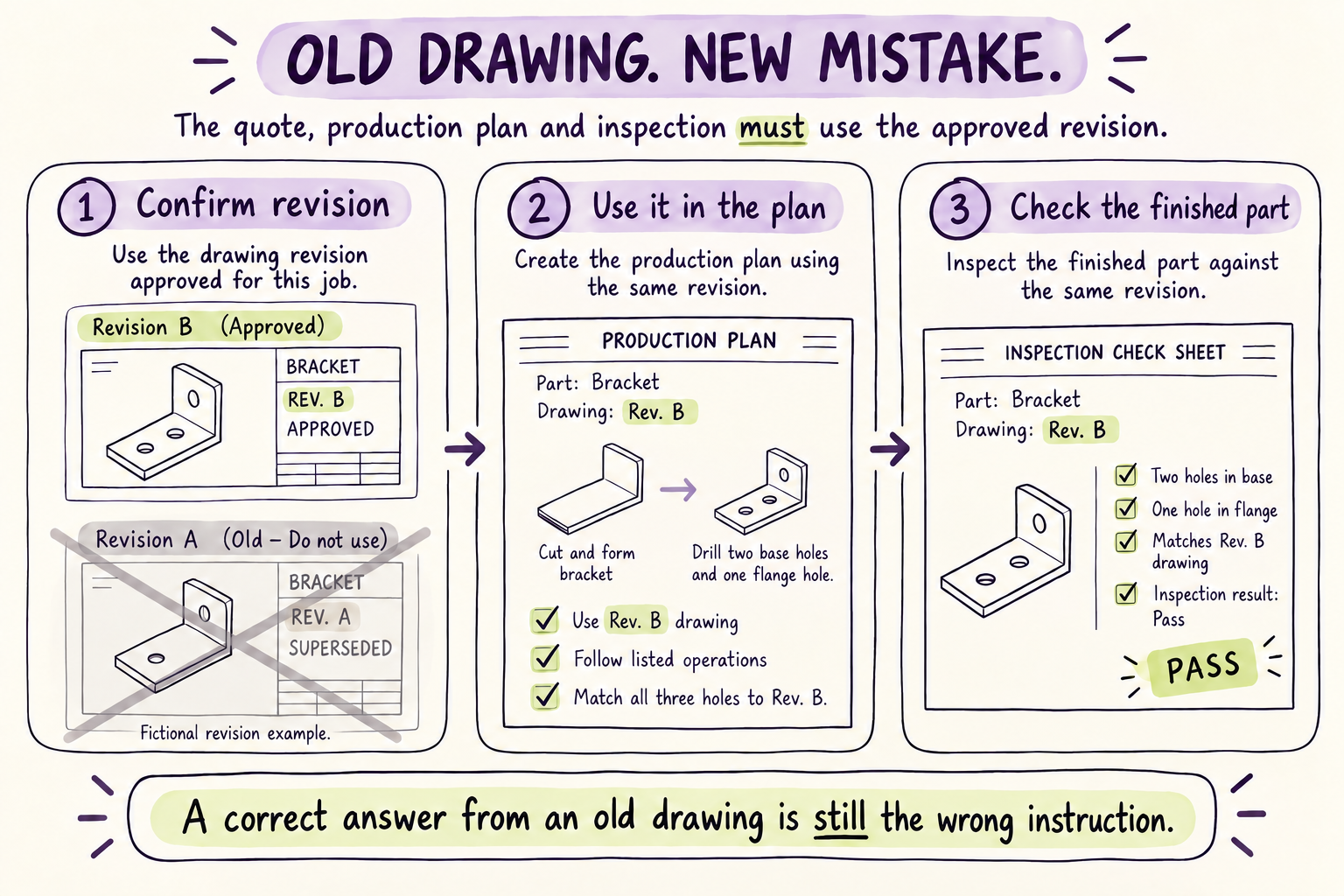
Read the visual explanation
Identify the current approved drawing and product revision.
Use the same revision in costing, instructions and production planning.
Inspect the finished part against that approved requirement.
Illustrative teaching example. The steps above are repeated in readable text below; depicted records are not customer results.
Separate the BOM from the work required to build it
A BOM describes component requirements. The route describes operations and resources. Microsoft explains their combined role in estimating product cost. Neither a clean material list nor an old unit price alone is a full manufacturing estimate. Microsoft bills of materials and formulas.
Include external processing as an identifiable cost, whether it sits in your BOM, route or another supported structure. Heat treatment, coating, testing and special packing can otherwise disappear between engineering and procurement. Give each cost one authoritative home to avoid double counting.
For subassemblies, decide whether to use an approved rolled-up cost or expand the component detail. Mixing both adds the same cost twice. If the subassembly is bought for this job rather than made, record that sourcing scenario explicitly. A historic make cost is not automatically a current buy cost.
Requirements
Identify the drawing, BOM and quantity being priced.
Cost basis
Record materials, yield, routing and external operations.
Approval
Validate assumptions, margin basis and commercial terms.
Conceptual guide by Looqus Editorial. Read the surrounding analysis for assumptions, exceptions and primary sources.
Use a cost record that exposes evidence quality
| Cost element | Required basis | Review question |
|---|---|---|
| Purchased material | Supplier, currency, quantity tier, date | Is this price valid for the actual purchase? |
| Material yield | Defined loss model and denominator | Is scrap counted once? |
| Setup | Hours and number of setups | Does the quantity require multiple batches? |
| Run time | Time per unit and rate basis | Are cycle time and labor time being confused? |
| Outside processing | Lot charges and unit charges | Are minimum charges included? |
| Inspection | Required plan and applicable effort | Is special testing separately priced? |
| Freight and packing | Agreed delivery scenario | Are inbound and outbound costs distinguished? |
| Overhead | Finance-approved allocation rule | Is it already inside a loaded rate? |
Maintain a source status for every material cost: current supplier quote, active contract, approved internal estimate or missing. Missing should remain visibly missing. Replacing it with zero can make the total look attractive precisely where the estimate is least reliable.
Microsoft documents warnings for conditions including zero component quantity or cost and alternative cost-price sources in BOM calculation groups. Those controls need configuration; their existence does not prove a given implementation will stop an incomplete quote. Microsoft BOM calculation groups.
Understand yield before applying a scrap percentage
Fictional USD example. Monetary assumptions in this guide are illustrative US-dollar amounts, not quoted prices, measured results or exchange-rate conversions. The currency does not imply a US tax or legal setting.
Suppose each saleable unit contains USD 40 of material and the expected material yield is 95%. Under a simple yield model, material input cost per good unit is USD 40 divided by 0.95, or approximately USD 42.11. Multiplying USD 40 by 1.05 gives USD 42.00, which represents a different assumption. The difference may be small here, but the distinction matters at larger losses.
State whether yield refers to material utilization, process output or final accepted units. Offcuts in sheet processing differ from rejected finished assemblies because the latter can include conversion cost already incurred. Do not automatically apply the same percentage to every cost element.
Use historical actuals from a comparable process where available and have the process owner validate them. A new material or geometry can invalidate an old yield assumption. Where evidence is weak, model a range and identify the qualification work needed to narrow it rather than pretending a precise percentage is known.
Worked example: a transparent 500-unit quote
The following synthetic quote is for 500 good units. Material content before yield is USD 40 per unit. Material yield is assumed to be 95%; all other costs below are specified separately. The loaded machine rate includes the overhead assigned to that machine, so no second machine-overhead percentage is added.
| Cost component | Calculation | Total USD |
|---|---|---|
| Material after yield allowance | 500 × 40 ÷ 0.95 | 21,052.63 |
| Setup | 8 hours × 180 | 1,440.00 |
| Run time | 500 × 0.12 hours × 180 | 10,800.00 |
| Outside finishing | 500 × 9 | 4,500.00 |
| Inspection | 12 hours × 90 | 1,080.00 |
| Packing and delivery | Job-specific allowance | 1,200.00 |
| Total modeled cost | Sum of rows | 40,072.63 |
Modeled cost per unit is USD 80.14526. At a target gross margin of 25% on this defined cost basis, the selling price is cost divided by 0.75: USD 53,430.18 for the job, or approximately USD 106.86 per unit before any stated taxes. Rounding the unit price to USD 106.86 produces USD 53,430 total, so the rounded quote differs by USD 0.18 from the unrounded target calculation.
A 25% markup would instead multiply cost by 1.25, producing USD 50,090.79 and a 20% margin on sales. Margin and markup are not interchangeable. The pricing rule must be named on the internal approval record, even if the customer only sees a selling price.
This example excludes corporate overhead outside the specified rates, financing costs and other business-specific charges. It therefore does not calculate operating profit. Finance must decide whether the cost basis is appropriate for the actual pricing decision.
Synthetic example · fixed modeled selling price USD 53,430.18
500 good units; defined cost basis only. This is not operating profit. Base cost USD 40,072.63; final stress cost USD 43,942.22.
Test the assumptions that can reverse the decision
Keep the selling price fixed at the rounded USD 53,430.18 for a sensitivity check. If material yield falls from 95% to 90%, material cost rises to USD 22,222.22. Total cost rises to USD 41,242.22, reducing modeled margin to approximately 22.81%.
If machine run time also rises from 0.12 to 0.15 hours per unit, run cost increases by USD 2,700. Combined with the lower material yield, total cost becomes USD 43,942.22 and margin falls to approximately 17.76%. A quote that looked comfortable can become much less attractive without any change to the customer's price.
Do not add a vague contingency and stop investigating. Identify which assumption drives exposure, who can improve the evidence and whether the quote should carry a condition. A trial run might reduce cycle-time uncertainty; an updated supplier quote might remove price uncertainty. Those are different actions with different costs and lead times.
Microsoft costing versions can separate standard and planned cost records. That supports maintaining explicit scenarios in systems that provide the feature; it does not prescribe how every business must account for inventory. Microsoft costing versions.
Quoted
The assumptions and cost basis used for the offer.
Released
The approved specification and production instruction.
Actual
Observed usage and costs inform the next estimate.
Conceptual guide by Looqus Editorial. Read the surrounding analysis for assumptions, exceptions and primary sources.
Price quantity breaks as different operating scenarios
Setup allocation falls as quantity rises only if the number of setups stays constant. A larger order may require extra batches, storage, tooling wear or staggered delivery. Supplier minimum order quantities can also create excess inventory that the unit-cost calculation hides.
For 100 units, the same USD 1,440 setup contributes USD 14.40 per unit. For 500 it contributes USD 2.88. That is a useful price difference, but it does not justify assuming every other cost scales linearly. Recalculate material tiers, route choice, inspection effort and outside-processing minimum charges for each break.
Distinguish committed quantity from forecast volume. Quoting the 5,000-unit price for a buyer who orders 100 at a time can leave the manufacturer carrying the economics of a promise the buyer never made. Commercial terms may address releases or minimum commitments, but their content requires appropriate review rather than automated invention.
Keep supplier uncertainty visible at quote release
An expired quote is evidence of a past price, not a current purchase commitment. Record price validity, lead time, currency and quantity conditions. If imported inputs create exchange-rate exposure, show the rate assumption and commercial treatment rather than quietly fixing a number indefinitely.
A lower supplier price may come with inspection, freight or reliability costs. NIST's supplier-selection guidance discusses total ownership cost and the importance of looking beyond purchase price. The inference for quotation costing is to include relevant consequences where there is evidence, not add arbitrary risk premiums to every supplier. NIST supplier selection.
Unqualified substitutes require technical approval. A model that finds a cheaper material description has not established equivalence. The owner should resolve the source, approved alternative or quotation condition before the price is released. Where the risk cannot be resolved, the quote should retain a clearly bounded assumption or be held.
Compare quoted and actual costs without rewriting history
Freeze the released estimate and compare it with the actual job using consistent cost categories. Keep the original quantity, revision, route and assumptions so the variance can be explained. Updating the quote workbook with today's costs before comparison destroys the evidence needed to learn.
Classify differences: purchase-price change, quantity change, excess consumption, cycle-time variance, additional setup, rework, scope change or allocation difference. A negative margin result may come from a commercial discount rather than manufacturing performance. The categories should distinguish causes instead of assigning blame to whichever team owns the final spreadsheet.
NIST published a manufacturer example in which labor and overhead were incorporated into job costing and quoted margins could be compared with actuals. That is an external case illustrating the discipline, not a Looqus result or a transferable savings promise. NIST pricing-model case.
Feed verified learning into the next estimate through approved cost and route updates. One unusually difficult job should not automatically change the standard for every product; investigate whether the cause is repeatable before generalizing it.
Introduce assistance around evidence and exception closure
Begin with a stable product family and a sample of completed jobs. Reconstruct the quote basis and compare the old estimates with actual outcomes. The exercise identifies whether the largest problem is document extraction, missing costs, outdated routes or inconsistent approval.
Then test AI-assisted extraction and comparison without allowing automatic price release. Check quantities, units, currency, revision and the difference between quoted supplier price and reference catalogue price. Use deterministic calculations for totals and pricing formulas; a language model's fluent explanation should not be the calculation engine of record.
Set release gates around unresolved material costs, unknown revision, unapproved substitutes and unexplained margin exceptions. A specialist should chase the source, obtain the qualified decision and verify the final quote record. Measure preparation time, unresolved-cost age, first-pass quote correctness and quoted-to-actual variance. Counting completed spreadsheets alone rewards output even when the cost basis is weak.
A useful starting scope with Looqus
This approach fits manufacturers with recurring product families, traceable purchasing data and owners for engineering and costing decisions. It is a poor candidate for automatic pricing where product definitions are unstable, rates are undocumented or the business cannot identify which costs the price must cover. Evidence preparation may still help, but automatic commitment would be premature.
Looqus can prepare the cost evidence, chase missing supplier inputs and reconcile the quote to its approved revision and assumptions. Your engineering and finance owners retain technical acceptance, cost-policy and price-release decisions. Specialists resolve the gaps and verify the completed quotation record. AI does the work. We own the outcome.
Sources
- Microsoft: BOM calculations.
- Microsoft: bills of materials and formulas.
- Microsoft: BOM calculation groups.
- Microsoft: costing versions.
- NIST: supplier selection.
- NIST: adjusting a pricing model.
AI does the work.We own the outcome.
Check the material, process and quantity assumptions behind a quote, with unresolved costs assigned for confirmation before your team commits to a price.
- Agree the result
- Connect the work
- Own the follow-through