
Manufacturing supplier qualification establishes whether a specific supplier, site and process can consistently meet the requirements of the parts you intend to buy. It combines capability evidence, commercial assessment, appropriate trials and ongoing performance review. A certificate or a cheap quotation can support the evaluation but cannot establish product suitability on its own. AI can organize evidence; qualified owners must approve technical acceptance and close gaps.
This guide proposes an evidence-led qualification process for business owners and procurement leaders. It is not a certification checklist or a substitute for sector-specific engineering and compliance requirements. The matrices and synthetic economic example show how evidence gaps and quality assumptions can change a sourcing decision.
Define the approval scope before collecting documents
“Approved supplier” is too broad if the company has several factories, different processes or a mixture of in-house and outsourced work. Approval should identify the relevant legal entity, manufacturing site, product family, process and any restrictions. A supplier approved for machined brackets is not automatically qualified for a pressure-containing component.
Start from the purchase requirement. Record the drawing revision, material, critical characteristics, inspection evidence, volume, delivery pattern and intended use. Procurement should obtain the technical team's approval of that requirement before comparing suppliers. Otherwise the evaluation can reward a supplier for answering a different question from the one the factory actually needs solved.
Use a bounded first scope. One recurring part family makes it easier to define acceptance and compare performance. A company-wide supplier transformation can come later, after the business has learned how to keep approval records current and how to resolve missing evidence.
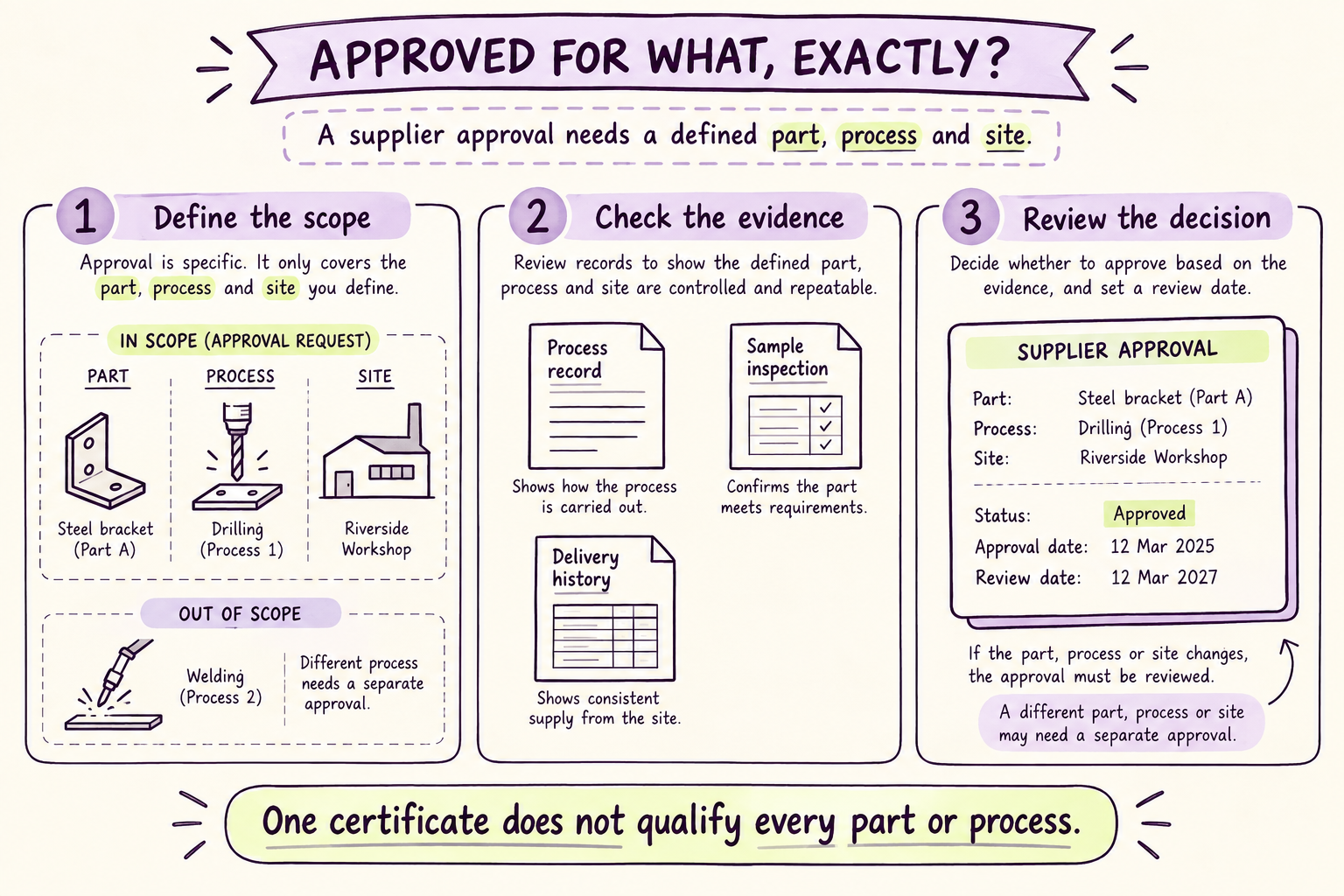
Read the visual explanation
Name the part, process and site the approval should cover.
Check relevant process, sample, inspection and delivery evidence.
Record the decision's scope and when it needs review.
Illustrative teaching example. The steps above are repeated in readable text below; depicted records are not customer results.
Separate discovery from qualification
Discovery produces candidates. Qualification determines whether a candidate can meet the defined requirement. NIST's Supplier Scouting service helps identify manufacturing candidates through the U.S. MEP network; it is a discovery resource in that geography, not proof that any candidate is qualified for a particular buyer. NIST Supplier Scouting.
The same distinction applies to trade directories, introductions and search tools. A persuasive website or a list of machines is a lead for investigation. Ask which operations are performed at the proposed site, which are subcontracted and what evidence supports the claimed capability.
Keep a candidate state before approval: discovered, information requested, technically reviewed, trial authorized, conditionally approved or approved for scope. The exact labels can vary. What matters is that a purchasing user cannot mistake “documents received” for permission to place unrestricted production orders.
Scope
Name the item, process, location and requirements.
Evidence
Check documents, capability and unresolved findings.
Decision
Approve within scope, apply conditions or hold.
Conceptual guide by Looqus Editorial. Read the surrounding analysis for assumptions, exceptions and primary sources.
Build a qualification evidence matrix
| Evidence area | What the evaluator needs | What should not count as closure |
|---|---|---|
| Process capability | Relevant equipment, people and process evidence | Generic factory brochure |
| Material control | Specified grade and traceable purchase/receipt evidence | Similar commercial name |
| Measurement | Appropriate inspection method and records | A photograph of a measuring instrument |
| Capacity | Credible volume and delivery plan | Unqualified “capacity available” |
| Quality system | Relevant scope and verified current status where required | Certificate image without scope review |
| Outsourced work | Named processes and control arrangements | “Our partner handles it” |
| Commercial continuity | Terms, lead time, key dependencies and response process | Unit price alone |
| Trial acceptance | Agreed results for representative output | A sample selected without a defined plan |
The matrix is a proposed buyer tool. The depth of evidence should follow product consequence and applicable requirements. A low-risk catalog item and a critical custom component should not receive identical treatment merely because the supplier onboarding form has one template.
Assign each open gap a decision owner, next action and expiry or review date. AI-assisted document extraction can populate a table, but the owner must determine whether the evidence is relevant and sufficient. A checked box is not the same thing as a supported conclusion.
Understand what ISO 9001 evidence can and cannot show
ISO's supplier-facing guidance explains that ISO 9001 concerns a quality management system and does not define the specific product requirements being purchased. A statement about the QMS is not a substitute for product or service conformity evidence. The buyer must specify its needs. ISO: ISO 9001 in the supply chain.
For a certificate relevant to your qualification, examine the entity, site, scope, issuing body and status. Resolve uncertainty with appropriate authoritative verification rather than inferring authenticity from a logo. Do not label products “ISO 9001 certified” as if the management-system certificate establishes every part's performance.
The ISO 9001 Auditing Practices Group's external-provider paper also discusses risk-based controls, scope review and the limits of merely maintaining an approved list. It is educational guidance with its own disclaimer, not an additional certifiable standard or an assurance that a particular process complies. ISO/IAF Auditing Practices Group: external providers.
Design a trial that answers a real production question
A trial should test the conditions that matter to the purchase: relevant material, process, tolerances, finish, measurement method and delivery arrangement. Define acceptance criteria and responsibility before the supplier ships samples. Otherwise a visually attractive sample can create pressure to accept a process that has not been properly evaluated.
Use a qualified quality or engineering owner to determine the sampling and validation plan. The appropriate plan depends on consequence, variability and sector requirements; this article does not prescribe a universal sample size. One successful sample is not evidence of sustained process performance at production volume.
Capture deviations explicitly. A trial approved with a concession may support a limited purchase, but should not become unrestricted approval unless the responsible owner has accepted the underlying condition. Record which corrective actions must be completed before the next stage and verify their effectiveness using the agreed evidence.
Also test the supplier's response behavior. Can it identify a document revision, answer a discrepancy and preserve the agreed material source? Responsiveness cannot compensate for failed technical acceptance, but poor response quality can make future exceptions much harder to close.
Fictional USD example. Monetary assumptions in this guide are illustrative US-dollar amounts, not quoted prices, measured results or exchange-rate conversions. The currency does not imply a US tax or legal setting.
Synthetic example · monthly modeled ownership cost
Both must pass qualification gates first. The USD 80 per-unit consequence is incremental and excludes original purchase price; modeled rates are assumptions.
Compare total cost after minimum requirements pass
Price comparison belongs after the essential technical and commercial gates. An inexpensive supplier that cannot meet the required specification should not remain in a weighted shortlist by scoring well on cost. Treat mandatory conditions as gates rather than negotiable points.
NIST's supplier-selection guidance encourages attention to total ownership cost and supplier performance beyond purchase price. That supports examining relevant freight, quality and operational consequences, while the actual numbers must come from your own evidence. NIST supplier selection process.
| Comparison dimension | Supplier A, synthetic | Supplier B, synthetic |
|---|---|---|
| Unit purchase price | USD 50 | USD 53 |
| Monthly volume | 1,000 | 1,000 |
| Inbound freight per month | USD 1,500 | USD 800 |
| Incremental receiving inspection | USD 1,000 | USD 500 |
| Expected nonconforming units | 30 | 10 |
| Incremental consequence per nonconforming unit | USD 80 | USD 80 |
| Expected monthly expedite cost | USD 900 | USD 300 |
The estimated nonconforming-unit rates in this table are assumptions for illustration. They should not be assigned to a real supplier from reputation or a model-generated score. Use comparable receipt and quality records, and state uncertainty where the data is limited.
Expiry
An owner resolves evidence reaching its validity limit.
Change
New processes, sites or requirements trigger review.
Performance
Delivery and quality evidence inform continued approval.
Conceptual guide by Looqus Editorial. Read the surrounding analysis for assumptions, exceptions and primary sources.
Worked example: a cheaper unit price is only part of the choice
Using the synthetic table, Supplier A costs USD 50,000 purchase price plus USD 1,500 freight, USD 1,000 inspection, USD 2,400 expected nonconformance consequences and USD 900 expediting: USD 55,800 monthly. Supplier B costs USD 53,000 plus USD 800, USD 500, USD 800 and USD 300: USD 55,400 monthly.
The modeled difference is USD 400 in B's favor. Define the USD 80 nonconformance consequence carefully: here it represents incremental handling, rework and disposal net of recoveries, excluding the original purchase price already included above. Counting the full unit price again without accounting for credits or replacement would distort the comparison.
If qualifying B costs USD 6,000 once, simple payback from the modeled USD 400 difference is fifteen months. That result may be unattractive if demand is uncertain or the part is near the end of its life. It may still be useful for resilience, but resilience value should be described separately rather than hidden in invented savings.
Sensitivity changes the decision. If A's actual nonconforming rate is 2% rather than 3%, its expected consequence is USD 1,600 and monthly total falls to USD 55,000. A then costs USD 400 less than B. A small difference in uncertain quality assumptions reverses the ranking. Validate the important inputs before treating the spreadsheet as a purchasing answer.
This example excludes inventory holding, payment-term effects, interruption losses and product-specific obligations. Add them only with a defined method and relevant evidence. The goal is a transparent comparison, not a longer list of speculative penalties for the less-preferred supplier.
Make conditional approval enforceable in purchasing
A conditional approval should say what may be bought, in what quantity or period, and which checks apply. It should also identify what cannot proceed until the conditions close. A note buried in an email is unlikely to protect the next buyer placing an order months later.
Where the ERP supports it, connect the approval scope to the purchasing item, supplier site and applicable process. Verify how the control behaves for imports, copied orders and urgent manual entries. A visible status label without an actual decision path can create false confidence.
The specialist's completion record should show the evidence obtained, qualified approval, system update and confirmation that the purchasing team can see the current restriction. If an exception allows a one-time order, preserve it as one-time permission. Do not let urgency silently redefine the approved scope for every future purchase.
Requalify when the facts change
Approval is a decision about a defined state. A supplier moving production, changing a key subcontractor, altering material sources or introducing a new process can change that state. Define which events trigger review and how the supplier is expected to notify the business.
Review performance by approved scope, not only supplier-wide averages. One strong product family can conceal repeated problems in another. Track on-time delivery using an agreed date definition, nonconformance by receipt or unit with clear denominators, response time and closure of corrective actions. Small samples need context; one failure out of ten receipts is not equivalent evidence to one hundred failures out of a thousand.
Do not automatically punish every disruption with a supplier change. Investigate buyer-caused specification changes, unrealistic schedules and unclear acceptance criteria. The qualification process should improve the quality of the trading relationship, including the information the buyer provides.
Pilot evidence assistance before automating approval
Start with a small supplier group and one part family. Assemble the existing evidence, identify missing scope and expiration data, and compare the record with actual purchasing behavior. This often reveals whether the bottleneck is collection, interpretation or enforcement.
AI can help sort documents, extract fields and highlight inconsistencies. Validate extraction against source documents, particularly site names, certificate scope, dates, material grades and decimal tolerances. Missing evidence should remain missing; a model should not infer that a supplier meets a requirement because it serves a similar industry.
Keep the technical approval with qualified people and the commercial decision with the authorized owner. A specialist can actively obtain clarifications, arrange the agreed next step, track actions and verify closure. Measure time to a supported decision, aged gaps and purchases outside approved scope. Document completeness is useful, but the business outcome is appropriate purchasing with fewer unresolved exceptions.
Where Looqus fits in the decision
This approach fits manufacturers whose supplier evidence is spread across inboxes and folders while purchasing decisions recur. It is a poor candidate for automatic qualification where safety-critical validation, specialist audits or sector-specific approvals are required but unavailable. Organizing the evidence may still be useful; it does not remove those requirements.
Looqus can organize supplier evidence, obtain missing scope information and follow qualification actions through to a current purchasing record. Qualified engineering, quality and procurement owners retain approval. Specialists close the evidence gaps and verify that the agreed restrictions are visible to buyers. AI does the work. We own the outcome.
Sources
- NIST: Supplier Scouting.
- ISO: ISO 9001 in the supply chain.
- ISO/IAF Auditing Practices Group: external providers.
- NIST: supplier selection process.
AI does the work.We own the outcome.
Define the evidence needed for the next supplier approval, and give unresolved capability or delivery questions an owner before placing the production order.
- Agree the result
- Connect the work
- Own the follow-through