
A brokerage keeps property marketing accurate by maintaining an approved property record, linking every published placement to that record, and assigning someone to resolve differences when the property changes. Generating consistent copy is useful, but it is not enough. Prices, availability, photographs, advertising permissions and enquiry destinations must remain aligned after publication.
For the owner, this is a demand-quality problem as well as a content problem. A buyer attracted by an outdated price has a different expectation from the one an agent can fulfil. An enquiry for a withdrawn unit consumes attention before anyone reaches a useful conversation. More creative output can amplify these errors unless the publishing process includes reconciliation.
This guide focuses on the control between the property record and live marketing. It does not replace brokerage licensing, legal review or the advertising requirements that apply in a particular jurisdiction. Dubai examples refer to Dubai Land Department sources; a team operating elsewhere needs the equivalent local checks. The operating tables and calculations are illustrative designs.
Define the property record before the campaign brief
Choose an identifier that survives changes in campaign name and agent ownership. A listing record should distinguish the actual unit or project, the listing agreement, and the marketing campaign. Combining these into one free-text title makes it difficult to withdraw a property everywhere without also affecting a different unit in the same building.
For each material fact, record the value, its source, who approved it and when it was checked. Material facts include price and currency, area and unit of measure, bedroom configuration, furnishing, availability, recurring charges where used, payment terms and any advertised incentive. Mark unknown facts as unknown. Do not let an assistant fill gaps from a similar listing.
Images need their own provenance. Label photographs, renders, show-unit images and locality images accurately. Preserve rights and any restrictions on their use. A render can help explain a property, but presenting it as the photographed condition of a completed unit changes what the buyer reasonably understands.
The record is not a large document that everyone ignores. It is a compact set of approved facts that a coordinator can use to answer, “Which price is current, and who confirmed it?” Unresolved conflicts should be visible without reading the history of an entire chat group.
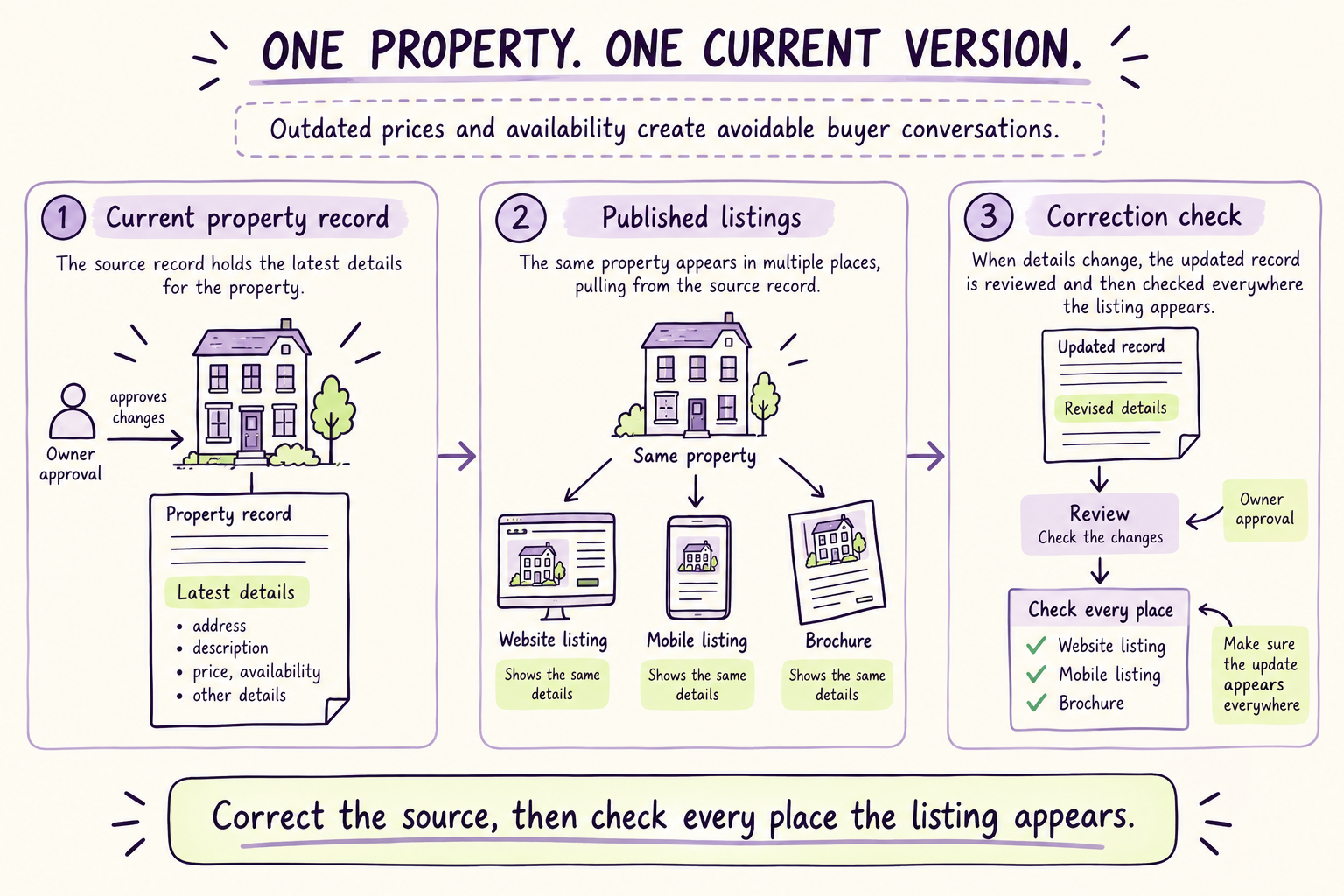
Read the visual explanation
Confirm the current property facts and the owner's instructions.
Publish the approved version wherever buyers see the listing.
Find and correct old prices, descriptions and availability.
Illustrative teaching example. The steps above are repeated in readable text below; depicted records are not customer results.
Separate approval of facts from approval to publish
A property fact being correct does not establish that every advertising use is authorized. Maintain distinct checks for owner or listing authority, required advertising permission, factual accuracy, asset rights and channel approval. Where a document is required, link the actual evidence rather than relying on a checkbox with no supporting record.
Dubai Land Department describes a real estate advertising permit service covering several advertising forms and specifies documentation for applicable permit categories. The correct requirements depend on the proposed advertising activity. Use the current service information and the brokerage's authorized compliance owner before release. DLD's Real Estate Ad Permit service
DLD also publishes a circular on applying QR codes to real estate advertisements. Include verification of the required code in the actual rendered placement, where applicable, instead of assuming that its presence in a source design means it remains legible in the final format. DLD's QR code circular
The workflow should prevent an unauthorized person or model from declaring an advertisement compliant. It can collect evidence, detect missing information and create a review task. The person authorized by the brokerage decides whether the specific placement can proceed. Record their decision and the exact version it covers.
| Control | Evidence in the record | Publication consequence |
|---|---|---|
| Property identity | Stable unit or project reference | Hold if identity is ambiguous |
| Price and terms | Approved current value with date | Hold conflicting claims |
| Image rights and type | Source and usage status | Exclude unapproved assets |
| Advertising permission | Applicable approval evidence | Hold until authorized |
| Enquiry destination | Tested form or contact route | Fix before traffic is sent |
| Final placement | Rendered copy and visual reviewed | Release only approved version |
Facts
Price, availability, features and permitted claims.
Placements
Record the live pages, ads, portals and other surfaces.
Change job
Update affected placements and verify the result.
Conceptual guide by Looqus Editorial. Read the surrounding analysis for assumptions, exceptions and primary sources.
Keep a placement register, including the forgotten surfaces
For each active property, list where it appears: website detail page, portal listing, paid advertisement, landing page, social post, downloadable brochure and messaging creative. Record the live URL or platform identifier, the published version, the publishing owner and whether the surface can be edited, paused or only removed.
This register answers a question that often becomes urgent: “The owner has changed the price; what is still live?” A central database is useful only if it is connected to this distribution map. Without it, someone updates the website while an older brochure continues circulating.
Classify surfaces by control. An owned landing page can usually be changed directly by the authorized publishing team. A portal may require a feed refresh or manual review. A static image already sent to a buyer cannot be recalled reliably. That last case requires a correction process, not a fictitious assumption that all copies have synchronized.
Record campaign links separately from destination content. Updating the destination does not update a price embedded in an image, an ad headline or a downloaded PDF. Similarly, pausing one advertisement does not prove the same property is absent from another campaign. Reconciliation must inspect the individual placement.
Turn every material change into a bounded update job
Treat a price change, withdrawal, revised handover statement or replaced photograph as a change event. The event should name the property, the old and new facts, approval evidence, affected placements and the required completion time. A coordinator owns the event until every placement has a recorded outcome.
The urgency depends on the consequence. Withdrawal or misleading material information may require pausing affected traffic while the correction is prepared. A spelling correction can follow a less urgent path. Define these categories with the brokerage so that a model does not invent its own policy under pressure.
Generate the changed copy from the approved record, then compare it with the previous version. The reviewer should see the actual differences, not reread dozens of unchanged fields. Pay particular attention to numerical values, units, exclusions and qualified statements such as “from” prices that may be inappropriate for a specific unit.
After publication, fetch the live page or placement and verify the changed fields. An API success response proves that a request was accepted; it does not always prove that buyers see the new version. Where publication is delayed, leave the update open with a retry time and a named owner.
Design visuals that explain the property honestly
The best marketing visual helps a buyer understand a real decision: layout, room use, location context or the difference between approved options. It does not need an invented rental return or a decorative urgency badge. A clear annotated floor plan can be more informative than several almost identical lifestyle renders.
Create an asset brief that lists what must remain exact. The unit layout, approved dimensions, developer branding and legally required information should not be reinterpreted by an image model. If a model generates an illustrative scene, label it as such and keep it out of places where buyers would reasonably treat it as a factual view of the offered property.
For responsive placements, test whether essential information survives cropping. A disclaimer that exists outside the visible mobile crop does not inform the viewer. A QR code that becomes unreadable after compression is operationally absent. Check the final platform format rather than approving only a large design canvas.
Madmoun was introduced as a way for customers to verify advertisement information through a QR code. A useful visual therefore preserves the verification route; it does not treat the code as a decorative mark to shrink or recolor beyond usability. DLD's explanation of Madmoun
Monthly value components and cost in the illustrative listing-control example.
Synthetic scenario. Media savings must be demonstrably avoidable. Handling value alone leaves a AED 1,540 shortfall.
Resolve failures without hiding incomplete work
Use explicit states for placements: verified current, update requested, awaiting channel publication, paused, removed, or blocked. “Done” is too vague if it mixes changed source files with live verification. The listing coordinator should be able to explain what remains exposed to buyers.
| Failure | Containment | Completion evidence |
|---|---|---|
| Portal still shows old price | Escalate portal update; review affected traffic | Live listing matches approved price |
| Permission evidence missing | Hold unpublished material or route existing placement for urgent decision | Authorized decision recorded |
| Landing page form breaks | Stop affected traffic under agreed authority | Successful test enquiry reaches owner |
| Image describes wrong unit | Remove or replace approved placement | Correct asset visible live |
| Withdrawal not propagated | Pause controllable placements and contact channel owner | Every placement reconciled |
| Static brochure already distributed | Prepare approved correction for appropriate recipients | Correction handling recorded |
Do not switch to a new outbound channel simply because a correction is urgent. Communications still need an appropriate basis and the relevant channel permissions. WhatsApp's policy places responsibility on businesses for permission and respecting stop requests. Build the correction route with that constraint in mind. WhatsApp Business Messaging Policy
Preserve the incident record. The purpose is to learn whether the error originated in approval, generation, publishing or delayed distribution. Deleting the old version may clean the folder while destroying the evidence needed to stop the same mistake from recurring.
Fact check
The property details have an authoritative basis.
Release approval
The placement is authorized for publication.
Live check
The published version matches the approved record.
Conceptual guide by Looqus Editorial. Read the surrounding analysis for assumptions, exceptions and primary sources.
Model the cost of inaccurate enquiries carefully
Consider a synthetic brokerage receiving 300 monthly enquiries across a defined group of listings. A record review finds 60 enquiries affected by a mismatch in price or availability. Suppose each consumes 12 minutes of agent and coordinator time before the mismatch is resolved. That is 720 minutes, or 12 hours. At an illustrative loaded cost of AED 120 an hour, direct handling cost is AED 1,440.
Assume a control pilot reduces mismatched enquiries from 60 to 20 in an equivalent month. Forty avoided cases release eight hours, worth AED 960 at the same cost assumption. If the control service costs AED 2,500 monthly, labor savings alone leave a AED 1,540 gap. It would be misleading to present the process as self-funding on those numbers.
There may be other value: reduced wasted advertising, fewer complaints, more productive viewings or lower correction effort. Measure each separately and avoid double counting. If eight hours are redeployed into viewings, do not simultaneously describe them as payroll savings and claim the full contribution from all work performed in those hours without explaining the resource assumption.
For example, AED 1,800 of measured avoidable media spend plus AED 960 of handling value would total AED 2,760, leaving AED 260 above the illustrative monthly cost. That conclusion only holds if the media spend was actually avoidable and attributable to the corrected errors. The scenario is a calculation framework, not an estimate of what a brokerage should expect.
Introduce the system with a small, observable portfolio
Choose a portfolio with enough activity to expose change events and a listing owner willing to maintain the source record. A useful pilot includes at least one portal, an owned page and a campaign format with embedded facts. Starting with only the website can miss the cross-channel problem.
First inventory the current placements and compare them with approved facts. Fix known material errors through the existing authorized process. Then run new changes through a manual register for a short period. This reveals which fields vary, how long channels take and where ownership is unclear before integration work obscures the fundamentals.
Introduce assisted drafting next. Require the proposed update to show its source facts and the placements it intends to change. Keep publication approval with the agreed owner. Only grant routine publishing permissions after the system reliably detects missing approvals, stale sources and ambiguous identifiers.
Test a withdrawal, a price correction, a delayed portal update and a broken enquiry destination. The pilot is ready to expand when the team can contain and close these cases without searching through private messages. If the control cannot determine which property a placement represents, stop expansion and repair the data model.
Know what to measure and when this is the wrong first project
The central measure is the share of active placements verified against their current approved property version. Pair it with time to propagate material changes, unresolved exceptions, mismatched enquiries and repeated error causes. Count placements with missing evidence in the denominator; otherwise removing difficult cases can make the score look better.
Track publication quality separately from business results. Fewer factual errors is a direct process result. More attended viewings or completed transactions may have many causes and take longer to observe. A credible owner report makes both visible without collapsing them into one claimed return on investment.
This is a poor first automation project when the brokerage cannot establish the authority to market its inventory, has no accountable listing owner, or keeps conflicting property facts without a resolution process. Start there. A small team with a few stable listings may need only an organized register and scheduled checks rather than a custom system.
Sources
- Dubai Land Department: Real Estate Ad Permit
- Dubai Land Department: Applying the QR code system
- Dubai Land Department: Madmoun verification service
- WhatsApp: Business Messaging Policy
AI does the work.We own the outcome.
Keep active property placements aligned with current prices and availability, with a clear process for finding outdated information and confirming each correction.
- Agree the result
- Connect the work
- Own the follow-through