
A service business recovers missed calls by identifying genuine unanswered enquiries, assigning a permitted callback, understanding the service need and confirming a feasible next step. The outcome might be a booked assessment, a scheduled job, an answer or a clear referral. Sending an automatic text to every number in a call log does not establish that recovery happened.
This matters when the owner is also delivering the work. A plumber on a job, a maintenance coordinator managing technicians or a cleaning company handling morning changes can miss an enquiry while doing necessary work. The practical problem is not simply answering faster. It is making sure somebody owns the unanswered request until it is resolved.
The process below is designed for ordinary service enquiries, not emergency dispatch, clinical triage or other high-stakes decisions. Channel permissions, calling rules and recording requirements vary by location and use. Establish the applicable rules before enabling outreach. The proposed workflow and economics are illustrative and should be tested against the business's own records.
Distinguish a missed call from an unresolved enquiry
A telephone event is technical evidence, not a complete customer outcome. A call may reach voicemail, transfer to another line, connect briefly or be answered by someone unable to help. Conversely, a customer may call twice and then successfully book online. Recovering every failed call separately would create unnecessary contact.
Twilio documents several call statuses, including no-answer, busy and completed. Those statuses describe call handling; the business still needs to determine whether the enquiry was resolved. A technically completed call should not automatically be classified as a productive conversation. Twilio's call status documentation
Define an unresolved enquiry as a service-related contact attempt with no recorded resolution within the business's chosen observation window. That window should reflect the operating model. The purpose is to avoid launching a callback while a receptionist is already speaking to the same customer on a second call.
Keep repeat attempts connected without erasing them. Three attempts in ten minutes may indicate urgency, but they do not establish a particular emergency or justify a diagnosis. Give the callback owner the contact history and allow them to apply the approved service process.
| Record state | What it means | Next action |
|---|---|---|
| Technical missed event | A call leg was not answered | Check for related resolved contact |
| Unresolved service enquiry | No useful resolution recorded | Assign an eligible callback |
| Contact attempted | A permitted callback was made | Record actual outcome |
| Assessment confirmed | Customer and service team agreed a feasible slot | Send authorized confirmation |
| Job completed | Delivery recorded in the service system | Reconcile payment and follow-up rules |
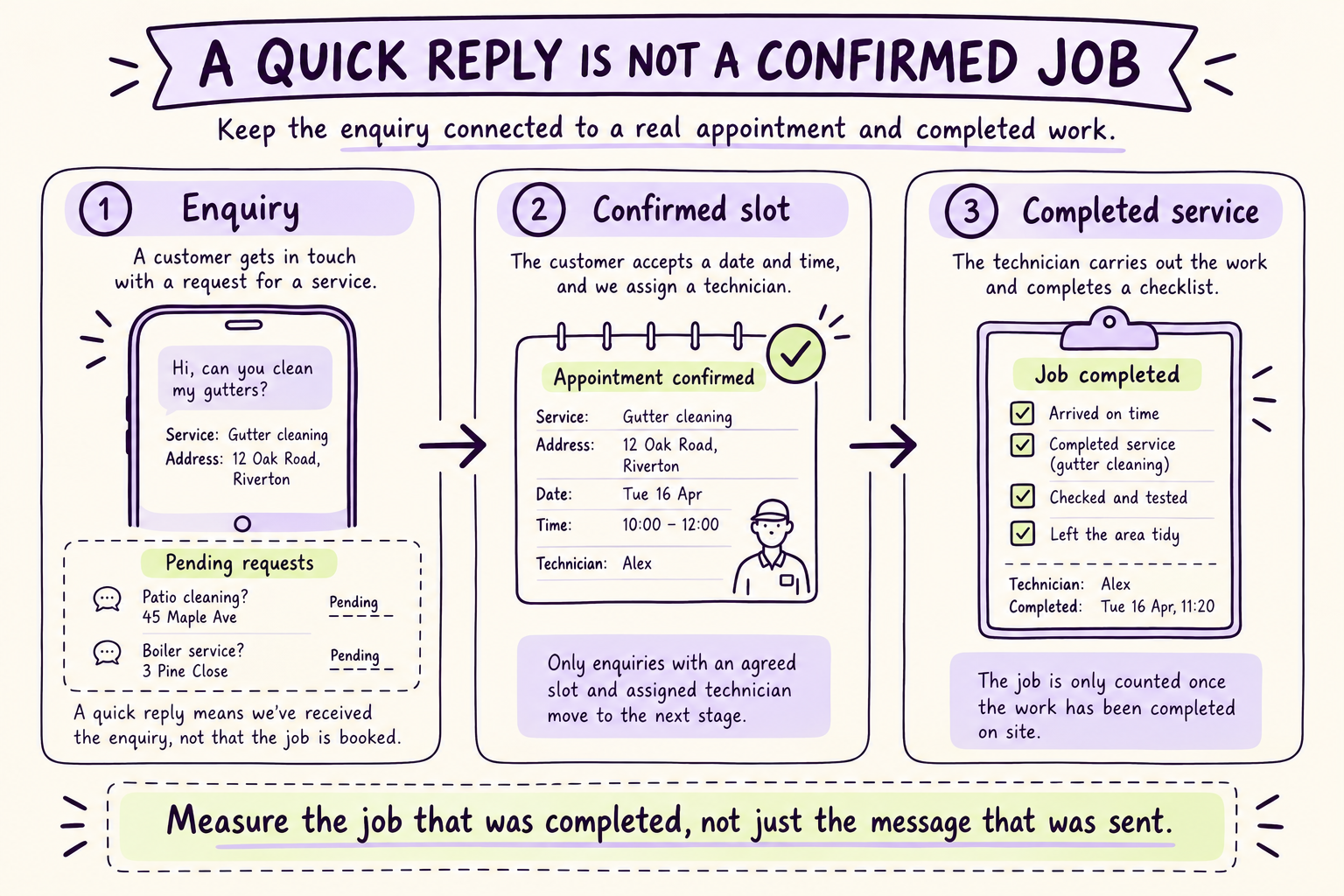
Read the visual explanation
Clarify what service the customer needs and where.
Confirm a real slot and the person responsible for attending.
Record completed work or an honest resolution of the customer's request.
Illustrative teaching example. The steps above are repeated in readable text below; depicted records are not customer results.
Build the queue from reliable call evidence
Use the actual phone system as the source for call events, with a stable event identifier, timestamps, destination number and status. Where a provider supports callbacks or webhooks, they can feed a queue, but the integration should verify authenticity and handle duplicate or delayed events. Twilio documents voice webhooks for call-related events. Twilio voice webhooks
Do not assume Google Business Profile supplies a usable historical missed-call feed. Google states that its Business Profile chat and call history features ended on July 31, 2024. Customers can still contact a business through Search and Maps, but operational recovery needs an appropriate current source. Google Business Profile call-history changes
Reconcile events with the CRM, booking system or receptionist's disposition. The minimum useful queue shows the caller, arrival time, known customer context, related attempts, current resolution status and owner. Avoid placing full transcripts and sensitive details in a broadly visible notification.
Unknown or withheld numbers need a defined outcome. If there is no permitted way to contact the person, the system cannot manufacture one. Record the limitation and review whether the public contact experience offers an alternative, such as a request form or clear opening hours.
Identify
Deduplicate callers and check existing conversations.
Understand
Establish the service need and permitted contact route.
Resolve
Confirm a feasible next step or record why it cannot proceed.
Conceptual guide by Looqus Editorial. Read the surrounding analysis for assumptions, exceptions and primary sources.
Decide who can be contacted and through which channel
An inbound call expresses an attempt to reach the business. It does not automatically authorize every later message category or unlimited repeated outreach. Define the permitted response routes with the appropriate guidance for the location, channel and relationship, and preserve relevant preference or permission evidence.
If using WhatsApp, its Business Messaging Policy requires businesses to manage permission and honor stop requests. A phone number captured in a call log should not be treated as a universal messaging subscription. WhatsApp Business Messaging Policy
Keep the recovery communication focused on the service request. Do not combine a callback acknowledgement with unrelated promotions simply because a channel is available. If a person asks not to be contacted, cancel pending actions across the workflow and record the stop state so that a duplicate event does not restart the sequence.
Set a finite attempt policy with appropriate calling windows. An unanswered callback is still unanswered; repeated attempts do not become a conversion. Give staff a clear way to close a wrong number, supplier call, spam event, resolved enquiry or request outside the service area.
Make the first conversation useful enough to progress
The first conversation should establish the service requested, location or service area, relevant urgency, customer preference and the next appropriate step. Ask only what is needed for that step. A short description and postcode may be sufficient for a routine assessment; a detailed technical diagnosis may require a qualified person.
Use approved service information for common questions: coverage area, operating hours, assessment process, indicative fee rules and what customers should expect. If the answer depends on inspection, say so. Do not generate a precise price from a vague description or imply that a technician has confirmed a diagnosis.
For a request that may involve immediate danger, follow a predefined escalation or emergency-information procedure reviewed by the business's qualified owner. The assistant should not improvise safety instructions or promise emergency attendance the business cannot provide. Keep the recovery workflow's role clear.
Summarize the customer's actual need for the dispatcher or technician. Separate stated facts from uncertain interpretation. “Customer reports water under the sink” is more faithful than “failed pipe requiring replacement” when no qualified assessment has occurred. Accurate handoff reduces repeated questioning and protects the delivery team from an unsupported promise.
Check service capacity before confirming anything
A booking requires the right service capability, time, location and resources. A calendar gap alone does not prove that the business can serve the request. Check travel time, territory, technician skills, job duration assumptions and any materials or access requirements relevant to the visit.
Google Calendar's appointment setup illustrates why configuration matters: co-host availability is not checked by default. Whatever scheduling tool is used, test the real resource combination required for the service. Google Calendar appointment schedules
Distinguish a requested slot, a provisional hold and a confirmed visit in both the internal record and customer wording. A request form should not send “Your technician is booked” before the business has accepted it. If scheduling requires a dispatcher, acknowledge the preference and give an accurate confirmation process.
The confirmation should state the service or assessment, date and time window, location, applicable approved fees and how to change the appointment. If arrival is a window rather than a precise time, say so. Preserve any access notes in the appropriate restricted system and share only what each recipient needs.
Fictional USD example. Monetary assumptions in this guide are illustrative US-dollar amounts, not quoted prices, measured results or exchange-rate conversions. The currency does not imply a US tax or legal setting.
Three distinct incremental outcomes in the synthetic monthly pilot.
Synthetic scenario. Six completed jobs contribute USD 2,160 before USD 1,200 workflow cost, leaving USD 960. Capacity and comparison validity must be checked.
Own exceptions until there is a real resolution
The recovery owner needs enough authority to solve ordinary blockers and a named escalation route for the rest. They may contact dispatch, correct a duplicate, verify service coverage or arrange an approved alternative. They should not quietly transfer an unresolved record into another queue and consider it complete.
| Exception | Response within the operating process | Closure evidence |
|---|---|---|
| Customer already booked elsewhere in the system | Stop recovery sequence and link records | Existing booking verified |
| No suitable technician available | Offer approved alternative or explain limitation | Customer decision recorded |
| Price requires inspection | Arrange assessment under stated terms | Assessment accepted and confirmed |
| Callback fails | Apply finite permitted retry policy | Contact result or exhausted-policy reason |
| Service outside coverage | Explain accurately; use approved referral if appropriate | Enquiry closed with reason |
| Customer cancels | Release capacity and stop reminders | Cancellation reconciled across systems |
If a booking integration fails after the customer agrees, create an urgent resolution task. Do not rely on the customer to discover that no appointment exists. The owner should check whether the slot remains available, complete the booking or explain the problem with verified alternatives.
Use an exception age measure. An unanswered enquiry that has been “assigned” for two days is still unresolved. Escalate based on the promised response window and service urgency, not simply the number of technical retries performed.
Request
The customer describes the job and location.
Check
Verify service area, skills and actual availability.
Confirm
Record the accepted arrangement and responsible owner.
Conceptual guide by Looqus Editorial. Read the surrounding analysis for assumptions, exceptions and primary sources.
Estimate value from completed jobs, not messages sent
Consider a synthetic service business with 100 missed-call events in a month. After deduplication and reconciliation, 60 represent unresolved service enquiries that can appropriately be contacted. The current process reaches 24 of them; a pilot reaches 42. The incremental contacts are 18, not 100 recovered leads.
Assume eight of those additional contacts produce confirmed jobs and six are completed. At an average revenue of USD 900 and variable delivery cost of USD 540 per completed job, contribution is USD 360 per job. Six additional completed jobs produce USD 2,160 contribution before the recovery service cost.
If the monthly workflow cost is USD 1,200, the illustrative contribution after that cost is USD 960. Break-even requires USD 1,200 ÷ USD 360 = 3.33 incremental completed jobs, meaning at least four whole additional jobs in that month under the assumptions. Revenue of USD 5,400 is not profit.
Capacity changes the result. If the six jobs displace six equally profitable jobs that would otherwise have been served, the incremental contribution may be zero. If overtime increases delivery cost, recalculate it. If the business collects payment later or experiences cancellations, report those outcomes separately rather than assuming every confirmation becomes cash.
Use similar weeks or a carefully defined comparison group to evaluate the pilot. Marketing changes, weather and staff coverage can all affect call demand. The model is a way to inspect economics, not a promise that automated recovery will produce the assumed conversion rate.
Launch with one number and a visible fallback
Begin with a single service line and a clear recovery owner. Review recent call records to identify how often technical misses are already resolved through another route. That baseline prevents an exaggerated business case and exposes data-quality problems before customers receive anything new.
Run the first stage in observation mode. Create the queue and proposed next actions without sending messages automatically. Check event duplication, timezones, caller matching and stop-state handling. Test a voicemail, a transfer, a repeat caller, a withheld number and a call followed by an online booking.
Next, allow staff to execute approved callbacks from the queue while the assistant prepares context and records outcomes. Keep scheduling confirmations under the established dispatch rules. Once those controls work, authorize only the routine actions that have been demonstrated to be dependable.
Maintain a fallback list that staff can use if the integration fails. A system outage should produce an alert and manual recovery work, not silently remove enquiries from view. Pause automation if it contacts opted-out people, creates duplicate bookings or cannot verify that reminders stopped after cancellation.
Measure the whole path and recognize poor fit
The owner view should separate missed events, unique unresolved enquiries, eligible contact attempts, successful conversations, confirmed visits and completed jobs. Add time to first useful response, overdue records, duplicate contacts, wrong classifications and customer complaints. These measures show whether the process helps people as well as filling a funnel.
Review outcomes by source and service type. A maintenance contract enquiry has a different path from a one-off cleaning request. A single conversion average can conceal a service category that is being routed incorrectly or lacks capacity. Use the findings to improve coverage and staffing, not just outreach volume.
This is a poor fit when call volumes are very low, current staff already resolve every enquiry reliably, or the business cannot fulfil additional demand. It also needs specialist design for regulated or emergency services. Sometimes the best first improvement is accurate public opening hours, better call routing or a staffed overflow arrangement.
Sources
- Twilio: Call statuses
- Twilio: Voice webhooks
- Google Business Profile: Call-history changes
- WhatsApp: Business Messaging Policy
- Google Calendar: Appointment schedule setup
AI does the work.We own the outcome.
Recover unanswered enquiries through useful replies and checked availability, with someone responsible for confirming the customer’s next step and the team’s ability to deliver.
- Agree the result
- Connect the work
- Own the follow-through